

520
260
;:;: 240
..
~
~ 220
. .
0e
..
I- 200
~
.. c
:§. 180
.;:
CD
160
Frequency: 6 GHz
Grain Size: 1 mm
Temperature: 0"1:
- - Horizontal Polarization
- - - Vertical Polarization
14OL--L __ L-~~L-~~ __ ~-J
o w ~ ~ 40 ~ 60 W M
Angle ot Incidence (degrees)
260
;:;:240
~
~ 220
. .
0e
~ 200
.. ..
. .
c
Frequency: 31 GHz
Grain Size: 1 mm
Temperature: 0"(
M. Hallikainen
- - - Horizontal Polarization
- - - Vertical Polarization
:§.180 r---.:::::~.
.;:
CD
160
140L-~~-~~-L--L~~
o w ~ ~ 40 ~ 60 W M
Angle of Incidence (degrees)
Figure 18.28: Calculated brightness temperature of snow-covered terrain for water contents of
0% and 2% , at 6 and 37 GHz (Ulaby et al., 1986) . The thickness of snow cover is 50 cm.
6GHz
210
260
-------~~~---250
/
/
= 240 ,I
~ ::>
,
1
230
I
~ 220 I
,
~ 210 ,
l!!
,
:E 200 ,
.!?
U'
~ 190 I
180
Horizontal Polarization
Angle of Incidence: 50 0
Grain Size: 1 mm
Temperature: 0"(
110 L..-'---'--'---'L....-.L..~.L.....J~--'--'--L-.J
0.0
to
2.0
3.0
Volumetric Water Content (%)
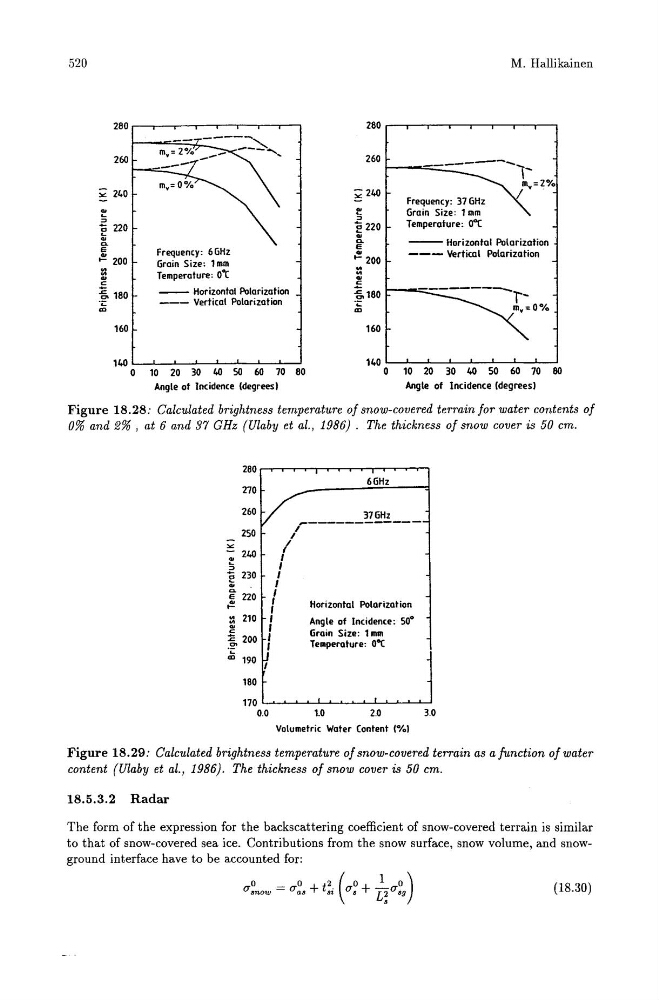
Figure 18.29: Calculated brightness temperature of snow-covered te1'1'ain as a function of water
content (Ulaby et al., 1986). The thickness of snow cover is 50 cm.
18.5.3.2 Radar
The form of the expression for the backscattering coefficient of snow-covered terrain is similar
to that of snow-covered sea ice. Contributions from the snow surface, snow volume, and snowground interface have to be accounted for:
o 0 e(o 10)
(J'snow'::::::(7as+ si
CFs + L~aSg
(18.30)
260
;:;: 240
..
~
~ 220
. .
0e
..
I- 200
~
.. c
:§. 180
.;:
CD
160
Frequency: 6 GHz
Grain Size: 1 mm
Temperature: 0"1:
- - Horizontal Polarization
- - - Vertical Polarization
14OL--L __ L-~~L-~~ __ ~-J
o w ~ ~ 40 ~ 60 W M
Angle ot Incidence (degrees)
260
;:;:240
~
~ 220
. .
0e
~ 200
.. ..
. .
c
Frequency: 31 GHz
Grain Size: 1 mm
Temperature: 0"(
M. Hallikainen
- - - Horizontal Polarization
- - - Vertical Polarization
:§.180 r---.:::::~.
.;:
CD
160
140L-~~-~~-L--L~~
o w ~ ~ 40 ~ 60 W M
Angle of Incidence (degrees)
Figure 18.28: Calculated brightness temperature of snow-covered terrain for water contents of
0% and 2% , at 6 and 37 GHz (Ulaby et al., 1986) . The thickness of snow cover is 50 cm.
6GHz
210
260
-------~~~---250
/
/
= 240 ,I
~ ::>
,
1
230
I
~ 220 I
,
~ 210 ,
l!!
,
:E 200 ,
.!?
U'
~ 190 I
180
Horizontal Polarization
Angle of Incidence: 50 0
Grain Size: 1 mm
Temperature: 0"(
110 L..-'---'--'---'L....-.L..~.L.....J~--'--'--L-.J
0.0
to
2.0
3.0
Volumetric Water Content (%)
Figure 18.29: Calculated brightness temperature of snow-covered te1'1'ain as a function of water
content (Ulaby et al., 1986). The thickness of snow cover is 50 cm.
18.5.3.2 Radar
The form of the expression for the backscattering coefficient of snow-covered terrain is similar
to that of snow-covered sea ice. Contributions from the snow surface, snow volume, and snowground interface have to be accounted for:
o 0 e(o 10)
(J'snow'::::::(7as+ si
CFs + L~aSg
(18.30)