

518
. .
"
1.3 GHz. W PoIariWion
~r---------~--~~~----'
9.6 (;H •• HH Polori .. tion
• MuIl4yN' 1<»
• Flrsl . V •• , k:.
* ~ImWill'"
~ ~~--~--~--~~~~~
10
20
30
4 0
'0
to
~o
Angl. oIlndcleftC4l, "'t' ....
M. Hallikainen
5.2 GHz. HH_ion
o·r--------------------,
• Mu..,..~r Ice
Fi.,1 • Y.~r 1<:,
~~--~2=.-----.~ O-----.~ . ----~.,
13.6 GHz. HH _olion
a FItSi . y." 1("
• ''''''If}"NJ k .
& CaImW.I.r
~~ _ _ ~ _ _ ~ _ _ ~~L_ _ _ L_~
o
1 0 ) 0
40
50
60
Ang .. of I~. de9fHS
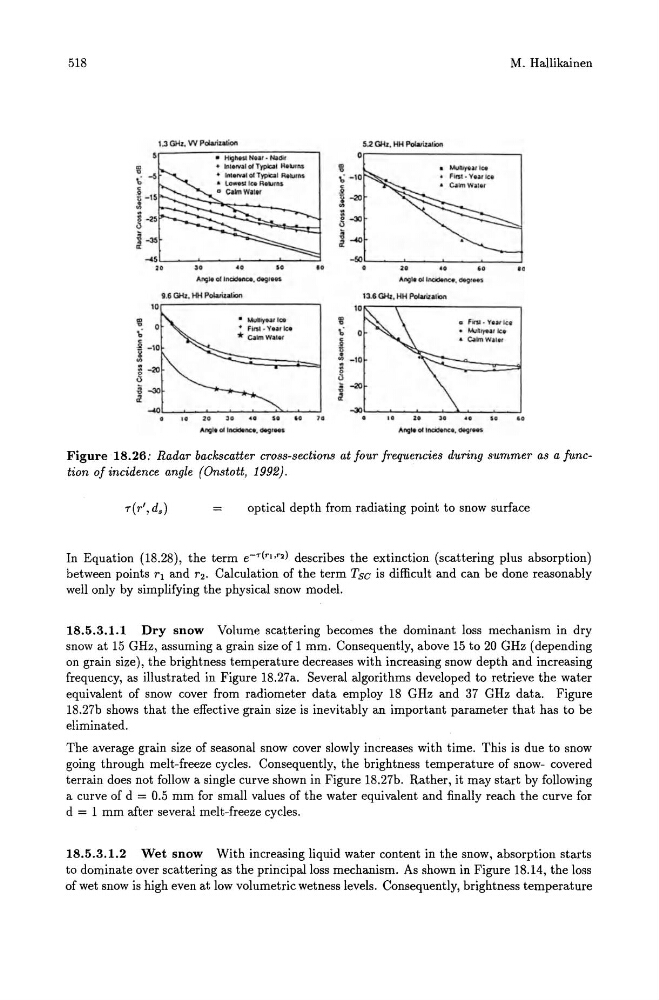
Figure 18.26: Radar backscatter cross-sections at four frequencies during summer as a function of incidence angle (Onstott, 1992).
r(r', ds )
optical depth from radiating point to snow surface
In Equation (18.28), the term e-T(rI,r,) describes the extinction (scattering plus absorption)
between points rl and r2. Calculation of the term Tsc is difficult and can be done reasonably
well only by simplifying the physical snow model.
18.5.3.1.1 Dry snow Volume scattering becomes the dominant loss mechanism in dry
snow at 15 GHz, assuming a grain size of 1 mm. Consequently, above 15 to 20 GHz (depending
on grain size), the brightness temperature decreases with increasing snow depth and increasing
frequency, as illustrated in Figure 18.27a. Several algorithms developed to retrieve the water
equivalent of snow cover from radiometer data employ 18 GHz and 37 GHz data. Figure
18.27b shows that the effective grain size is inevitably an important parameter that has to be
eliminated.
The average grain size of seasonal snow cover slowly increases with time. This is due to snow
going through melt-freeze cycles. Consequently, the brightness temperature of snow- covered
terrain does not follow a single curve shown in Figure 18.27b. Rather, it may start by following
a curve of d = 0.5 mm for small values of the water equivalent and finally reach the curve for
d = 1 mm after several melt-freeze cycles.
18.5.3.1.2 Wet snow With increasing liquid water content in the snow, absorption starts
to dominate over scattering as the principal loss mechanism. As shown in Figure 18.14, the loss
of wet snow is high even at low volumetric wetness levels. Consequently, brightness temperature