

Physical Basis for Microwave Remote Sensing ...
517
"
.2
1l
3
~
r1.
1.3 GHz. W Polarization
.r-----------------~~~~_,
15
30
60
Angle of Incidence, degrees
9.6 GHz. HH Polarization
or-------------------------~
-20
-30
-10
I.
20
30
50
6.
Angle of InOdGnce, degrees
or5=.2~G=H=l~.H=H~Po='=ar=;l=al=~~n~ __________ __,
~ -10 • First· Year Ice
a:
• Multiyear Ice
-SO
20
'0
60
80
Angle of Incidence, degrees
13.6 GHz. HH Polamalion
~r-,,------------------__.
.,
10
"
".
~
~
§ -20
~
r1. -30
a Mufttyear Ice
• Fitsl - Year Ice
JI CaImWater
-IO~~~~ __ L-~~~ __ ~_J
10'
20
30
50
60
iO
Angle of Incidence, degrees
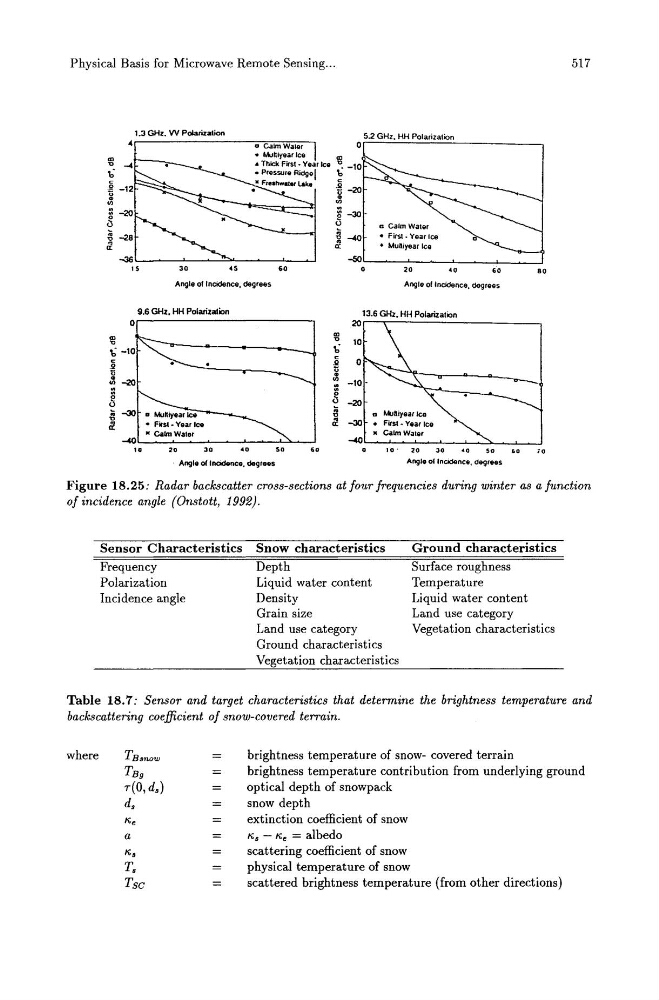
Figure 18.25: Radar backscatter cross-sections at four frequencies during winter as a function
of incidence angle (Onstott, 1992).
Sensor Characteristics
Frequency
Polarization
Incidence angle
Snow characteristics
Depth
Liquid water content
Density
Grain size
Land use category
Ground characteristics
Vegetation characteristics
Ground characteristics
Surface roughness
Temperature
Liquid water content
Land use category
Vegetation characteristics
Table 18.7: Sensor and target characteristics that determine the brightness temperature and
backscattering coefficient of snow-covered terrain.
where
TBsnow
TRy
r(O, d.)
d.
"' .
T.
Tsc
brightness temperature of snow- covered terrain
brightness temperature contribution from underlying ground
optical depth of snowpack
snow depth
extinction coefficient of snow
"'. - "' e = albedo
scattering coefficient of snow
physical temperature of snow
scattered brightness tern perature (from other directions)