

516
Baltic Sea Low-5alinity Ice
Winter Conditions
Young Ice
•
Fast Ice
I
..
•
C-band
W-Pol
Incidence Angle: 23°
Thin -First-Year Ice
•
New Ice
~
o:dB
I I I I I I I I I I I I I I I I I I I I I
-25
-20
-15
-10
-5
Multiyear Ice
0------6.
Thin First-Year Ice
Arctic Sea Ice
Winter-late Spring
Young Ice
6 .
C
C [Kim eI aI., 1985)
6 [Onstott eI al., 1987)
C-band
HH-Pol
Incidence Angle: 23°
• [Hyyppa and HaUikainen, 1991]
• [Ulander et aI., 1991]
• [Ulander and Carlstrom, 1991]
M. Hallikainen
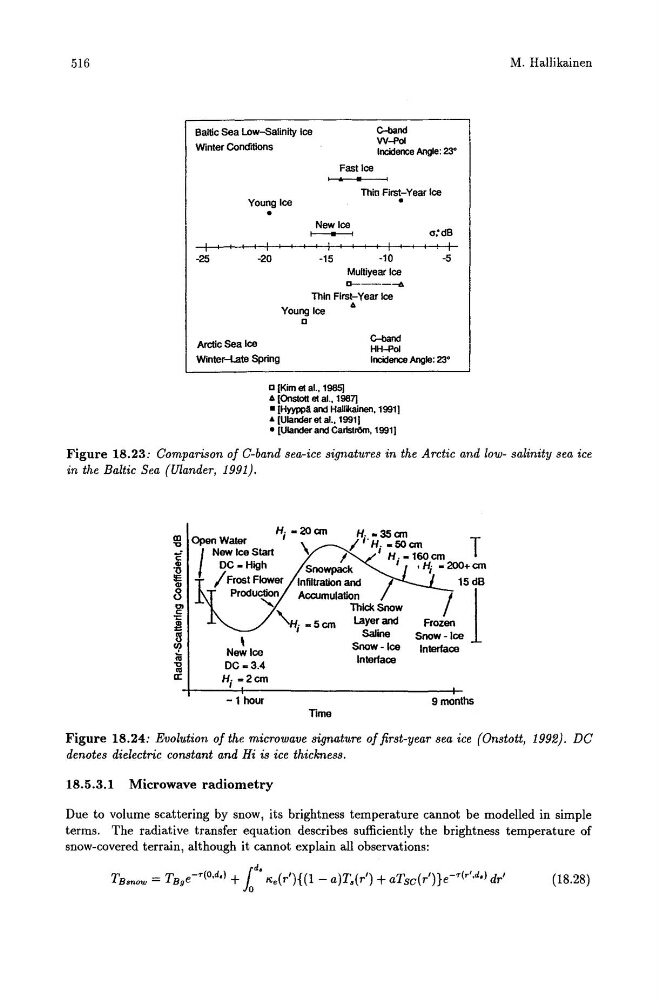
Figure 18.23: Comparison of C-band sea-ice signatures in the Arctic and low- salinity sea ice
in the Baltic Sea (mander, 1991).
,
New Ice
DC-3.4
Hi -2cm
-1 hour
Hi ·-35cm
T
/
H. -50cm
I
I H. -160em
Snowpack
I . Hi - 200+ em
Infiltration and
15 dB
Accumulation
/
1
Thick Snow
Layer and
Frozen
Saline
Snow - Ice
Snow - Ice
Interface
Interface
9 months
Time
Figure 18.24: Evolution of the microwave signature of first-year sea ice (Onstott, 1992). DC
denotes dielectric constant and Hi is ice thickness.
18.5.3.1 Microwave radiometry
Due to volume scattering by snow, its brightness temperature cannot be modelled in simple
terms. The radiative transfer equation describes sufficiently the brightness temperature of
snow-covered terrain, although it cannot explain all observations:
rd.
TBsnow = TBge-r(O,d.) + Jo lI;e{r'){{1 - a)T.{r') + aTsc(r')}e-r(r',d.) dr'
(18.28)