

Physical Basis for Microwave Remote Sensing ...
51.'5
+5
0
Frequency: 9.8 GHz
ro
Incidence Angle: 45'
~
ORUbbie Field
oJ
Dry
-10
C
c#:."bb" F. 1d
Q)
Wet
;g
Q;
Level Ice
Level Ice
0
u -20
Dry
Wet
'" c
ew Ice
·c
2
Wet
0
()
-30
en
ONew Ice
.>(.
()
Dry
0
OJ
-40
-40
-30
-20
-10
0 +5
Bockscottering Coefficient cr' w (dB)
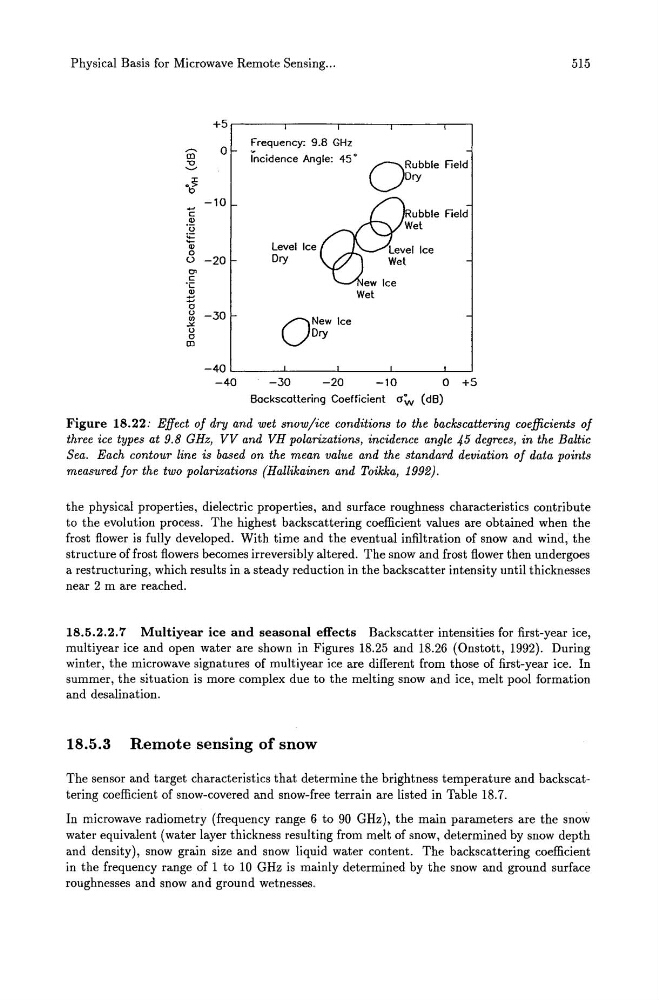
Figure 18.22: Effect of dry and wet snow/ice conditions to the backscattering coefficients of
three ice types at 9.8 GHz, VVand VH polarizations, incidence angle 45 de9rees, in the Baltic
Sea. Each contour line is based on the mean value and the standard deviation of data points
measured for the two polarizations (Hallikainen and Toikka, 1992).
the physical properties, dielectric properties, and surface roughness characteristics contribute
to the evolution process. The highest backscattering coefficient values are obtained when the
frost flower is fully developed. With time and the eventual infiltration of snow and wind, the
structure of frost flowers becomes irreversibly altered. The snow and frost flower then undergoes
a restructuring, which results in a steady reduction in the backscatter intensity until thicknesses
near 2 m are reached.
18.5.2.2.7 Multiyear ice and seasonal effects Backscatter intensities for first-year ice,
multiyear ice and open water are shown in Figures 18.25 and 18.26 (Onstott, 1992). During
winter, the microwave signatures of multiyear ice are different from those of first-year ice. In
summer, the situation is more complex due to the melting snow and ice, melt pool formation
and desalination.
18.5.3 Remote sensing of snow
The sensor and target characteristics that determine the brightness temperature and backscattering coefficient of snow-covered and snow-free terrain are listed in Table 18.7.
In microwave radiometry (frequency range 6 to 90 GHz), the main parameters are the snow
water equivalent (water layer thickness resulting from melt of snow, determined by snow depth
and density), snow grain size and snow liquid water content. The backscattering coefficient
in the frequency range of 1 to 10 GHz is mainly determined by the snow and ground surface
roughnesses and snow and ground wetnesses.