

Physical Basis for Microwave Remote Sensing ...
513
18.5.2.2.2 Backscattering coefficient of sea ice The backscattering coefficient of sea ice
consists of contributions from air-snow interface, snow medium, snow-ice interface, ice medium
and ice-water interface:
where
backscattering coefficient of air-snow interface
Fresnel power transmission coefficient at air-snow interface
backscattering coefficient of snow medium
total attenuation of snow layer
backscattering coefficient of snow-ice interface
backscattering coefficient of ice medium
Fresnel power transmission coefficient for ice layer
total attenuation of ice layer
backscattering coefficient of ice-water interface
(18.27)
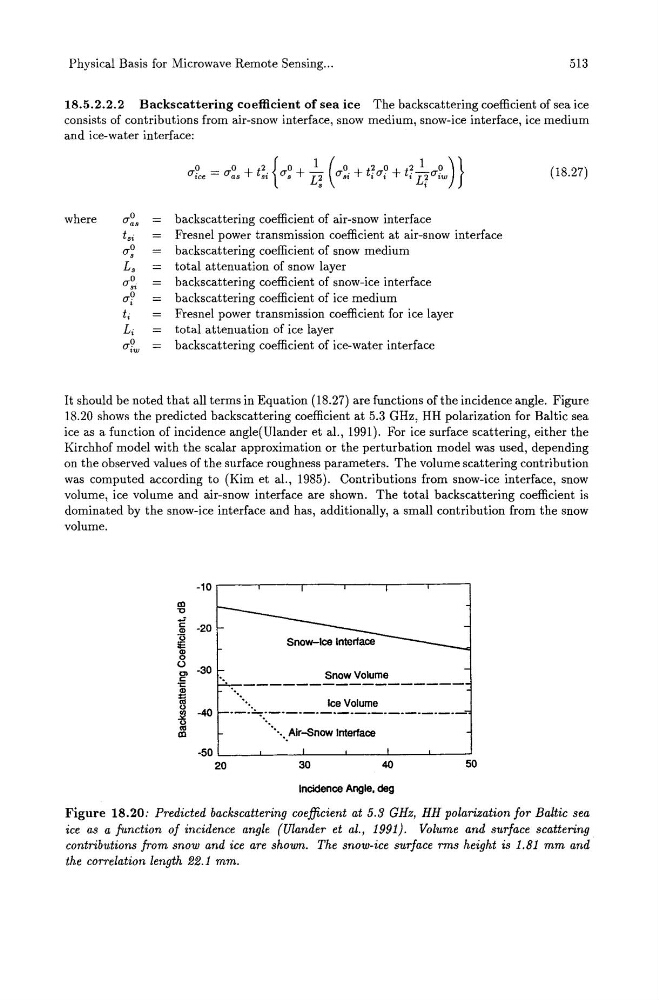
It should be noted that all terms in Equation (18.27) are functions of the incidence angle. Figure
18.20 shows the predicted backscattering coefficient at 5.3 GHz, HH polarization for Baltic sea
ice as a function of incidence angle(Ulander et al., 1991). For ice surface scattering, either the
Kirchhof model with the scalar approximation or the perturbation model was used, depending
on the observed values of the surface roughness parameters. The volume scattering contribution
was computed according to (Kim et al., 1985). Contributions from snow-ice interface, snow
volume, ice volume and air-snow interface are shown. The total backscattering coefficient is
dominated by the snow-ice interface and has, additionally, a small contribution from the snow
volume.
-10 ,----,,----,----,--.......,.---,----,
Snow Volume
Ice Volume
.--~~:-:- .. -----. . - .. - .. ---. . - . . -.-. . -
••• ••• Alr-5now Interface
-50 L-_--'-_ _ ..L-_ _ ' - - _ - - ' -_ _ - - ' - _ - - '
~
~
~
W
Incidence Angle. deg
Figure 18.20: Predicted backscattering coefficient at 5.3 GHz, HH polarization for Baltic sea
ice as a function of incidence angle (Ulander et al., 1991). Volume and surface scattering
contributions from snow and ice are shown. The snow-ice surface rms height is 1.Bl mm and
the correlation length 22.1 mm.