

512
M. Hallikainen
of sea ice depends on the characteristics of the snow cover only. Since the permittivity of wet
snow is lower (1.5 to 2.5) than that of sea ice (3 to 5), the brightness temperature of wet
snow-covered sea ice is higher than that of snow-free sea ice.
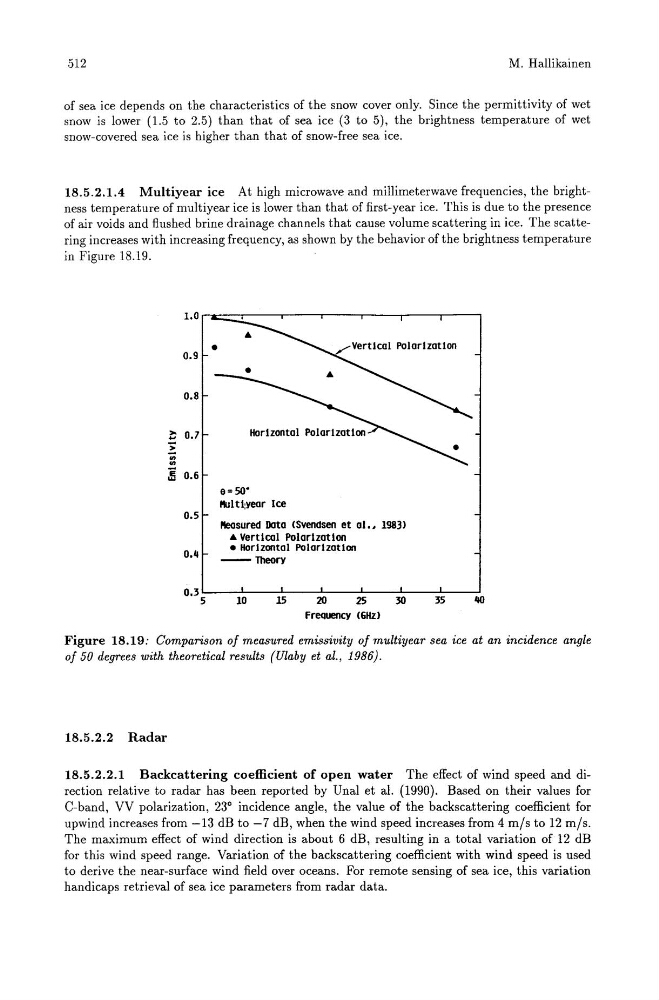
18.5.2.1.4 Multiyear ice At high microwave and millimeterwave frequencies, the brightness temperature of multiyear ice is lower than that of first-year ice. This is due to the presence
of air voids and flushed brine drainage channels that cause volume scattering in ice. The scattering increases with increasing frequency, as shown by the behavior of the brightness temperature
in Figure 18.19.
1.0~~~-----r----'-----r---~-----r--~
0.9
0.8
!: 0.7
:E . .
. .
;S 0.6
0.5
0.4
0=50"
llul ti:yeor Ice
IIeosured Data (Svendsen et 01 •• 1983)
'" Vertical Polarization
• Horizontal Polarization
- - Theory
FrequencY (6Hz)
Figure 18.19: Comparison of measured emissivity of multiyear sea ice at an incidence angle
of 50 degrees with theoretical results (Ulaby et ai., 1986).
18.5.2.2 Radar
18.5.2.2.1 Backcattering coefficient of open water The effect of wind speed and direction relative to radar has been reported by Unal et al. (1990). Based on their values for
C-band, VV polarization, 23° incidence angle, the value of the backscattering coefficient for
upwind increases from -13 dB to -7 dB, when the wind speed increases from 4 mls to 12 m/s.
The maximum effect of wind direction is about 6 dB, resulting in a total variation of 12 dB
for this wind speed range. Variation of the backscattering coefficient with wind speed is used
to derive the near-surface wind field over oceans. For remote sensing of sea ice, this variation
handicaps retrieval of sea ice parameters from radar data.
M. Hallikainen
of sea ice depends on the characteristics of the snow cover only. Since the permittivity of wet
snow is lower (1.5 to 2.5) than that of sea ice (3 to 5), the brightness temperature of wet
snow-covered sea ice is higher than that of snow-free sea ice.
18.5.2.1.4 Multiyear ice At high microwave and millimeterwave frequencies, the brightness temperature of multiyear ice is lower than that of first-year ice. This is due to the presence
of air voids and flushed brine drainage channels that cause volume scattering in ice. The scattering increases with increasing frequency, as shown by the behavior of the brightness temperature
in Figure 18.19.
1.0~~~-----r----'-----r---~-----r--~
0.9
0.8
!: 0.7
:E . .
. .
;S 0.6
0.5
0.4
0=50"
llul ti:yeor Ice
IIeosured Data (Svendsen et 01 •• 1983)
'" Vertical Polarization
• Horizontal Polarization
- - Theory
FrequencY (6Hz)
Figure 18.19: Comparison of measured emissivity of multiyear sea ice at an incidence angle
of 50 degrees with theoretical results (Ulaby et ai., 1986).
18.5.2.2 Radar
18.5.2.2.1 Backcattering coefficient of open water The effect of wind speed and direction relative to radar has been reported by Unal et al. (1990). Based on their values for
C-band, VV polarization, 23° incidence angle, the value of the backscattering coefficient for
upwind increases from -13 dB to -7 dB, when the wind speed increases from 4 mls to 12 m/s.
The maximum effect of wind direction is about 6 dB, resulting in a total variation of 12 dB
for this wind speed range. Variation of the backscattering coefficient with wind speed is used
to derive the near-surface wind field over oceans. For remote sensing of sea ice, this variation
handicaps retrieval of sea ice parameters from radar data.