

Physical Basis for Microwave Remote Sensing ...
511
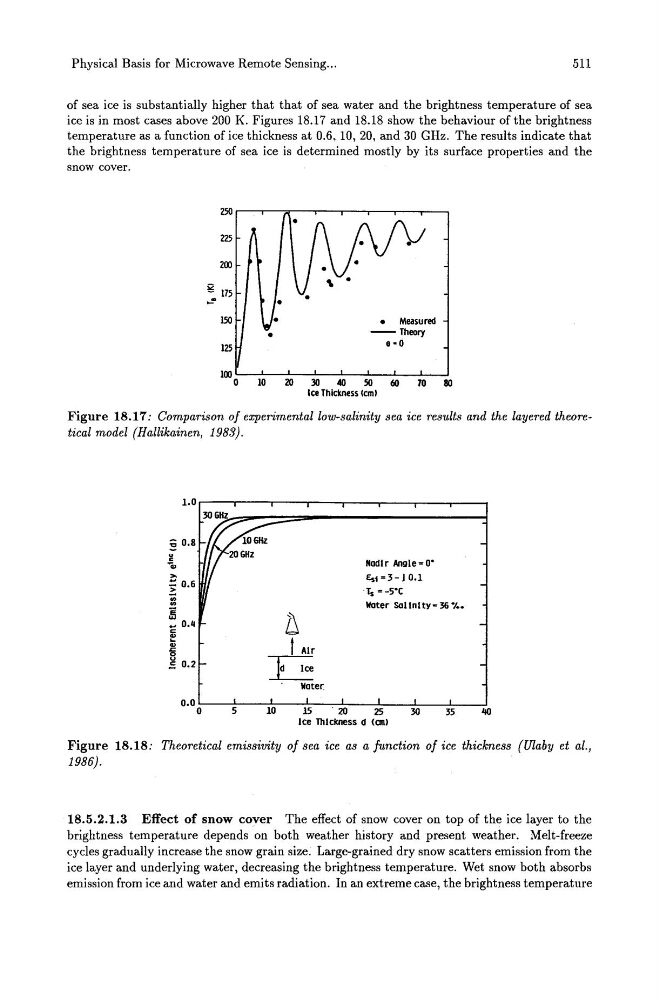
of sea ice is substantially higher that that of sea water and the brightness temperature of sea
ice is in most cases above 200 K. Figures 18.17 and 18.18 show the behaviour of the brightness
temperature as a function of ice thickness at 0.6, 10, 20, and 30 GHz. The results indicate that
the brightness temperature of sea ice is determined mostly by its surface properties and the
snow cover.
225
200
g 175
~.
ISO
125
•
• Measured
- - Theory
,-0
100 '--':_....':.._...I..-_'--':_--L_...I..---I
o ro ro ~ ~ SO ~ ro ~
Ice Thickness (cm'
Figure 18.17: Comparison of experimental low-salinity sea ice results and the layered theoretical model (Hallikainen, 1983).
1.0 r - - , - - - , - - . , - - r - - . . , - - - , - - , - - - - ;
§ 0.8
l!
-., ,..
.; 0.6
i
~ _ 0.4
~
.,
8
oS 0.2
[j
I Air
e
Woter.
Nodlr Angle=O'
€si=3-J 0.1
'T. = -5'C
Water Sollnlty - 36 ./ ••
0.00~--~5----7.10~--~~~~,~~~--~~~--~~~--~35~--~~
Ice Thickness (f (an)
Figure 18.18: Theoretical emissivity of sea ice as a function of ice thickness (Ulaby et al.,
1986).
18.5.2.1.3 Effect of snow cover The effect of snow cover on top of the ice layer to the
brightness temperature depends on both weather history and present weather. Melt-freeze
cycles gradually increase the snow grain size. Large-grained dry snow scatters emission from the
ice layer and underlying water, decreasing the brightness temperature. Wet snow both absorbs
emission from ice and water and emits radiation. In an extreme case, the brightness temperature
511
of sea ice is substantially higher that that of sea water and the brightness temperature of sea
ice is in most cases above 200 K. Figures 18.17 and 18.18 show the behaviour of the brightness
temperature as a function of ice thickness at 0.6, 10, 20, and 30 GHz. The results indicate that
the brightness temperature of sea ice is determined mostly by its surface properties and the
snow cover.
225
200
g 175
~.
ISO
125
•
• Measured
- - Theory
,-0
100 '--':_....':.._...I..-_'--':_--L_...I..---I
o ro ro ~ ~ SO ~ ro ~
Ice Thickness (cm'
Figure 18.17: Comparison of experimental low-salinity sea ice results and the layered theoretical model (Hallikainen, 1983).
1.0 r - - , - - - , - - . , - - r - - . . , - - - , - - , - - - - ;
§ 0.8
l!
-., ,..
.; 0.6
i
~ _ 0.4
~
.,
8
oS 0.2
[j
I Air
e
Woter.
Nodlr Angle=O'
€si=3-J 0.1
'T. = -5'C
Water Sollnlty - 36 ./ ••
0.00~--~5----7.10~--~~~~,~~~--~~~--~~~--~35~--~~
Ice Thickness (f (an)
Figure 18.18: Theoretical emissivity of sea ice as a function of ice thickness (Ulaby et al.,
1986).
18.5.2.1.3 Effect of snow cover The effect of snow cover on top of the ice layer to the
brightness temperature depends on both weather history and present weather. Melt-freeze
cycles gradually increase the snow grain size. Large-grained dry snow scatters emission from the
ice layer and underlying water, decreasing the brightness temperature. Wet snow both absorbs
emission from ice and water and emits radiation. In an extreme case, the brightness temperature