

510
M. Hallikainen
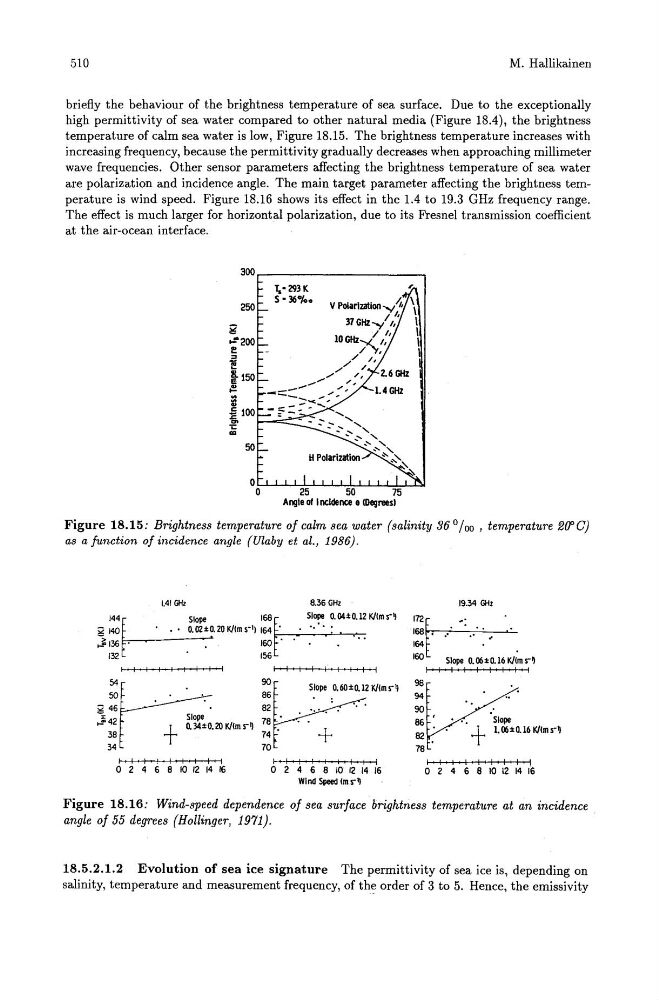
briefly the behaviour of the brightness temperature of sea surface. Due to the exceptionally
high permittivity of sea water compared to other natural media (Figure 18.4), the brightness
temperature of calm sea water is low, Figure 18.15. The brightness temperature increases with
increasing frequency, because the permittivity gradually decreases when approaching millimeter
wave frequencies. Other sensor parameters affecting the brightness temperature of sea water
are polarization and incidence angle. The main target parameter affecting the brightness temperature is wind speed. Figure 18.16 shows its effect in the 1.4 to 19.3 GHz frequency range.
The effect is much larger for horizontal polarization, due to its Fresnel transmission coefficient
at the air-ocean interface.
300,.-_ _ _ _ _ _ _ _ _ --,
250
g
~200
e
~
~ 150
t!!.
~
:c
~ 100
"t:
'" 50
Ts- Z93 K
S - 36%.
Figure 18.15: Brightness temperature of calm sea water (salinity 36 0/00 , temperature 2(J'C)
as a function of incidence angle (Ulaby et al., 1986).
1.41 GHz
8.36 GHz
Slope O.04±0.12 K/(m,'
;;;: 140
. ' o.02±~20K/(ms·'1 164~·_-.:-_...-'-. ~.--,-"_
~~
~~
~~
> ~-~------.~
160 •
.... 1136
32
•
54
38
34
o
I- I
I 1
4 6
•
156
I
I
I
J
I
90
86
82
+
~~~ 0.20 K/(m ,~ 78
74
70
1 1 I 1
1 1 1 1
1 1 1 "
Slope 0.60±0.12 K/(m,~
+
1 I I 1 1 1 I
10 12 14 16
o 4 6 8 10 12 14 16
Wind Speed (m ,II
19.34 GHz
172 [
168"",. ---,;.-...,.:.,---,,:....
164
160
Slope 0.06±0.16 K/(m,~
98
94
90
86
82
78
I 1 1 1 1 I 1 1 I
Slo~
+ 1. O6±o. 16 K/(m,~
1 1 1 I 1 I 1 I I
024 6 8 ~ ~ ~ ~
Figure 18.16: Wind-speed dependence of sea surface brightness temperature at an incidence
angle of 55 degrees (Hollinger, 1971).
18.5.2.1.2 Evolution of sea ice signature The permittivity of sea ice is, depending on
salinity, temperature and measurement frequency, of the order of 3 to 5. Hence, the emissivity
M. Hallikainen
briefly the behaviour of the brightness temperature of sea surface. Due to the exceptionally
high permittivity of sea water compared to other natural media (Figure 18.4), the brightness
temperature of calm sea water is low, Figure 18.15. The brightness temperature increases with
increasing frequency, because the permittivity gradually decreases when approaching millimeter
wave frequencies. Other sensor parameters affecting the brightness temperature of sea water
are polarization and incidence angle. The main target parameter affecting the brightness temperature is wind speed. Figure 18.16 shows its effect in the 1.4 to 19.3 GHz frequency range.
The effect is much larger for horizontal polarization, due to its Fresnel transmission coefficient
at the air-ocean interface.
300,.-_ _ _ _ _ _ _ _ _ --,
250
g
~200
e
~
~ 150
t!!.
~
:c
~ 100
"t:
'" 50
Ts- Z93 K
S - 36%.
Figure 18.15: Brightness temperature of calm sea water (salinity 36 0/00 , temperature 2(J'C)
as a function of incidence angle (Ulaby et al., 1986).
1.41 GHz
8.36 GHz
Slope O.04±0.12 K/(m,'
;;;: 140
. ' o.02±~20K/(ms·'1 164~·_-.:-_...-'-. ~.--,-"_
~~
~~
~~
> ~-~------.~
160 •
.... 1136
32
•
54
38
34
o
I- I
I 1
4 6
•
156
I
I
I
J
I
90
86
82
+
~~~ 0.20 K/(m ,~ 78
74
70
1 1 I 1
1 1 1 1
1 1 1 "
Slope 0.60±0.12 K/(m,~
+
1 I I 1 1 1 I
10 12 14 16
o 4 6 8 10 12 14 16
Wind Speed (m ,II
19.34 GHz
172 [
168"",. ---,;.-...,.:.,---,,:....
164
160
Slope 0.06±0.16 K/(m,~
98
94
90
86
82
78
I 1 1 1 1 I 1 1 I
Slo~
+ 1. O6±o. 16 K/(m,~
1 1 1 I 1 I 1 I I
024 6 8 ~ ~ ~ ~
Figure 18.16: Wind-speed dependence of sea surface brightness temperature at an incidence
angle of 55 degrees (Hollinger, 1971).
18.5.2.1.2 Evolution of sea ice signature The permittivity of sea ice is, depending on
salinity, temperature and measurement frequency, of the order of 3 to 5. Hence, the emissivity