

Physical Basis for Microwave Remote Sensing ...
Sensor Characteristics
Frequency
Polarization
Incidence angle
Sea ice characteristics
Surface roughness
Temperature profile
Salinity profile
Air bubble characteristics
Snow depth
Snow liquid water content
Snow density
Snow grain size (dry)
Water characteristics
Temperature
Wave characteristics
Salinity
509
Table 18.6: Sensor and target characteristics that determine the brightness temperature and
backscattering coefficient of sea ice and open water.
TB,up
TB,down =
TB,cosm =
atmospheric upwelling radiation
atmospheric downwelling radiation
cosmic background radiation
The first term in Equation (18.26) is the surface emission attenuated by the atmosphere, the
second term is the atmospheric upwelling radiation, the third term is the atmospheric downwelling radiation reflected from the surface and attenuated by the atmosphere, and the fourth
term is the cosmic background radiation reflected by the surface and attenuated twice by the
atmosphere.
At low microwave frequencies (below 5 GHz) the atmospheric effects can be ignored practically
independent of weather conditions. Presence of rainfall in the sensor's field of view may introduce large errors at higher frequencies. Above 18 GHz, the varying amounts of atmospheric
water vapor and cloud liquid water may cause errors. However, the atmosphere is usually very
dry over consolidated ice and cloudiness generally consists of underlying stratus that contains
mostly ice crystals. These clouds have low opacity in the microwave region, but they may
affect the sea ice surface temperature. Cloud effects as high as 7 K have been observed on the
physical temperature of sea ice (Gloersen et al., 1973).
For present spaceborne radars, the atmospheric effects are negligible under normal weather
conditions. Precipitation may attenuate the signal and mask the target.
18.5.2 Remote sensing of sea ice
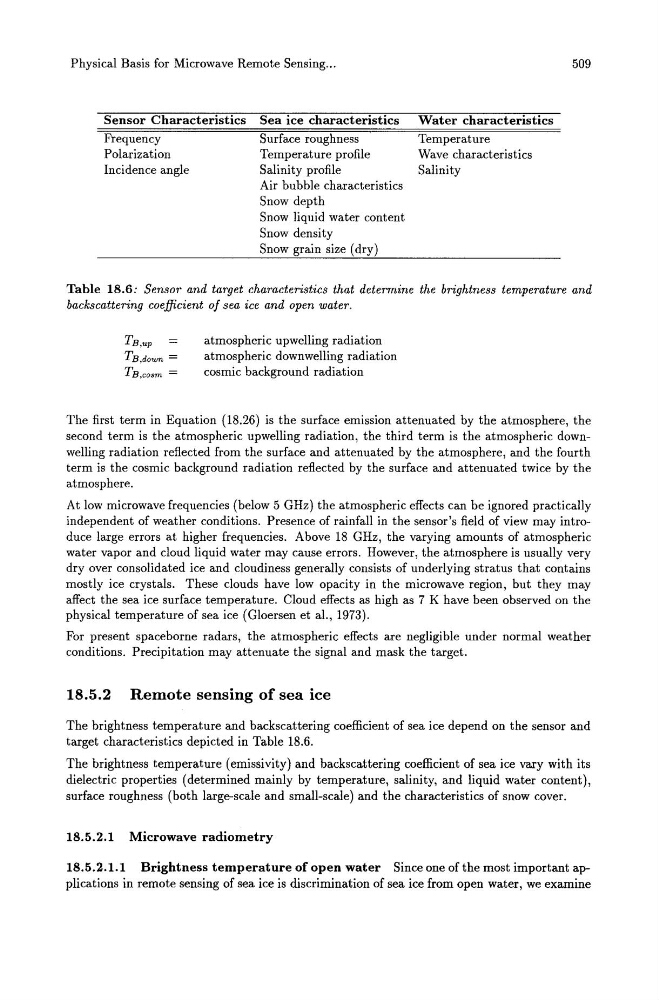
The brightness temperature and backscattering coefficient of sea ice depend on the sensor and
target characteristics depicted in Table 18.6.
The brightness temperature (emissivity) and backscattering coefficient of sea ice vary with its
dielectric properties (determined mainly by temperature, salinity, and liquid water content),
surface roughness (both large-scale and small-scale) and the characteristics of snow cover.
18.5.2.1 Microwave radiometry
18.5.2.1.1 Brightness temperature of open water Since one of the most important applications in remote sensing of sea ice is discrimination of sea ice from open water, we examine
Sensor Characteristics
Frequency
Polarization
Incidence angle
Sea ice characteristics
Surface roughness
Temperature profile
Salinity profile
Air bubble characteristics
Snow depth
Snow liquid water content
Snow density
Snow grain size (dry)
Water characteristics
Temperature
Wave characteristics
Salinity
509
Table 18.6: Sensor and target characteristics that determine the brightness temperature and
backscattering coefficient of sea ice and open water.
TB,up
TB,down =
TB,cosm =
atmospheric upwelling radiation
atmospheric downwelling radiation
cosmic background radiation
The first term in Equation (18.26) is the surface emission attenuated by the atmosphere, the
second term is the atmospheric upwelling radiation, the third term is the atmospheric downwelling radiation reflected from the surface and attenuated by the atmosphere, and the fourth
term is the cosmic background radiation reflected by the surface and attenuated twice by the
atmosphere.
At low microwave frequencies (below 5 GHz) the atmospheric effects can be ignored practically
independent of weather conditions. Presence of rainfall in the sensor's field of view may introduce large errors at higher frequencies. Above 18 GHz, the varying amounts of atmospheric
water vapor and cloud liquid water may cause errors. However, the atmosphere is usually very
dry over consolidated ice and cloudiness generally consists of underlying stratus that contains
mostly ice crystals. These clouds have low opacity in the microwave region, but they may
affect the sea ice surface temperature. Cloud effects as high as 7 K have been observed on the
physical temperature of sea ice (Gloersen et al., 1973).
For present spaceborne radars, the atmospheric effects are negligible under normal weather
conditions. Precipitation may attenuate the signal and mask the target.
18.5.2 Remote sensing of sea ice
The brightness temperature and backscattering coefficient of sea ice depend on the sensor and
target characteristics depicted in Table 18.6.
The brightness temperature (emissivity) and backscattering coefficient of sea ice vary with its
dielectric properties (determined mainly by temperature, salinity, and liquid water content),
surface roughness (both large-scale and small-scale) and the characteristics of snow cover.
18.5.2.1 Microwave radiometry
18.5.2.1.1 Brightness temperature of open water Since one of the most important applications in remote sensing of sea ice is discrimination of sea ice from open water, we examine