

506
M. Hallikainen
2
100~~~~~~~ __ ~ __ ~ __ ~ __ ~~~
o 02 0.4 0.6 0.8 1.0 12 1.4 1.6
Grain Size, mm
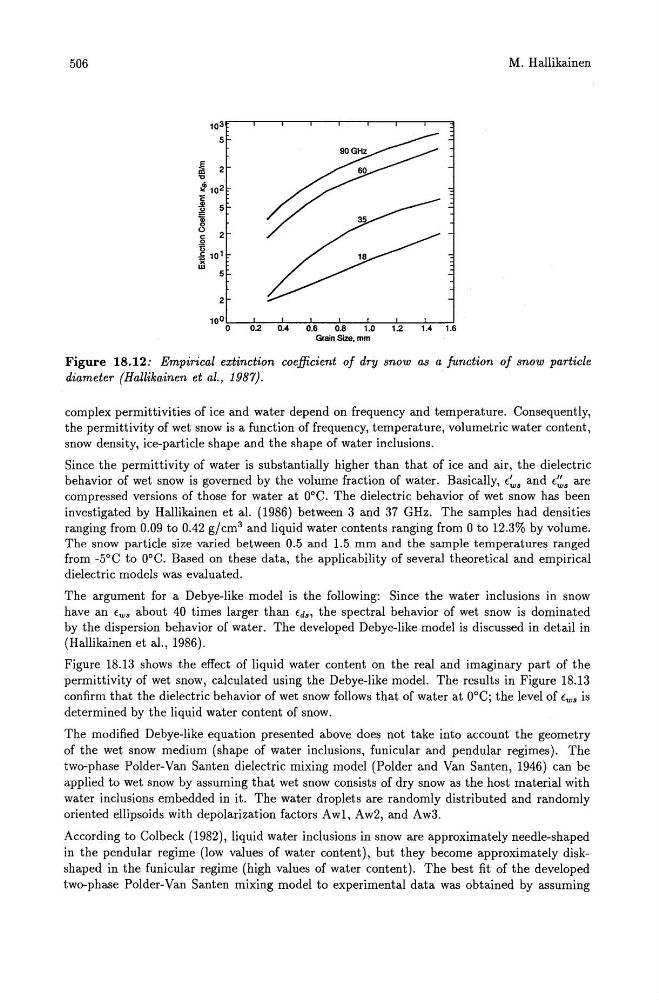
Figure 18.12: Empirical extinction coefficient of dry snow as a function of snow particle
diameter (Hallikainen et ai., 1987).
complex permittivities of ice and water depend on frequency and temperature. Consequently,
the permittivity of wet snow is a function of frequency, temperature, volumetric water content,
snow density, ice-particle shape and the shape of water inclusions.
Since the permittivity of water is substantially higher than that of ice and air, the dielectric
behavior of wet snow is governed by the volume fraction of water. Basically, f~s and f~s are
compressed versions of those for water at ODC. The dielectric behavior of wet snow has been
investigated by Hallikainen et al. (1986) between 3 and 37 GHz. The samples had densities
ranging from 0.09 to 0.42 g/cm 3 and liquid water contents ranging from 0 to 12.3% by volume.
The snow particle size varied between 0.5 and 1.5 mm and the sample temperatures ranged
from -5 D C to ODC. Based on these data, the applicability of several theoretical and empirical
dielectric models was evaluated.
The argument for a Debye-like model is the following: Since the water inclusions in snow
have an fws about 40 times larger than fds, the spectral behavior of wet snow is dominated
by the dispersion behavior of water. The developed Debye-like model is discussed in detail in
(Hallikainen et al., 1986).
Figure 18.13 shows the effect of liquid water content on the real and imaginary part of the
permittivity of wet snow, calculated using the Debye-like model. The results in Figure 18.13
confirm that the dielectric behavior of wet snow follows that of water at ODC; the level of fws is
determined by the liquid water content of snow.
The modified Debye-like equation presented above does not take into account the geometry
of the wet snow medium (shape of water inclusions, funicular and pendular regimes). The
two-phase Polder-Van Santen dielectric mixing model (Polder and Van Santen, 1946) can be
applied to wet snow by assuming that wet snow consists of dry snow as the host material with
water inclusions embedded in it. The water droplets are randomly distributed and randomly
oriented ellipsoids with depolarization factors Awl, Aw2, and Aw3.
According to Colbeck (1982), liquid water inclusions in snow are approximately needle-shaped
in the pendular regime (low values of water content), but they become approximately diskshaped in the funicular regime (high values of water content). The best fit of the developed
two-phase Polder-Van Santen mixing model to experimental data was obtained by assuming
M. Hallikainen
2
100~~~~~~~ __ ~ __ ~ __ ~ __ ~~~
o 02 0.4 0.6 0.8 1.0 12 1.4 1.6
Grain Size, mm
Figure 18.12: Empirical extinction coefficient of dry snow as a function of snow particle
diameter (Hallikainen et ai., 1987).
complex permittivities of ice and water depend on frequency and temperature. Consequently,
the permittivity of wet snow is a function of frequency, temperature, volumetric water content,
snow density, ice-particle shape and the shape of water inclusions.
Since the permittivity of water is substantially higher than that of ice and air, the dielectric
behavior of wet snow is governed by the volume fraction of water. Basically, f~s and f~s are
compressed versions of those for water at ODC. The dielectric behavior of wet snow has been
investigated by Hallikainen et al. (1986) between 3 and 37 GHz. The samples had densities
ranging from 0.09 to 0.42 g/cm 3 and liquid water contents ranging from 0 to 12.3% by volume.
The snow particle size varied between 0.5 and 1.5 mm and the sample temperatures ranged
from -5 D C to ODC. Based on these data, the applicability of several theoretical and empirical
dielectric models was evaluated.
The argument for a Debye-like model is the following: Since the water inclusions in snow
have an fws about 40 times larger than fds, the spectral behavior of wet snow is dominated
by the dispersion behavior of water. The developed Debye-like model is discussed in detail in
(Hallikainen et al., 1986).
Figure 18.13 shows the effect of liquid water content on the real and imaginary part of the
permittivity of wet snow, calculated using the Debye-like model. The results in Figure 18.13
confirm that the dielectric behavior of wet snow follows that of water at ODC; the level of fws is
determined by the liquid water content of snow.
The modified Debye-like equation presented above does not take into account the geometry
of the wet snow medium (shape of water inclusions, funicular and pendular regimes). The
two-phase Polder-Van Santen dielectric mixing model (Polder and Van Santen, 1946) can be
applied to wet snow by assuming that wet snow consists of dry snow as the host material with
water inclusions embedded in it. The water droplets are randomly distributed and randomly
oriented ellipsoids with depolarization factors Awl, Aw2, and Aw3.
According to Colbeck (1982), liquid water inclusions in snow are approximately needle-shaped
in the pendular regime (low values of water content), but they become approximately diskshaped in the funicular regime (high values of water content). The best fit of the developed
two-phase Polder-Van Santen mixing model to experimental data was obtained by assuming