

Physical Basis for Microwave Remote Sensing ...
505
50
... 20
.., 10
~
~
5
~ . . 2
u..
lJl 0
...J
"
"c:
U 0.5
~
is 02
0.1
0.3 0.5
2
5
10
20
50
100
Frequency, GHz
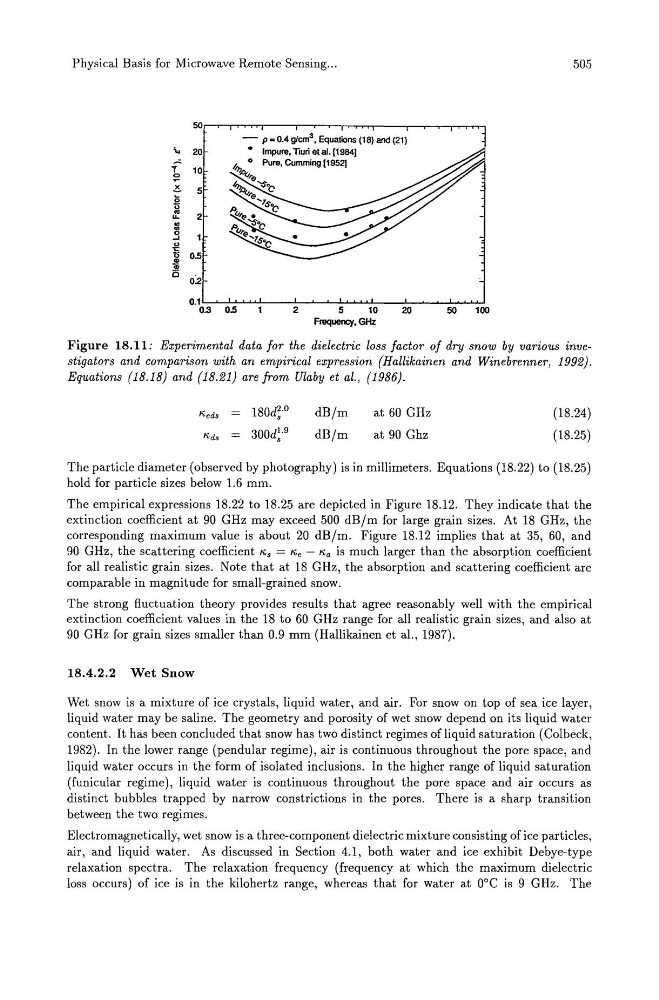
Figure 18.11: Experimental data for the dielectric loss factor of dry snow by various investigators and comparison with an empirical expression (Hallikainen and Winebrenner, 1992).
Equations (18.18) and (18.21) are from Ulaby et al., (1986).
180d;'0
300d;·9
dB/m
dB/m
at 60 GHz
at 90 Ghz
(18.24)
(18.25)
The particle diameter (observed by photography) is in millimeters. Equations (18.22) to (18.25)
hold for particle sizes below 1.6 mm.
The empirical expressions 18.22 to 18.25 are depicted in Figure 18.12. They indicate that the
extinction coefficient at 90 GHz may exceed 500 dB/m for large grain sizes. At 18 GHz, the
corresponding maximum value is about 20 dB/m. Figure 18.12 implies that at 35, 60, and
90 GHz, the scattering coefficient /'i,. = /'i,e - /'i,a is much larger than the absorption coefficient
for all realistic grain sizes. Note that at 18 GHz, the absorption and scattering coefficient are
comparable in magnitude for small-grained snow.
The strong fluctuation theory provides results that agree reasonably well with the empirical
extinction coefficient values in the 18 to 60 GHz range for all realistic grain sizes, and also at
90 GHz for grain sizes smaller than 0.9 mm (Hallikainen et al., 1987).
18.4.2.2 Wet Snow
Wet snow is a mixture of ice crystals, liquid water, and air. For snow on top of sea ice layer,
liquid water may be saline. The geometry and porosity of wet snow depend on its liquid water
content. It has been concluded that snow has two distinct regimes ofliquid saturation (Colbeck,
1982). In the lower range (pendular regime), air is continuous throughout the pore space, and
liquid water occurs in the form of isolated inclusions. In the higher range of liquid saturation
(funicular regime), liquid water is continuous throughout the pore space and air occurs as
distinct bubbles trapped by narrow constrictions in the pores. There is a sharp transition
between the two regimes.
Electromagnetically, wet snow is a three-component dielectric mixture consisting of ice particles,
air, and liquid water. As discussed in Section 4.1, both water and ice exhibit Debye-type
relaxation spectra. The relaxation frequency (frequency at which the maximum dielectric
loss occurs) of ice is in the kilohertz range, whereas that for water at O°C is 9 GHz. The
505
50
... 20
.., 10
~
~
5
~ . . 2
u..
lJl 0
...J
"
"c:
U 0.5
~
is 02
0.1
0.3 0.5
2
5
10
20
50
100
Frequency, GHz
Figure 18.11: Experimental data for the dielectric loss factor of dry snow by various investigators and comparison with an empirical expression (Hallikainen and Winebrenner, 1992).
Equations (18.18) and (18.21) are from Ulaby et al., (1986).
180d;'0
300d;·9
dB/m
dB/m
at 60 GHz
at 90 Ghz
(18.24)
(18.25)
The particle diameter (observed by photography) is in millimeters. Equations (18.22) to (18.25)
hold for particle sizes below 1.6 mm.
The empirical expressions 18.22 to 18.25 are depicted in Figure 18.12. They indicate that the
extinction coefficient at 90 GHz may exceed 500 dB/m for large grain sizes. At 18 GHz, the
corresponding maximum value is about 20 dB/m. Figure 18.12 implies that at 35, 60, and
90 GHz, the scattering coefficient /'i,. = /'i,e - /'i,a is much larger than the absorption coefficient
for all realistic grain sizes. Note that at 18 GHz, the absorption and scattering coefficient are
comparable in magnitude for small-grained snow.
The strong fluctuation theory provides results that agree reasonably well with the empirical
extinction coefficient values in the 18 to 60 GHz range for all realistic grain sizes, and also at
90 GHz for grain sizes smaller than 0.9 mm (Hallikainen et al., 1987).
18.4.2.2 Wet Snow
Wet snow is a mixture of ice crystals, liquid water, and air. For snow on top of sea ice layer,
liquid water may be saline. The geometry and porosity of wet snow depend on its liquid water
content. It has been concluded that snow has two distinct regimes ofliquid saturation (Colbeck,
1982). In the lower range (pendular regime), air is continuous throughout the pore space, and
liquid water occurs in the form of isolated inclusions. In the higher range of liquid saturation
(funicular regime), liquid water is continuous throughout the pore space and air occurs as
distinct bubbles trapped by narrow constrictions in the pores. There is a sharp transition
between the two regimes.
Electromagnetically, wet snow is a three-component dielectric mixture consisting of ice particles,
air, and liquid water. As discussed in Section 4.1, both water and ice exhibit Debye-type
relaxation spectra. The relaxation frequency (frequency at which the maximum dielectric
loss occurs) of ice is in the kilohertz range, whereas that for water at O°C is 9 GHz. The