

504
M. Hallikainen
where Vt, :s: 70 0 / 00 . Equations (18.15) to (18.20) do not explicitly take into account the effect
of ice density upon the real part of the permittivity. The correlation coefficient for Equations
(18.15) to (18.20) is, in general, between 0.7 and 0.8.
Theoretical models are reviewed by Hallikainen and Winebrenner (1992).
18.4.2 Snow
18.4.2.1 Dry Snow
Dry snow consists of ice crystals and air voids. After a snowfall, the shapes of ice particles are
naturally modified. Thermodynamically, the ice crystals seek equilibrium, for which the ratio
of surface area to volume is minimum (Gray and Male, 1981). Any water in the snow medium
collects at points of contact between the ice grains. The metamorphism caused by melting
and freezing changes the microstructure of snow. The ice grains become rounded during the
melting process and some of the smaller grains disappear completely. Snow that has undergone
several melt-freeze cycles tends to form multiple clusters. In general, the density of snow slowly
increases with time due to metamorphism and melt-freeze cycles. The density of dry snow
varies from 0.1 g/cm 3 (newly fallen snow) to 0.5 g/cm 3 (refrozen snow). The interface between
snow and sea ice may be gradual, consisting of a high-density now-ice layer. Due to flooding,
this layer may be saline.
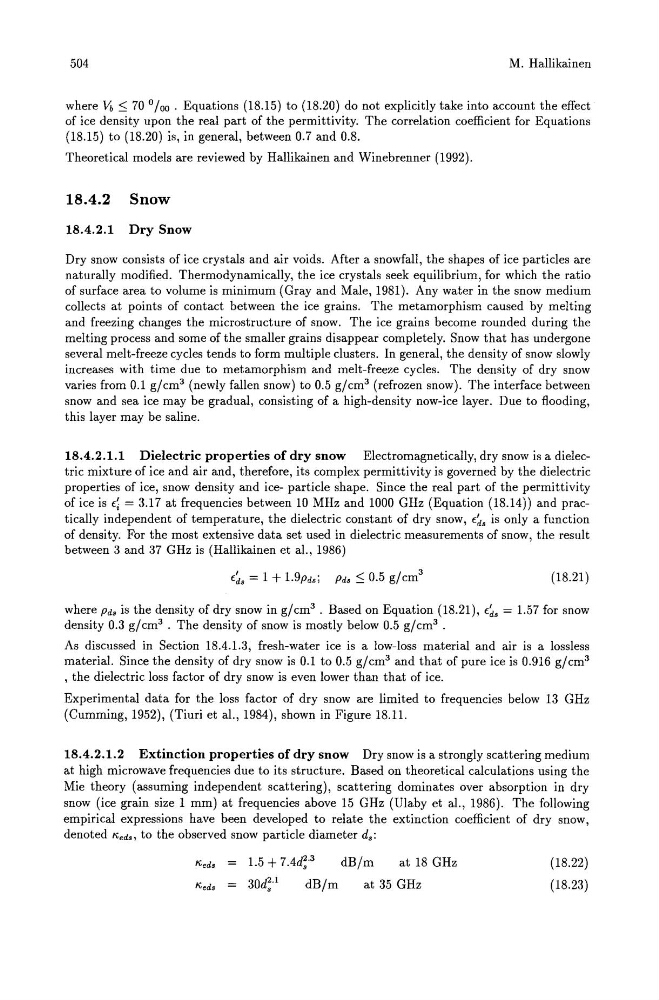
18.4.2.1.1 Dielectric properties of dry snow Electromagnetically, dry snow is a dielectric mixture of ice and air and, therefore, its complex permittivity is governed by the dielectric
properties of ice, snow density and ice- particle shape. Since the real part of the permittivity
of ice is ti = 3.17 at frequencies between 10 MHz and 1000 GHz (Equation (18.14)) and practically independent of temperature, the dielectric constant of dry snow, t~s is only a function
of density. For the most extensive data set used in dielectric measurements of snow, the result
between 3 and 37 GHz is (Hallikainen et al., 1986)
(18.21 )
where Pd. is the density of dry snow in g/cm 3 . Based on Equation (18.21), t~. = 1.57 for snow
density 0.3 g/cm 3 . The density of snow is mostly below 0.5 g/cm 3 .
As discussed in Section 18.4.1.3, fresh-water ice is a low-loss material and air is a lossless
material. Since the density of dry snow is 0.1 to 0.5 g/cm 3 and that of pure ice is 0.916 g/cm 3
, the dielectric loss factor of dry snow is even lower than that of ice.
Experimental data for the loss factor of dry snow are limited to frequencies below 13 GHz
(Cumming, 1952), (Tiuri et al., 1984), shown in Figure 18.11.
18.4.2.1.2 Extinction properties of dry snow Dry snow is a strongly scattering medium
at high microwave frequencies due to its structure. Based on theoretical calculations using the
Mie theory (assuming independent scattering), scattering dominates over absorption in dry
snow (ice grain size 1 mm) at frequencies above 15 GHz (Ulaby et al., 1986). The following
empirical expressions have been developed to relate the extinction coefficient of dry snow,
denoted I>ed., to the observed snow particle diameter ds:
1.5 + 7.4d~·3 dB/m at 18 GHz
30d;·1
dB/m
at 35 GHz
(18.22)
(18.23)
M. Hallikainen
where Vt, :s: 70 0 / 00 . Equations (18.15) to (18.20) do not explicitly take into account the effect
of ice density upon the real part of the permittivity. The correlation coefficient for Equations
(18.15) to (18.20) is, in general, between 0.7 and 0.8.
Theoretical models are reviewed by Hallikainen and Winebrenner (1992).
18.4.2 Snow
18.4.2.1 Dry Snow
Dry snow consists of ice crystals and air voids. After a snowfall, the shapes of ice particles are
naturally modified. Thermodynamically, the ice crystals seek equilibrium, for which the ratio
of surface area to volume is minimum (Gray and Male, 1981). Any water in the snow medium
collects at points of contact between the ice grains. The metamorphism caused by melting
and freezing changes the microstructure of snow. The ice grains become rounded during the
melting process and some of the smaller grains disappear completely. Snow that has undergone
several melt-freeze cycles tends to form multiple clusters. In general, the density of snow slowly
increases with time due to metamorphism and melt-freeze cycles. The density of dry snow
varies from 0.1 g/cm 3 (newly fallen snow) to 0.5 g/cm 3 (refrozen snow). The interface between
snow and sea ice may be gradual, consisting of a high-density now-ice layer. Due to flooding,
this layer may be saline.
18.4.2.1.1 Dielectric properties of dry snow Electromagnetically, dry snow is a dielectric mixture of ice and air and, therefore, its complex permittivity is governed by the dielectric
properties of ice, snow density and ice- particle shape. Since the real part of the permittivity
of ice is ti = 3.17 at frequencies between 10 MHz and 1000 GHz (Equation (18.14)) and practically independent of temperature, the dielectric constant of dry snow, t~s is only a function
of density. For the most extensive data set used in dielectric measurements of snow, the result
between 3 and 37 GHz is (Hallikainen et al., 1986)
(18.21 )
where Pd. is the density of dry snow in g/cm 3 . Based on Equation (18.21), t~. = 1.57 for snow
density 0.3 g/cm 3 . The density of snow is mostly below 0.5 g/cm 3 .
As discussed in Section 18.4.1.3, fresh-water ice is a low-loss material and air is a lossless
material. Since the density of dry snow is 0.1 to 0.5 g/cm 3 and that of pure ice is 0.916 g/cm 3
, the dielectric loss factor of dry snow is even lower than that of ice.
Experimental data for the loss factor of dry snow are limited to frequencies below 13 GHz
(Cumming, 1952), (Tiuri et al., 1984), shown in Figure 18.11.
18.4.2.1.2 Extinction properties of dry snow Dry snow is a strongly scattering medium
at high microwave frequencies due to its structure. Based on theoretical calculations using the
Mie theory (assuming independent scattering), scattering dominates over absorption in dry
snow (ice grain size 1 mm) at frequencies above 15 GHz (Ulaby et al., 1986). The following
empirical expressions have been developed to relate the extinction coefficient of dry snow,
denoted I>ed., to the observed snow particle diameter ds:
1.5 + 7.4d~·3 dB/m at 18 GHz
30d;·1
dB/m
at 35 GHz
(18.22)
(18.23)