

Physical Basis for Microwave Remote Sensing ...
507
that their shapes depend on snow water content and, additionally, that the water inclusions
are nonsymmetrical in shape (Hallikainen et aI., 1986). Transition from the pendular regime
to the funicular regime was observed to take place around mv = 3 %.
Both the modified Debye-like model and the two-phase Polder-Van Santen model (with variable,
nonsymmetrical shape factors) provide good accuracy (Hallikainen et aI., 1986). As stated
before, the simplified Debye-like model works well only at frequencies below 15 GHz. The
two-phase Polder-Van Santen model with wetness-dependent shape factors provides a slightly
better overall fit to the experimental observations of wet snow. The modified Debye-like model
is easier to use and is likely to provide adequate accuracy for most applications.
(al
3.0
....,
E
~ 2.5
c
0
<.)
0
u
'" 2.0
iii
0
1.5
(b)1.0
' "
~- 0.8
0
0 .,
U.
...J
0
~ 0.4
Q)
a;
is
0.2
0 0
10
0
-
10
Snow Density Ps: 0.25 g1cm3
10
8
~-----=~
20
Frequency, GHz
30
2
40
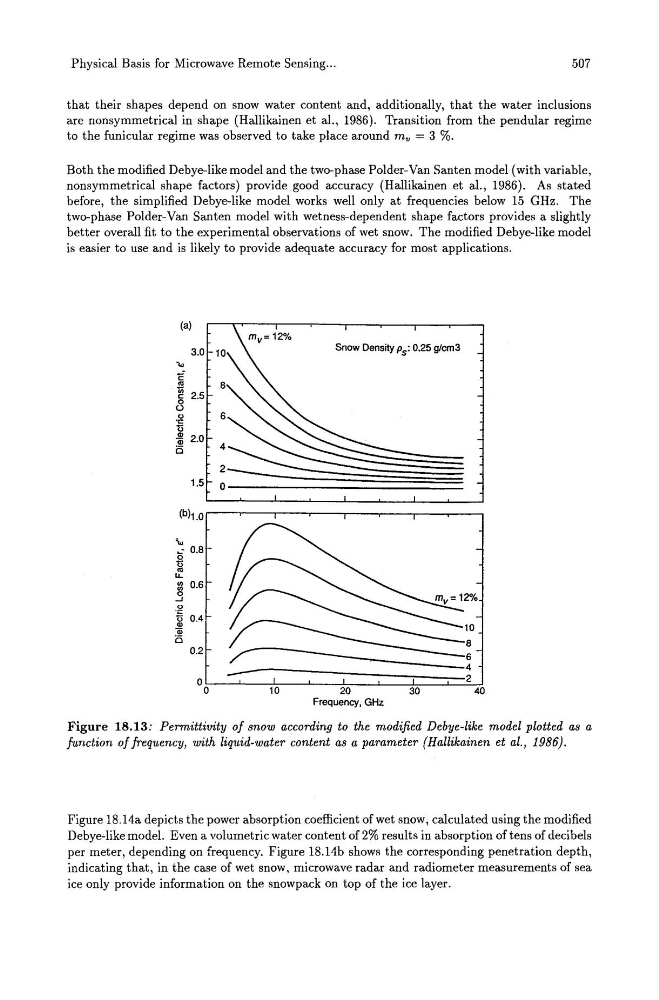
Figure 18.13: Permittivity of snow according to the modified Debye-like model plotted as a
function of frequency, with liquid-water content as a parameter (Hallikainen et al., 1986).
Figure 18.14a depicts the power absorption coefficient of wet snow, calculated using the modified
Debye~like model. Even a volumetric water content of 2% results in absorption of tens of decibels
per meter, depending on frequency. Figure 18.14b shows the corresponding penetration depth,
indicating that, in the case of wet snow, microwave radar and radiometer measurements of sea
ice only provide information on the snowpack on top of the ice layer.
507
that their shapes depend on snow water content and, additionally, that the water inclusions
are nonsymmetrical in shape (Hallikainen et aI., 1986). Transition from the pendular regime
to the funicular regime was observed to take place around mv = 3 %.
Both the modified Debye-like model and the two-phase Polder-Van Santen model (with variable,
nonsymmetrical shape factors) provide good accuracy (Hallikainen et aI., 1986). As stated
before, the simplified Debye-like model works well only at frequencies below 15 GHz. The
two-phase Polder-Van Santen model with wetness-dependent shape factors provides a slightly
better overall fit to the experimental observations of wet snow. The modified Debye-like model
is easier to use and is likely to provide adequate accuracy for most applications.
(al
3.0
....,
E
~ 2.5
c
0
<.)
0
u
'" 2.0
iii
0
1.5
(b)1.0
' "
~- 0.8
0
0 .,
U.
...J
0
~ 0.4
Q)
a;
is
0.2
0 0
10
0
-
10
Snow Density Ps: 0.25 g1cm3
10
8
~-----=~
20
Frequency, GHz
30
2
40
Figure 18.13: Permittivity of snow according to the modified Debye-like model plotted as a
function of frequency, with liquid-water content as a parameter (Hallikainen et al., 1986).
Figure 18.14a depicts the power absorption coefficient of wet snow, calculated using the modified
Debye~like model. Even a volumetric water content of 2% results in absorption of tens of decibels
per meter, depending on frequency. Figure 18.14b shows the corresponding penetration depth,
indicating that, in the case of wet snow, microwave radar and radiometer measurements of sea
ice only provide information on the snowpack on top of the ice layer.