

502
- 1 0 GHl. V.,. 1'974]
5.5 _
10 GH&. Haa.btn ""111.1'888)
..... .. 95 G:Hz. ht:#t4 ...... 119861
- - - 16 GHz. HiI~ 1'~77J
.. 5.0 --g.aGHl. ~ and CappiIino 11971)
0.1
...
! 0.6
M. Hallikainen
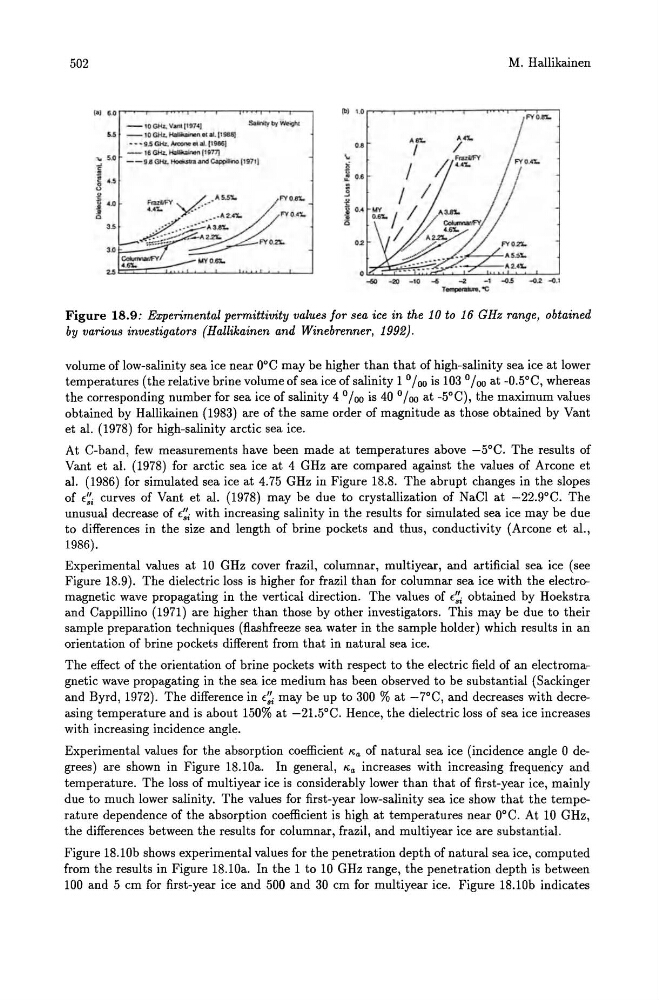
Figure 18.9: Experimental permittivity values for sea ice in the 10 to 16 GHz range, obtained
by various investigators (Hallikainen and Winebrenner, 1992).
volume of low-salinity sea ice near O°C may be higher than that of high-salinity sea ice at lower
temperatures (the relative brine volume of sea ice of salinity 1 0/00 is 103 0/00 at -0.5°C, whereas
the corresponding number for sea ice of salinity 4 0/00 is 40 0/00 at -5°C), the maximum values
obtained by Hallikainen (19S3) are of the same order of magnitude as those obtained by Vant
et al. (197S) for high-salinity arctic sea ice.
At C-band, few measurements have been made at temperatures above -5°C. The results of
Vant et al. (197S) for arctic sea ice at 4 GHz are compared against the values of Arcone et
al. (19S6) for simulated sea ice at 4.75 GHz in Figure IS.S. The abrupt changes in the slopes
of £~i curves of Vant et al. (197S) may be due to crystallization of NaCI at -22.9°C. The
unusual decrease of £~i with increasing salinity in the results for simulated sea ice may be due
to differences in the size and length of brine pockets and thus, conductivity (Arcone et aI.,
19S6).
Experimental values at 10 GHz cover frazil, columnar, multiyear, and artificial sea ice (see
Figure IS.9). The dielectric loss is higher for frazil than for columnar sea ice with the electromagnetic wave propagating in the vertical direction. The values of £~i obtained by Hoekstra
and Cappillino (1971) are higher than those by other investigators. This may be due to their
sample preparation techniques (flashfreeze sea water in the sample holder) which results in an
orientation of brine pockets different from that in natural sea ice.
The effect of the orientation of brine pockets with respect to the electric field of an electromagnetic wave propagating in the sea ice medium has been observed to be substantial (Sackinger
and Byrd, 1972). The difference in £~i may be up to 300 % at -7°C, and decreases with decreasing temperature and is about 150% at -21.5°C. Hence, the dielectric loss of sea ice increases
with increasing incidence angle.
Experimental values for the absorption coefficient Ka of natural sea ice (incidence angle 0 degrees) are shown in Figure IS.lOa. In general, Ka increases with increasing frequency and
temperature. The loss of multiyear ice is considerably lower than that of first-year ice, mainly
due to much lower salinity. The values for first-year low-salinity sea ice show that the temperature dependence of the absorption coefficient is high at temperatures near O°C. At 10 GHz,
the differences between the results for columnar, frazil, and multiyear ice are substantial.
Figure IS.lOb shows experimental values for the penetration depth of natural sea ice, computed
from the results in Figure IS. lOa. In the 1 to 10 GHz range, the penetration depth is between
100 and 5 cm for first-year ice and 500 and 30 cm for multiyear ice. Figure IS.lOb indicates
- 1 0 GHl. V.,. 1'974]
5.5 _
10 GH&. Haa.btn ""111.1'888)
..... .. 95 G:Hz. ht:#t4 ...... 119861
- - - 16 GHz. HiI~ 1'~77J
.. 5.0 --g.aGHl. ~ and CappiIino 11971)
0.1
...
! 0.6
M. Hallikainen
Figure 18.9: Experimental permittivity values for sea ice in the 10 to 16 GHz range, obtained
by various investigators (Hallikainen and Winebrenner, 1992).
volume of low-salinity sea ice near O°C may be higher than that of high-salinity sea ice at lower
temperatures (the relative brine volume of sea ice of salinity 1 0/00 is 103 0/00 at -0.5°C, whereas
the corresponding number for sea ice of salinity 4 0/00 is 40 0/00 at -5°C), the maximum values
obtained by Hallikainen (19S3) are of the same order of magnitude as those obtained by Vant
et al. (197S) for high-salinity arctic sea ice.
At C-band, few measurements have been made at temperatures above -5°C. The results of
Vant et al. (197S) for arctic sea ice at 4 GHz are compared against the values of Arcone et
al. (19S6) for simulated sea ice at 4.75 GHz in Figure IS.S. The abrupt changes in the slopes
of £~i curves of Vant et al. (197S) may be due to crystallization of NaCI at -22.9°C. The
unusual decrease of £~i with increasing salinity in the results for simulated sea ice may be due
to differences in the size and length of brine pockets and thus, conductivity (Arcone et aI.,
19S6).
Experimental values at 10 GHz cover frazil, columnar, multiyear, and artificial sea ice (see
Figure IS.9). The dielectric loss is higher for frazil than for columnar sea ice with the electromagnetic wave propagating in the vertical direction. The values of £~i obtained by Hoekstra
and Cappillino (1971) are higher than those by other investigators. This may be due to their
sample preparation techniques (flashfreeze sea water in the sample holder) which results in an
orientation of brine pockets different from that in natural sea ice.
The effect of the orientation of brine pockets with respect to the electric field of an electromagnetic wave propagating in the sea ice medium has been observed to be substantial (Sackinger
and Byrd, 1972). The difference in £~i may be up to 300 % at -7°C, and decreases with decreasing temperature and is about 150% at -21.5°C. Hence, the dielectric loss of sea ice increases
with increasing incidence angle.
Experimental values for the absorption coefficient Ka of natural sea ice (incidence angle 0 degrees) are shown in Figure IS.lOa. In general, Ka increases with increasing frequency and
temperature. The loss of multiyear ice is considerably lower than that of first-year ice, mainly
due to much lower salinity. The values for first-year low-salinity sea ice show that the temperature dependence of the absorption coefficient is high at temperatures near O°C. At 10 GHz,
the differences between the results for columnar, frazil, and multiyear ice are substantial.
Figure IS.lOb shows experimental values for the penetration depth of natural sea ice, computed
from the results in Figure IS. lOa. In the 1 to 10 GHz range, the penetration depth is between
100 and 5 cm for first-year ice and 500 and 30 cm for multiyear ice. Figure IS.lOb indicates