

Physical Basis for Microwave Remote Sensing .. .
501
of brine pockets with respect to the propagation direction of the electromagnetic wave. Most
of these parameters depend on ice temperature.
Experimental investigations of the microwave dielectric behavior of sea ice have been carried
out at frequencies below 40 GHz. A review of these investigations is given in (Hallikainen and
Winebrenner, 1992).
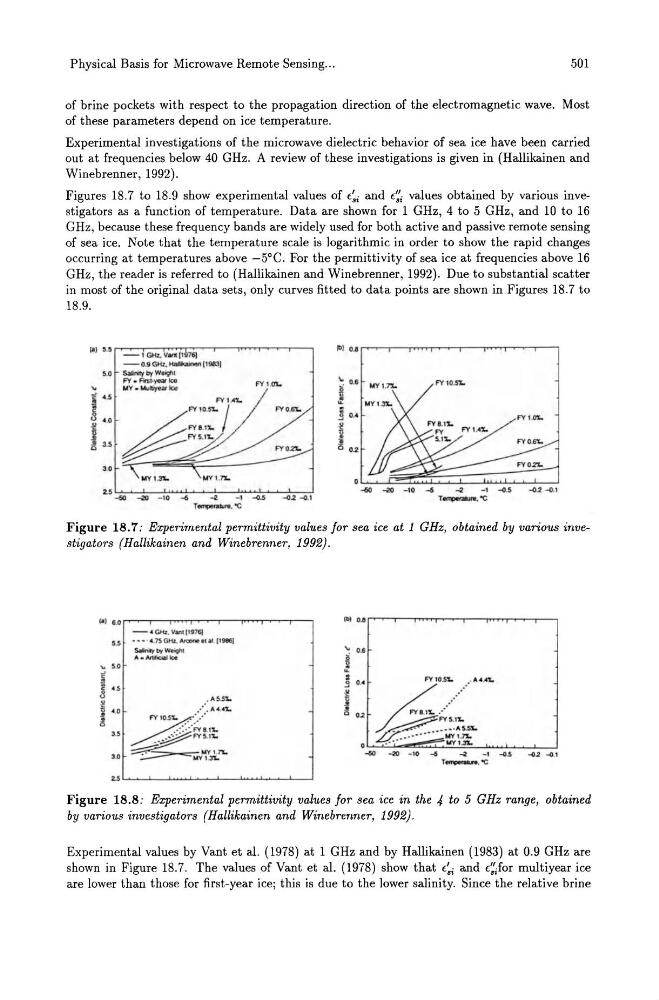
Figures 18.7 to 18.9 show experimental values of GHz, because these frequency bands are widely used for both active and passive remote sensing
of sea ice. Note that the temperature scale is logarithmic in order to show the rapid changes
occurring at temperatures above -5°C. For the permittivity of sea ice at frequencies above 16
GHz, the reader is referred to (Hallikainen and Winebrenner, 1992). Due to substantial scatter
in most of the original data sets, only curves fitted to data points are shown in Figures 18.7 to
18.9.
(a) S,' r-~""f -= GHz --r, ~"'~I' r:''-61~-'---'''''''''""''T~-r---,
- o,oGHz. ___ 1111831
S,O
~.,. Weiohl
FV ... Fkt-~ lot
MY _ Ul"ltWyear k:s
3.0
FY1 .0'I..
~~~~-~~-_~ '~0~~~~~~-_L'~~~5~~ ~~ 2~~~'
T..",........"C
MYl.n..
FY,o..~
:
..9 0 .•
~
-10
-6
~
-1 ~5
-42 -0.1
T _ . " C
Figure 18.7: Experimental permittivity values for sea ice at 1 GHz, obtained by various investigators (Hallikainen and Winebrenner, 1992).
-
" GH:'. Vaant 119781
S..!o
...... -.. 7SG~_ ~.IJJ, II911!161
Sainiry by Wofig/'It
A .. ArIiloc:IaItce
~ 5.0
~
~ 4 .5
j 4 ,0
AS,S1;.
~
Figure 18.8: Experimental permittivity values for sea ice in the 4 to 5 GHz range, obtained
by various investigators (Hallikainen and Winebrenner, 1992).
Experimental values by Vant et al. (1978) at 1 GHz and by Hallikainen (1983) at 0.9 GHz are
shown in Figure 18.7. The values of Vant et al. (1978) show that f.~i and f.~Jor multiyear ice
are lower than those for first-year ice; this is due to the lower salinity. Since the relative brine
501
of brine pockets with respect to the propagation direction of the electromagnetic wave. Most
of these parameters depend on ice temperature.
Experimental investigations of the microwave dielectric behavior of sea ice have been carried
out at frequencies below 40 GHz. A review of these investigations is given in (Hallikainen and
Winebrenner, 1992).
Figures 18.7 to 18.9 show experimental values of GHz, because these frequency bands are widely used for both active and passive remote sensing
of sea ice. Note that the temperature scale is logarithmic in order to show the rapid changes
occurring at temperatures above -5°C. For the permittivity of sea ice at frequencies above 16
GHz, the reader is referred to (Hallikainen and Winebrenner, 1992). Due to substantial scatter
in most of the original data sets, only curves fitted to data points are shown in Figures 18.7 to
18.9.
(a) S,' r-~""f -= GHz --r, ~"'~I' r:''-61~-'---'''''''''""''T~-r---,
- o,oGHz. ___ 1111831
S,O
~.,. Weiohl
FV ... Fkt-~ lot
MY _ Ul"ltWyear k:s
3.0
FY1 .0'I..
~~~~-~~-_~ '~0~~~~~~-_L'~~~5~~ ~~ 2~~~'
T..",........"C
MYl.n..
FY,o..~
:
..9 0 .•
~
-10
-6
~
-1 ~5
-42 -0.1
T _ . " C
Figure 18.7: Experimental permittivity values for sea ice at 1 GHz, obtained by various investigators (Hallikainen and Winebrenner, 1992).
-
" GH:'. Vaant 119781
S..!o
...... -.. 7SG~_ ~.IJJ, II911!161
Sainiry by Wofig/'It
A .. ArIiloc:IaItce
~ 5.0
~
~ 4 .5
j 4 ,0
AS,S1;.
~
Figure 18.8: Experimental permittivity values for sea ice in the 4 to 5 GHz range, obtained
by various investigators (Hallikainen and Winebrenner, 1992).
Experimental values by Vant et al. (1978) at 1 GHz and by Hallikainen (1983) at 0.9 GHz are
shown in Figure 18.7. The values of Vant et al. (1978) show that f.~i and f.~Jor multiyear ice
are lower than those for first-year ice; this is due to the lower salinity. Since the relative brine