

500
M. Hallikainen
18.4.1.3 Fresh-water ice
Fresh-water ice is free from salt but usually it includes air bubbles, impurities, and cracks.
Pure ice is an idealization of fresh-water ice (frozen distilled water). The dielectric properties
offresh-water ice at microwave frequencies are determined by two physical processes, namely the
high-frequency tail of a relaxation spectrum (relaxation frequency in the kilohertz range) and
the low-frequency tail offar-infrared absorption bands (Evans, 1965), (Matzler and Wegmiiller,
1987). These processes result in a practically constant value for the dielectric constant < at
microwave frequencies and in a minimum of the dielectric loss factor <' centered around 1 to 5
GHz.
Based on experimental data, the relative dielectric constant of pure and fresh-water ice may be
assigned the constant value
£;=3.17
(18.14)
between 10 MHz and 1000 GHz (Matzler and Wegmiiller, 1987; Cumming, 1952).
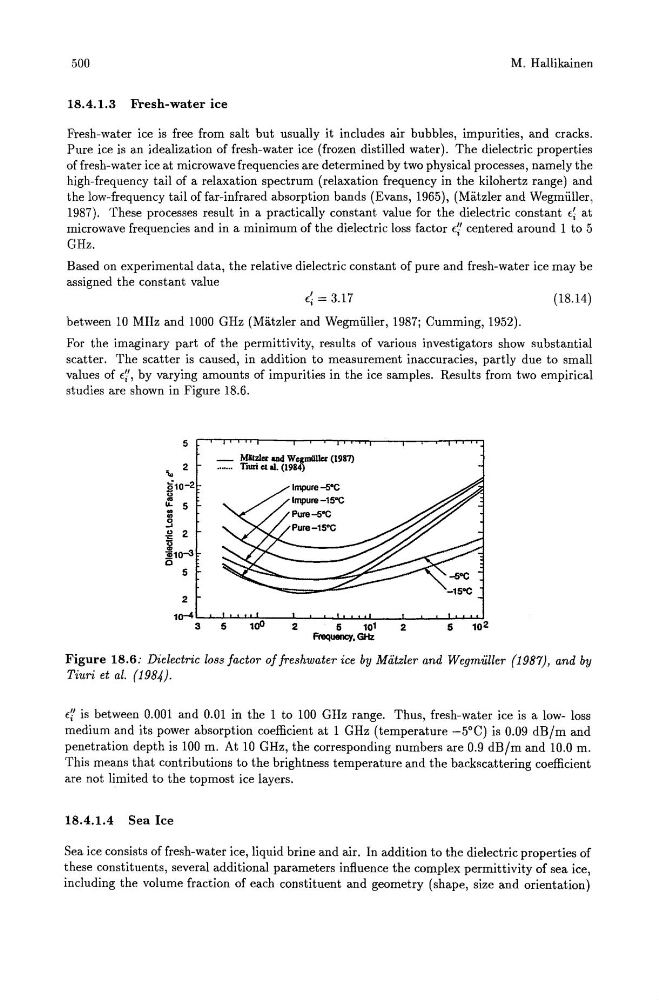
For the imaginary part of the permittivity, results of various investigators show substantial
scatter. The scatter is caused, in addition to measurement inaccuracies, partly due to small
values of E;' , by varying amounts of impurities in the ice samples. Results from two empirical
studies are shown in Figure 18.6.
5
5
2
MIIzIer and Wegmllllu (1987)
TIuri et at. (1984)
10-4~~~~~~ __ 4-~~~~~~ __ ~~~-L~~
3
5
100
2
5
101
2
5
102
Frequency. GHz
Figure 18.6: Dielectric loss factor of freshwater ice by Miitzler and Wegmiiller (1987), and by
Tiuri et al. (1984).
E;' is between 0.001 and 0.01 in the 1 to 100 GHz range. Thus, fresh-water ice is a low- loss
medium and its power absorption coefficient at 1 GHz (temperature -5°C) is 0.09 dB/m and
penetration depth is 100 m. At 10 GHz, the corresponding numbers are 0.9 dB/m and 10.0 m.
This means that contributions to the brightness temperature and the backscattering coefficient
are not limited to the topmost ice layers.
18.4.1.4 Sea Ice
Sea ice consists of fresh-water ice, liquid brine and air. In addition to the dielectric properties of
these constituents, several additional parameters influence the complex permittivity of sea ice,
including the volume fraction of each constituent and geometry (shape, size and orientation)
M. Hallikainen
18.4.1.3 Fresh-water ice
Fresh-water ice is free from salt but usually it includes air bubbles, impurities, and cracks.
Pure ice is an idealization of fresh-water ice (frozen distilled water). The dielectric properties
offresh-water ice at microwave frequencies are determined by two physical processes, namely the
high-frequency tail of a relaxation spectrum (relaxation frequency in the kilohertz range) and
the low-frequency tail offar-infrared absorption bands (Evans, 1965), (Matzler and Wegmiiller,
1987). These processes result in a practically constant value for the dielectric constant < at
microwave frequencies and in a minimum of the dielectric loss factor <' centered around 1 to 5
GHz.
Based on experimental data, the relative dielectric constant of pure and fresh-water ice may be
assigned the constant value
£;=3.17
(18.14)
between 10 MHz and 1000 GHz (Matzler and Wegmiiller, 1987; Cumming, 1952).
For the imaginary part of the permittivity, results of various investigators show substantial
scatter. The scatter is caused, in addition to measurement inaccuracies, partly due to small
values of E;' , by varying amounts of impurities in the ice samples. Results from two empirical
studies are shown in Figure 18.6.
5
5
2
MIIzIer and Wegmllllu (1987)
TIuri et at. (1984)
10-4~~~~~~ __ 4-~~~~~~ __ ~~~-L~~
3
5
100
2
5
101
2
5
102
Frequency. GHz
Figure 18.6: Dielectric loss factor of freshwater ice by Miitzler and Wegmiiller (1987), and by
Tiuri et al. (1984).
E;' is between 0.001 and 0.01 in the 1 to 100 GHz range. Thus, fresh-water ice is a low- loss
medium and its power absorption coefficient at 1 GHz (temperature -5°C) is 0.09 dB/m and
penetration depth is 100 m. At 10 GHz, the corresponding numbers are 0.9 dB/m and 10.0 m.
This means that contributions to the brightness temperature and the backscattering coefficient
are not limited to the topmost ice layers.
18.4.1.4 Sea Ice
Sea ice consists of fresh-water ice, liquid brine and air. In addition to the dielectric properties of
these constituents, several additional parameters influence the complex permittivity of sea ice,
including the volume fraction of each constituent and geometry (shape, size and orientation)