

Physical Basis for Microwave Remote Sensing ...
-~. W.altt
-
So .......
1~'L,O" O~~~~,0~,--L-~~~,~~~~~~
Ff~. GHz
499
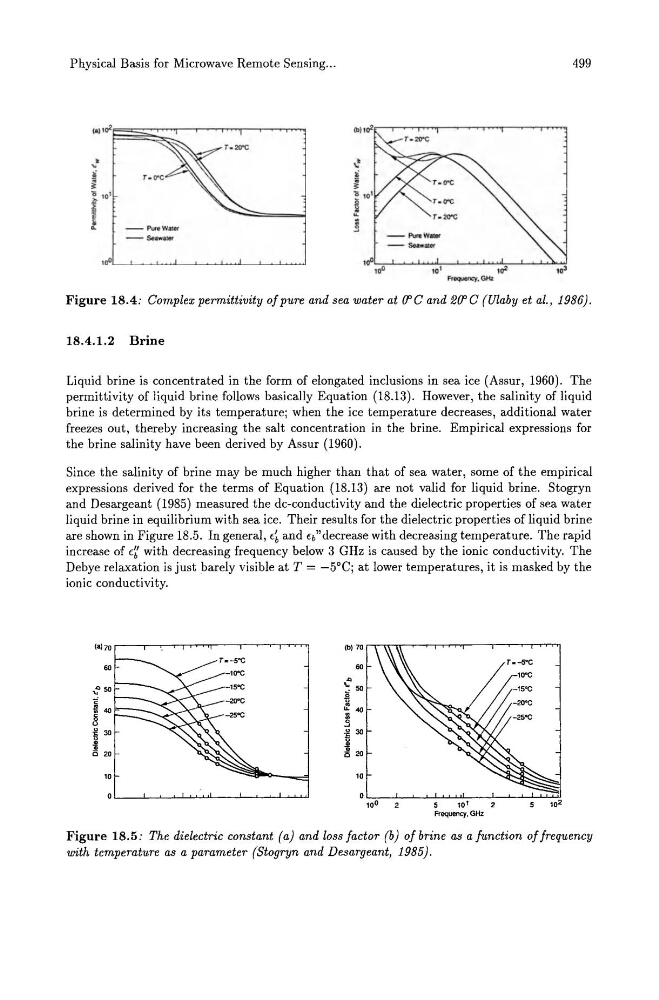
Figure 18.4: Complex permittivity of pure and sea water at (f'C and 2(f' C (Ulaby et at., 1986).
18.4.1.2 Brine
Liquid brine is concentrated in the form of elongated inclusions in sea ice (Assur, 1960). The
permittivity of liquid brine follows basically Equation (18.13). However, the salinity of liquid
brine is determined by its temperature; when the ice temperature decreases, additional water
freezes out, thereby increasing the salt concentration in the brine. Empirical expressions for
the brine salinity have been derived by Assur (1960) .
Since the salinity of brine may be much higher than that of sea water, some of the empirical
expressions derived for the terms of Equation (18.13) are not valid for liquid brine. Stogryn
and Desargeant (1985) measured the dc-conductivity and the dielectric properties of sea water
liquid brine in equilibrium with sea ice. Their results for the dielectric properties of liquid brine
are shown in Figure 18.5. In general, t~ and tb"decrease with decreasing temperature. The rapid
increase of t~ with decreasing frequency below 3 GHz is caused by the ionic conductivity. The
Debye relaxation is just barely visible at T = -5°C; at lower temperatures, it is masked by the
ionic conductivity.
(b) 70 r-r--n-..".-~~..-~,------,-~~r-r"-"'"
60
;!
;J 40
g
.g 30
i a 20
10
10
Figure 18.5 : The dielectric constant (a) and loss factor (b) of brine as a function of frequency
with temperature as a parameter (Stogryn and Desargeant, 1985).
-~. W.altt
-
So .......
1~'L,O" O~~~~,0~,--L-~~~,~~~~~~
Ff~. GHz
499
Figure 18.4: Complex permittivity of pure and sea water at (f'C and 2(f' C (Ulaby et at., 1986).
18.4.1.2 Brine
Liquid brine is concentrated in the form of elongated inclusions in sea ice (Assur, 1960). The
permittivity of liquid brine follows basically Equation (18.13). However, the salinity of liquid
brine is determined by its temperature; when the ice temperature decreases, additional water
freezes out, thereby increasing the salt concentration in the brine. Empirical expressions for
the brine salinity have been derived by Assur (1960) .
Since the salinity of brine may be much higher than that of sea water, some of the empirical
expressions derived for the terms of Equation (18.13) are not valid for liquid brine. Stogryn
and Desargeant (1985) measured the dc-conductivity and the dielectric properties of sea water
liquid brine in equilibrium with sea ice. Their results for the dielectric properties of liquid brine
are shown in Figure 18.5. In general, t~ and tb"decrease with decreasing temperature. The rapid
increase of t~ with decreasing frequency below 3 GHz is caused by the ionic conductivity. The
Debye relaxation is just barely visible at T = -5°C; at lower temperatures, it is masked by the
ionic conductivity.
(b) 70 r-r--n-..".-~~..-~,------,-~~r-r"-"'"
60
;!
;J 40
g
.g 30
i a 20
10
10
Figure 18.5 : The dielectric constant (a) and loss factor (b) of brine as a function of frequency
with temperature as a parameter (Stogryn and Desargeant, 1985).