

Physical Basis for Microwave Remote Sensing ...
pMicrowave
Imaging
Radiometers
Synthetic
Aperture
RadIUS
-
Altimeters
Roe
Resolution
V_to
ThennaI
........
Moderate
-V_to
Ocean Color
1960
491
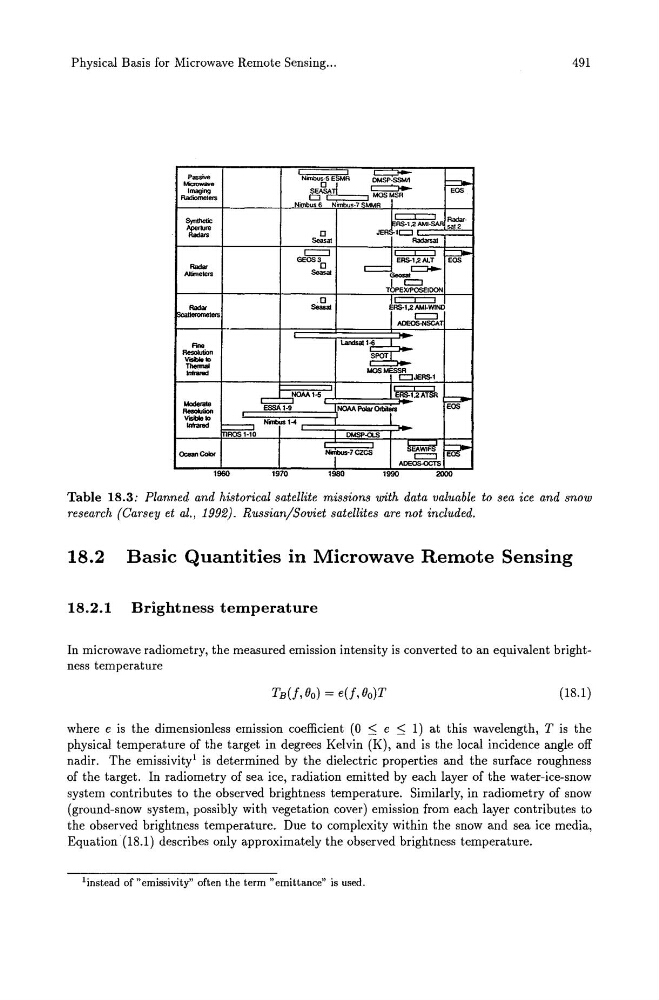
Table 18.3: Planned and historical satellite missions with data valuable to sea ice and snow
research (Carsey et al., 1992). Russian/Soviet satellites are not included.
18.2 Basic Quantities in Microwave Remote Sensing
18.2.1 Brightness temperature
In microwave radiometry, the measured emission intensity is converted to an equivalent brightness temperature
(18.1)
where e is the dimensionless emission coefficient (0 :::; e :::; 1) at this wavelength, T is the
physical temperature of the target in degrees Kelvin (K), and is the local incidence angle off
nadir. The emissivity! is determined by the dielectric properties and the surface roughness
of the target. In radiometry of sea ice, radiation emitted by each layer of the water-ice-snow
system contributes to the observed brightness temperature. Similarly, in radiometry of snow
(ground-snow system, possibly with vegetation cover) emission from each layer contributes to
the observed brightness temperature. Due to complexity within the snow and sea ice media,
Equation(18.1) describes only approximately the observed brightness temperature.
linstead of" emissivity" often the term" emittance" is used.
pMicrowave
Imaging
Radiometers
Synthetic
Aperture
RadIUS
-
Altimeters
Roe
Resolution
V_to
ThennaI
........
Moderate
-V_to
Ocean Color
1960
491
Table 18.3: Planned and historical satellite missions with data valuable to sea ice and snow
research (Carsey et al., 1992). Russian/Soviet satellites are not included.
18.2 Basic Quantities in Microwave Remote Sensing
18.2.1 Brightness temperature
In microwave radiometry, the measured emission intensity is converted to an equivalent brightness temperature
(18.1)
where e is the dimensionless emission coefficient (0 :::; e :::; 1) at this wavelength, T is the
physical temperature of the target in degrees Kelvin (K), and is the local incidence angle off
nadir. The emissivity! is determined by the dielectric properties and the surface roughness
of the target. In radiometry of sea ice, radiation emitted by each layer of the water-ice-snow
system contributes to the observed brightness temperature. Similarly, in radiometry of snow
(ground-snow system, possibly with vegetation cover) emission from each layer contributes to
the observed brightness temperature. Due to complexity within the snow and sea ice media,
Equation(18.1) describes only approximately the observed brightness temperature.
linstead of" emissivity" often the term" emittance" is used.