

490
Variable
Ice extent
Thickness distribution
Snow depth
Snow wetness
Summer melt pond coverage
Ice motion and deformation on 5 km scale
Wind, currents, clouds, air/ocean temperatures
M. Hallikainen
Accuracy requirement
5cm
1%
3%
2 cm/s
Table 18.1: Primary sea ice variables and their accuracy requirements (Carsey et al., 1992).
Variable
Extent
Water equivalent
Water content
Surface temperature
Albedo
Accuracy requirement
5%
10mm
2%
0.5 0 C
5%
Table 18.2: Observational accuracy requirements for snow surveys (Kuittinen, 1992).
climate through the changes that it makes in the radiation balance and the water vapor input
to the atmosphere (Foster and Chang, 1992). The increasing demand for water throughout
the world imposes a challenging problem for water resources managers. Since precipitation
deposited as snow represents an important source of the water supply, improved knowledge of
the water equivalent of snow over large regions should result in a more accurate estimate of
eventual runoff (Foster et al., 1984).
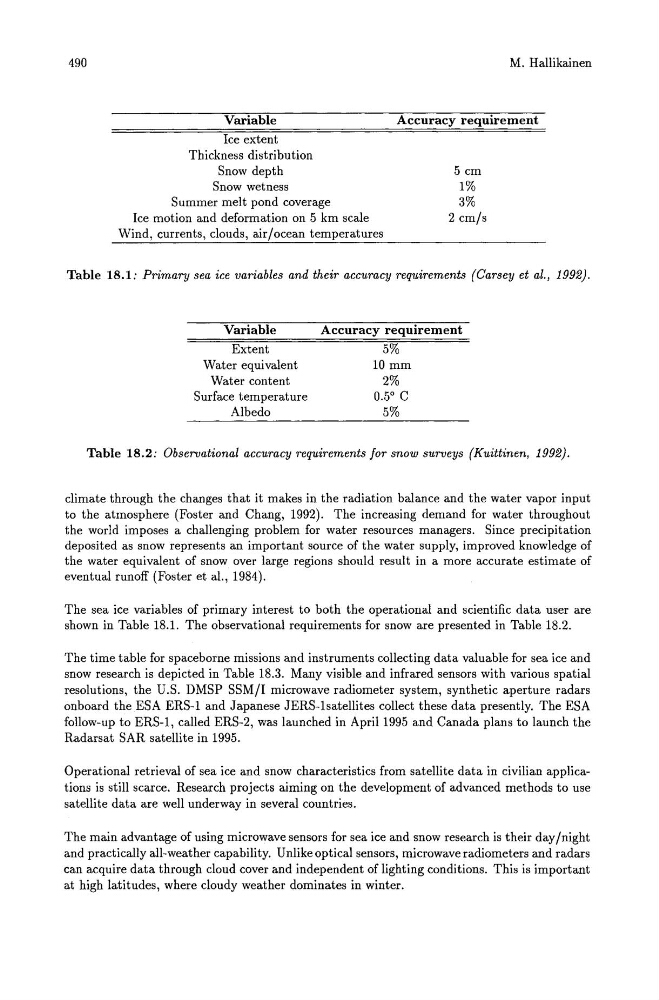
The sea ice variables of primary interest to both the operational and scientific data user are
shown in Table 18.1. The observational requirements for snow are presented in Table 18.2.
The time table for spaceborne missions and instruments collecting data valuable for sea ice and
snow research is depicted in Table 18.3. Many visible and infrared sensors with various spatial
resolutions, the U.S. DMSP SSM/I microwave radiometer system, synthetic aperture radars
onboard the ESA ERS-l and Japanese JERS-lsatellites collect these data presently. The ESA
follow-up to ERS-l, called ERS-2, was launched in April 1995 and Canada plans to launch the
Radarsat SAR satellite in 1995.
Operational retrieval of sea ice and snow characteristics from satellite data in civilian applications is still scarce. Research projects aiming on the development of advanced methods to use
satellite data are well underway in several countries.
The main advantage of using microwave sensors for sea ice and snow research is their day/night
and practically all-weather capability. Unlike optical sensors, microwave radiometers and radars
can acquire data through cloud cover and independent of lighting conditions. This is important
at high latitudes, where cloudy weather dominates in winter.
Variable
Ice extent
Thickness distribution
Snow depth
Snow wetness
Summer melt pond coverage
Ice motion and deformation on 5 km scale
Wind, currents, clouds, air/ocean temperatures
M. Hallikainen
Accuracy requirement
5cm
1%
3%
2 cm/s
Table 18.1: Primary sea ice variables and their accuracy requirements (Carsey et al., 1992).
Variable
Extent
Water equivalent
Water content
Surface temperature
Albedo
Accuracy requirement
5%
10mm
2%
0.5 0 C
5%
Table 18.2: Observational accuracy requirements for snow surveys (Kuittinen, 1992).
climate through the changes that it makes in the radiation balance and the water vapor input
to the atmosphere (Foster and Chang, 1992). The increasing demand for water throughout
the world imposes a challenging problem for water resources managers. Since precipitation
deposited as snow represents an important source of the water supply, improved knowledge of
the water equivalent of snow over large regions should result in a more accurate estimate of
eventual runoff (Foster et al., 1984).
The sea ice variables of primary interest to both the operational and scientific data user are
shown in Table 18.1. The observational requirements for snow are presented in Table 18.2.
The time table for spaceborne missions and instruments collecting data valuable for sea ice and
snow research is depicted in Table 18.3. Many visible and infrared sensors with various spatial
resolutions, the U.S. DMSP SSM/I microwave radiometer system, synthetic aperture radars
onboard the ESA ERS-l and Japanese JERS-lsatellites collect these data presently. The ESA
follow-up to ERS-l, called ERS-2, was launched in April 1995 and Canada plans to launch the
Radarsat SAR satellite in 1995.
Operational retrieval of sea ice and snow characteristics from satellite data in civilian applications is still scarce. Research projects aiming on the development of advanced methods to use
satellite data are well underway in several countries.
The main advantage of using microwave sensors for sea ice and snow research is their day/night
and practically all-weather capability. Unlike optical sensors, microwave radiometers and radars
can acquire data through cloud cover and independent of lighting conditions. This is important
at high latitudes, where cloudy weather dominates in winter.