

492
M. Hallikainen
18.2.2 Backscattering coefficient
The microwaves transmitted by a radar are reflected and scattered by a target. The backscattered intensity is measured by the receiver and the result is expressed as the differential
backscattering coefficient a O (usually referred to as the backscattering coefficient).
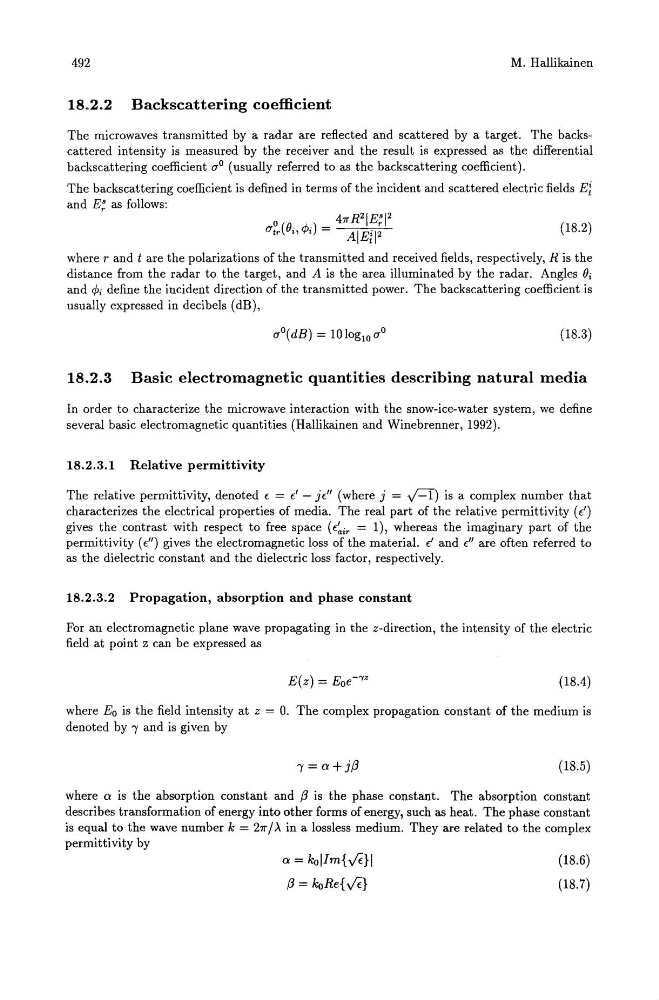
The backscattering coefficient is defined in terms of the incident and scattered electric fields Ei
and E: as follows:
(18.2)
where rand t are the polarizations of the transmitted and received fields, respectively, R is the
distance from the radar to the target, and A is the area illuminated by the radar. Angles Oi
and
(18.3)
18.2.3 Basic electromagnetic quantities describing natural media
In order to characterize the microwave interaction with the snow-ice-water system, we define
several basic electromagnetic quantities (Hallikainen and Winebrenner, 1992).
18.2.3.1 Relative permittivity
The relative permittivity, denoted € = €' - j€" (where j = A) is a complex number that
characterizes the electrical properties of media. The real part of the relative permittivity (€')
gives the contrast with respect to free space (€~ir = 1), whereas the imaginary part of the
permittivity (f") gives the electromagnetic loss of the material. £' and £" are often referred to
as the dielectric constant and the dielectric loss factor, respectively.
18.2.3.2 Propagation, absorption and phase constant
For an electromagnetic plane wave propagating in the z-direction, the intensity of the electric
field at point z can be expressed as
(18.4)
where Eo is the field intensity at z = O. The complex propagation constant of the medium is
denoted by I and is given by
(18.5)
where a is the absorption constant and f3 is the phase constant. The absorption constant
describes transformation of energy into other forms of energy, such as heat. The phase constant
is equal to the wave number k = 27l' /,\ in a lossless medium. They are related to the complex
permittivity by
a = kollm{y'€}1
f3 = koRe{ y'€}
(18.6)
(18.7)
M. Hallikainen
18.2.2 Backscattering coefficient
The microwaves transmitted by a radar are reflected and scattered by a target. The backscattered intensity is measured by the receiver and the result is expressed as the differential
backscattering coefficient a O (usually referred to as the backscattering coefficient).
The backscattering coefficient is defined in terms of the incident and scattered electric fields Ei
and E: as follows:
(18.2)
where rand t are the polarizations of the transmitted and received fields, respectively, R is the
distance from the radar to the target, and A is the area illuminated by the radar. Angles Oi
and
(18.3)
18.2.3 Basic electromagnetic quantities describing natural media
In order to characterize the microwave interaction with the snow-ice-water system, we define
several basic electromagnetic quantities (Hallikainen and Winebrenner, 1992).
18.2.3.1 Relative permittivity
The relative permittivity, denoted € = €' - j€" (where j = A) is a complex number that
characterizes the electrical properties of media. The real part of the relative permittivity (€')
gives the contrast with respect to free space (€~ir = 1), whereas the imaginary part of the
permittivity (f") gives the electromagnetic loss of the material. £' and £" are often referred to
as the dielectric constant and the dielectric loss factor, respectively.
18.2.3.2 Propagation, absorption and phase constant
For an electromagnetic plane wave propagating in the z-direction, the intensity of the electric
field at point z can be expressed as
(18.4)
where Eo is the field intensity at z = O. The complex propagation constant of the medium is
denoted by I and is given by
(18.5)
where a is the absorption constant and f3 is the phase constant. The absorption constant
describes transformation of energy into other forms of energy, such as heat. The phase constant
is equal to the wave number k = 27l' /,\ in a lossless medium. They are related to the complex
permittivity by
a = kollm{y'€}1
f3 = koRe{ y'€}
(18.6)
(18.7)