

470
K.B. Katsaros
the microwave signals at one frequency as more cloud and rain emissions are added to the
original polarized signals emerging from the sea. Corrections for absorption by water vapor
and for the degree of depolarization already present in the signals emerging from the sea due
to wind roughening are required. These corrections are found from the clear areas in the pixels
surrounding the clouds and precipitation. Cloud liquid water algorithms employing 37 and
85 GHz signals are described in more detail in section 17.4. For liquid precipitation, similar
polarization based algorithms have been developed based on the 37 and 19 GHz signals. A
second principle is used to infer precipitation from convective cloud systems that contain large
wet ice particles, such as graupel and hail. This type of algorithm is referred to as a 'scattering
index' and employs the higher frequencies, 37 and 85 GHz.
FREQUENCY (GHZ)
30
80
90
o.s
w
o.a
<..>
g 0.7
:::E
<1.1
0.&
z
... a::
>0.5
!.1
a::
w
0.4.
a:
g
tc
Q.3
02
~1
0.0
WAWI.ENGnf (em)
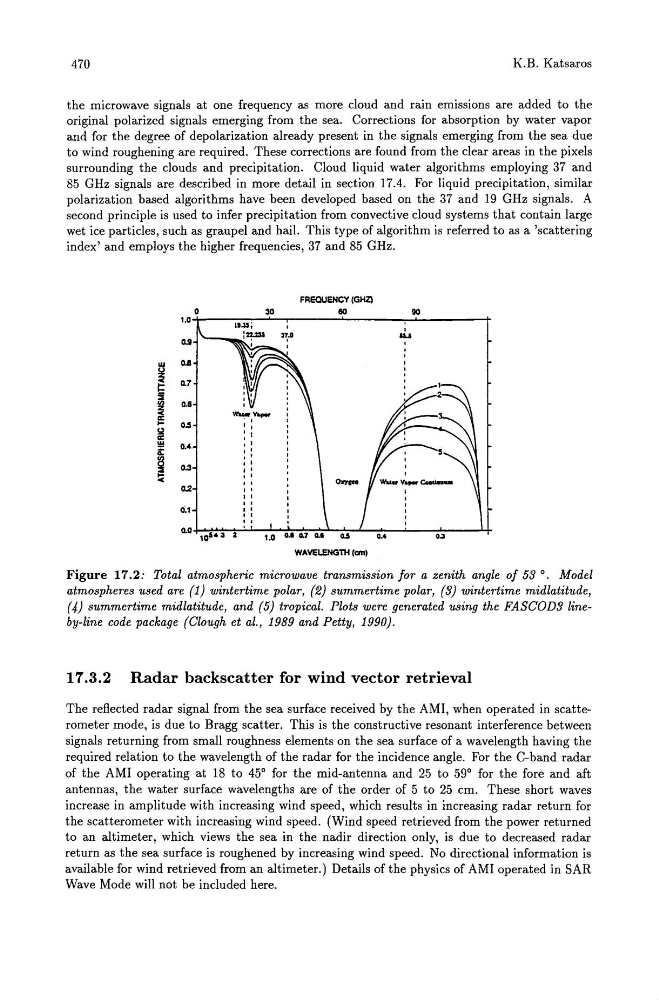
Figure 17.2: Total atmospheric microwave transmission for a zenith angle of 53 0. Model
atmospheres used are (1) wintertime polar, (2) summertime polar, (3) wintertime midlatitude,
(4) summertime midlatitude, and (5) tropical. Plots were generated using the FASCOD3 lineby-line code package (Clough et al., 1989 and Petty, 1990).
17.3.2 Radar backscatter for wind vector retrieval
The reflected radar signal from the sea surface received by the AMI, when operated in scatterometer mode, is due to Bragg scatter. This is the constructive resonant interference between
signals returning from small roughness elements on the sea surface of a wavelength having the
required relation to the wavelength of the radar for the incidence angle. For the C-band radar
of the AMI operating at 18 to 45° for the mid-antenna and 25 to 59° for the fore and aft
antennas, the water surface wavelengths are of the order of 5 to 25 cm. These short waves
increase in amplitude with increasing wind speed, which results in increasing radar return for
the scatterometer with increasing wind speed. (Wind speed retrieved from the power returned
to an altimeter, which views the sea in the nadir direction only, is due to decreased radar
return as the sea surface is roughened by increasing wind speed. No directional information is
available for wind retrieved from an altimeter.) Details of the physics of AMI operated in SAR
Wave Mode will not be included here.
K.B. Katsaros
the microwave signals at one frequency as more cloud and rain emissions are added to the
original polarized signals emerging from the sea. Corrections for absorption by water vapor
and for the degree of depolarization already present in the signals emerging from the sea due
to wind roughening are required. These corrections are found from the clear areas in the pixels
surrounding the clouds and precipitation. Cloud liquid water algorithms employing 37 and
85 GHz signals are described in more detail in section 17.4. For liquid precipitation, similar
polarization based algorithms have been developed based on the 37 and 19 GHz signals. A
second principle is used to infer precipitation from convective cloud systems that contain large
wet ice particles, such as graupel and hail. This type of algorithm is referred to as a 'scattering
index' and employs the higher frequencies, 37 and 85 GHz.
FREQUENCY (GHZ)
30
80
90
o.s
w
o.a
<..>
g 0.7
:::E
<1.1
0.&
z
... a::
>0.5
!.1
a::
w
0.4.
a:
g
tc
Q.3
02
~1
0.0
WAWI.ENGnf (em)
Figure 17.2: Total atmospheric microwave transmission for a zenith angle of 53 0. Model
atmospheres used are (1) wintertime polar, (2) summertime polar, (3) wintertime midlatitude,
(4) summertime midlatitude, and (5) tropical. Plots were generated using the FASCOD3 lineby-line code package (Clough et al., 1989 and Petty, 1990).
17.3.2 Radar backscatter for wind vector retrieval
The reflected radar signal from the sea surface received by the AMI, when operated in scatterometer mode, is due to Bragg scatter. This is the constructive resonant interference between
signals returning from small roughness elements on the sea surface of a wavelength having the
required relation to the wavelength of the radar for the incidence angle. For the C-band radar
of the AMI operating at 18 to 45° for the mid-antenna and 25 to 59° for the fore and aft
antennas, the water surface wavelengths are of the order of 5 to 25 cm. These short waves
increase in amplitude with increasing wind speed, which results in increasing radar return for
the scatterometer with increasing wind speed. (Wind speed retrieved from the power returned
to an altimeter, which views the sea in the nadir direction only, is due to decreased radar
return as the sea surface is roughened by increasing wind speed. No directional information is
available for wind retrieved from an altimeter.) Details of the physics of AMI operated in SAR
Wave Mode will not be included here.