

Applications of Passive and Active Microwave Sensors ...
469
SSMR
SSMjI
Freq. Ghz Approx. Resolution
(km)
6.6
150
10.7
100
18
65
21
60
37
35
Swath Width
Seasat :
650 km
Nimbus -7 :
780 km
Period of Operation
Seasat :
July-October 1978
Nimbus -7 :
October 1978 - Fall, 1987
Freq. GHZ
19.35
22.235
37.
85.5
Swath Width
1400 km
Period of Operation
July 1987-Present
Approx. Resolution
(km)
55
50
35
15
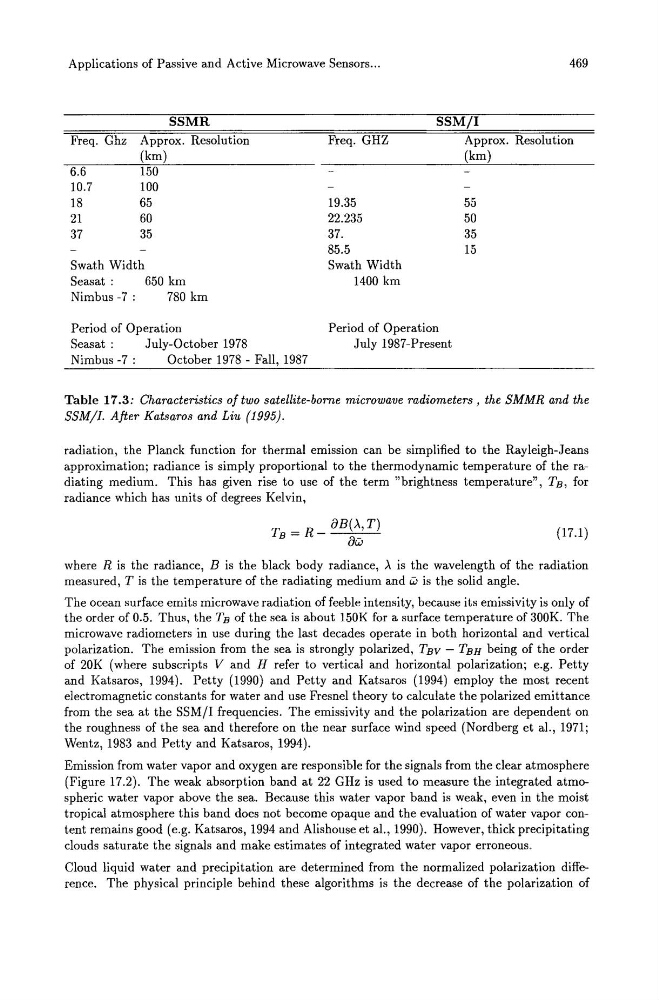
Table 17.3: Characteristics of two satellite-borne microwave radiometers, the SMMR and the
SSM/I. After Katsaros and Liu (1995).
radiation, the Planck function for thermal emission can be simplified to the Rayleigh-Jeans
approximation; radiance is simply proportional to the thermodynamic temperature of the radiating medium. This has given rise to use of the term "brightness temperature", TB , for
radiance which has units of degrees Kelvin,
TB = R _ fJB()., T)
fJw
(17.1)
where R is the radiance, B is the black body radiance, A is the wavelength of the radiation
measured, T is the temperature of the radiating medium and w is the solid angle.
The ocean surface emits microwave radiation of feeble intensity, because its emissivity is only of
the order of 0.5. Thus, the TB of the sea is about 150K for a surface temperature of 300K. The
microwave radiometers in use during the last decades operate in both horizontal and vertical
polarization. The emission from the sea is strongly polarized, T BV - TBH being of the order
of 20K (where subscripts V and H refer to vertical and horizontal polarization; e.g. Petty
and Katsaros, 1994). Petty (1990) and Petty and Katsaros (1994) employ the most recent
electromagnetic constants for water and use Fresnel theory to calculate the polarized emittance
from the sea at the SSM/I frequencies. The emissivity and the polarization are dependent on
the roughness of the sea and therefore on the near surface wind speed (Nordberg et al., 1971;
Wentz, 1983 and Petty and Katsaros, 1994).
Emission from water vapor and oxygen are responsible for the signals from the clear atmosphere
(Figure 17.2). The weak absorption band at 22 GHz is used to measure the integrated atmospheric water vapor above the sea. Because this water vapor band is weak, even in the moist
tropical atmosphere this band does not become opaque and the evaluation of water vapor content remains good (e.g. Katsaros, 1994 and Alishouse et al., 1990). However, thick precipitating
clouds saturate the signals and make estimates of integrated water vapor erroneous.
Cloud liquid water and precipitation are determined from the normalized polarization difference. The physical principle behind these algorithms is the decrease of the polarization of
469
SSMR
SSMjI
Freq. Ghz Approx. Resolution
(km)
6.6
150
10.7
100
18
65
21
60
37
35
Swath Width
Seasat :
650 km
Nimbus -7 :
780 km
Period of Operation
Seasat :
July-October 1978
Nimbus -7 :
October 1978 - Fall, 1987
Freq. GHZ
19.35
22.235
37.
85.5
Swath Width
1400 km
Period of Operation
July 1987-Present
Approx. Resolution
(km)
55
50
35
15
Table 17.3: Characteristics of two satellite-borne microwave radiometers, the SMMR and the
SSM/I. After Katsaros and Liu (1995).
radiation, the Planck function for thermal emission can be simplified to the Rayleigh-Jeans
approximation; radiance is simply proportional to the thermodynamic temperature of the radiating medium. This has given rise to use of the term "brightness temperature", TB , for
radiance which has units of degrees Kelvin,
TB = R _ fJB()., T)
fJw
(17.1)
where R is the radiance, B is the black body radiance, A is the wavelength of the radiation
measured, T is the temperature of the radiating medium and w is the solid angle.
The ocean surface emits microwave radiation of feeble intensity, because its emissivity is only of
the order of 0.5. Thus, the TB of the sea is about 150K for a surface temperature of 300K. The
microwave radiometers in use during the last decades operate in both horizontal and vertical
polarization. The emission from the sea is strongly polarized, T BV - TBH being of the order
of 20K (where subscripts V and H refer to vertical and horizontal polarization; e.g. Petty
and Katsaros, 1994). Petty (1990) and Petty and Katsaros (1994) employ the most recent
electromagnetic constants for water and use Fresnel theory to calculate the polarized emittance
from the sea at the SSM/I frequencies. The emissivity and the polarization are dependent on
the roughness of the sea and therefore on the near surface wind speed (Nordberg et al., 1971;
Wentz, 1983 and Petty and Katsaros, 1994).
Emission from water vapor and oxygen are responsible for the signals from the clear atmosphere
(Figure 17.2). The weak absorption band at 22 GHz is used to measure the integrated atmospheric water vapor above the sea. Because this water vapor band is weak, even in the moist
tropical atmosphere this band does not become opaque and the evaluation of water vapor content remains good (e.g. Katsaros, 1994 and Alishouse et al., 1990). However, thick precipitating
clouds saturate the signals and make estimates of integrated water vapor erroneous.
Cloud liquid water and precipitation are determined from the normalized polarization difference. The physical principle behind these algorithms is the decrease of the polarization of