

446
P. Schliissel
several minutes which lead to short but effectful mixing of the surface water which prevented
the surface warming as near the end of the following day. Such short-term fluctuations might
be partly responsible for the failure of simple parameterisations for t::.T when entering hourly
means of heat and momentum fluxes.
Different processes prevail at different wind speeds which can be classified in the domains of
free convection in calm situations, the forced convection by rollers on top of breaking wavelets
at moderate wind speeds and the longwave breaking at gale force winds. For each of theses
wind-speed classes a different parameterisation for t::.T is necessary. The mean temperature
difference across the thermal boundary layer under moderate wind speeds at night has been
described by Saunders (1967):
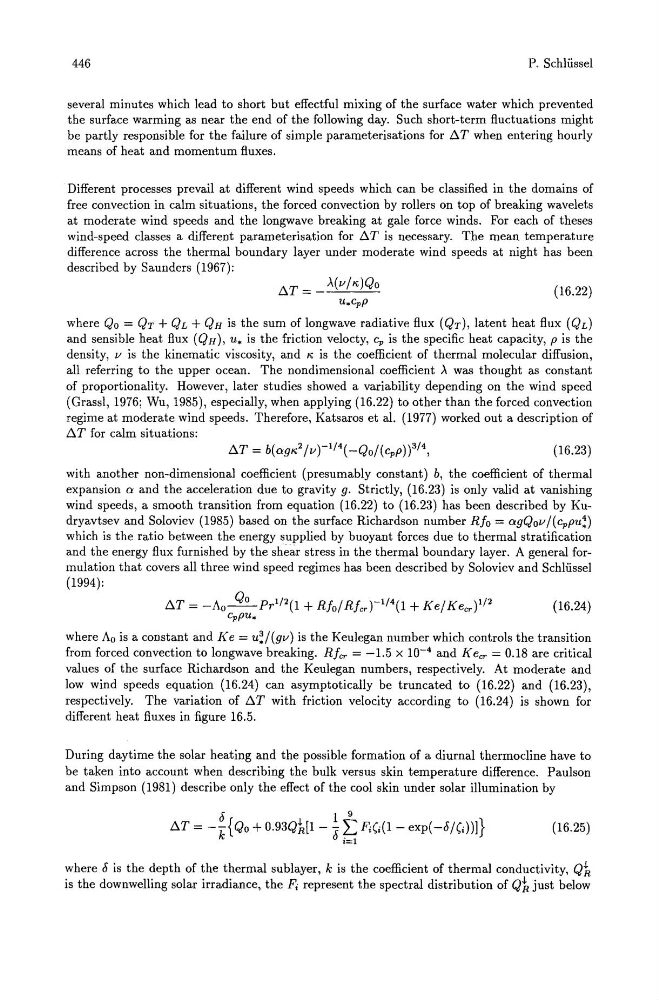
t::.T=
(16.22)
where Qo = QT + QL + QH is the sum of longwave radiative flux (QT), latent heat flux (QL)
and sensible heat flux (QH), u. is the friction velocty, cp is the specific heat capacity, p is the
density, v is the kinematic viscosity, and K is the coefficient of thermal molecular diffusion,
all referring to the upper ocean. The nondimensional coefficient >. was thought as constant
of proportionality. However, later studies showed a variability depending on the wind speed
(Grassl, 1976; Wu, 1985), especially, when applying (16.22) to other than the forced convection
regime at moderate wind speeds. Therefore, Katsaros et al. (1977) worked out a description of
t::.T for calm situations:
(16.23)
with another non-dimensional coefficient (presumably constant) b, the coefficient of thermal
expansion a and the acceleration due to gravity g. Strictly, (16.23) is only valid at vanishing
wind speeds, a smooth transition from equation (16.22) to (16.23) has been described by Kudryavtsev and Soloviev (1985) based on the surface Richardson number Rio = agQovj(cppu!)
which is the ratio between the energy supplied by buoyant forces due to thermal stratification
and the energy flux furnished by the shear stress in the thermal boundary layer. A general formulation that covers all three wind speed regimes has been described by Soloviev and Schliissel
(1994):
(16.24)
where Ao is a constant and K e = u~/(gv) is the Keulegan number which controls the transition
from forced convection to longwave breaking. Ricr = -1.5 x 10- 4 and K ecr = 0.18 are critical
values of the surface Richardson and the Keulegan numbers, respectively. At moderate and
low wind speeds equation (16.24) can asymptotically be truncated to (16.22) and (16.23),
respectively. The variation of t::.T with friction velocity according to (16.24) is shown for
different heat fluxes in figure 16.5.
During daytime the solar heating and the possible formation of a diurnal thermocline have to
be taken into account when describing the bulk versus skin temperature difference. Paulson
and Simpson (1981) describe only the effect of the cool skin under solar illumination by
5 1 9
t::.T = -·d Qo + 0.93QMl - J L Fi (i(1 - exp( -5/(;))]}
,=1
(16.25)
where 5 is the depth of the thermal sublayer, k is the coefficient of thermal conductivity, Q1
is the downwelling solar irradiance, the F; represent the spectral distribution of Q1 just below
P. Schliissel
several minutes which lead to short but effectful mixing of the surface water which prevented
the surface warming as near the end of the following day. Such short-term fluctuations might
be partly responsible for the failure of simple parameterisations for t::.T when entering hourly
means of heat and momentum fluxes.
Different processes prevail at different wind speeds which can be classified in the domains of
free convection in calm situations, the forced convection by rollers on top of breaking wavelets
at moderate wind speeds and the longwave breaking at gale force winds. For each of theses
wind-speed classes a different parameterisation for t::.T is necessary. The mean temperature
difference across the thermal boundary layer under moderate wind speeds at night has been
described by Saunders (1967):
t::.T=
(16.22)
where Qo = QT + QL + QH is the sum of longwave radiative flux (QT), latent heat flux (QL)
and sensible heat flux (QH), u. is the friction velocty, cp is the specific heat capacity, p is the
density, v is the kinematic viscosity, and K is the coefficient of thermal molecular diffusion,
all referring to the upper ocean. The nondimensional coefficient >. was thought as constant
of proportionality. However, later studies showed a variability depending on the wind speed
(Grassl, 1976; Wu, 1985), especially, when applying (16.22) to other than the forced convection
regime at moderate wind speeds. Therefore, Katsaros et al. (1977) worked out a description of
t::.T for calm situations:
(16.23)
with another non-dimensional coefficient (presumably constant) b, the coefficient of thermal
expansion a and the acceleration due to gravity g. Strictly, (16.23) is only valid at vanishing
wind speeds, a smooth transition from equation (16.22) to (16.23) has been described by Kudryavtsev and Soloviev (1985) based on the surface Richardson number Rio = agQovj(cppu!)
which is the ratio between the energy supplied by buoyant forces due to thermal stratification
and the energy flux furnished by the shear stress in the thermal boundary layer. A general formulation that covers all three wind speed regimes has been described by Soloviev and Schliissel
(1994):
(16.24)
where Ao is a constant and K e = u~/(gv) is the Keulegan number which controls the transition
from forced convection to longwave breaking. Ricr = -1.5 x 10- 4 and K ecr = 0.18 are critical
values of the surface Richardson and the Keulegan numbers, respectively. At moderate and
low wind speeds equation (16.24) can asymptotically be truncated to (16.22) and (16.23),
respectively. The variation of t::.T with friction velocity according to (16.24) is shown for
different heat fluxes in figure 16.5.
During daytime the solar heating and the possible formation of a diurnal thermocline have to
be taken into account when describing the bulk versus skin temperature difference. Paulson
and Simpson (1981) describe only the effect of the cool skin under solar illumination by
5 1 9
t::.T = -·d Qo + 0.93QMl - J L Fi (i(1 - exp( -5/(;))]}
,=1
(16.25)
where 5 is the depth of the thermal sublayer, k is the coefficient of thermal conductivity, Q1
is the downwelling solar irradiance, the F; represent the spectral distribution of Q1 just below