

Satellite Remote Sensing of Evaporation over Sea
1.0
~\ I
~ I
./ ' 1\
,
I
I
'\
"
\
\
0.8
I
I
1 -
-
+---\\ I
f0.6
-&
-&
~
0.4
0.2
0.0
1.0
I -r l
---1
-IT --,
I
I
-L..
,
~
V 1 \
0.8
, \ I
0.6
,
0.4
I
0.2
/
\1
0.0
/
'-"
1.0 +--+_1...---'-----'-_+
0.8 -i--+-:c0.6 -1--+1,,,,,,- +11
0.4 -i+-iH~--0.2
0.0 +--+-.----.---.-+
-
. _ -
I
1
I
!
)
\
=±z/\ I ( 0
R I
\
-+ . II \ \
l
J.
\
\
\
\
I
I
\
I
) 1
./ I'.. I
I
.,. ~ - .... --. . -..... . -- --_ .. -(
3.2 3.4 3.6 3.8 4.0 4.2 10
11
12
A. b.lml
A. [I.lm]
I
I
1
1"-. 1
435
(a)
(b)
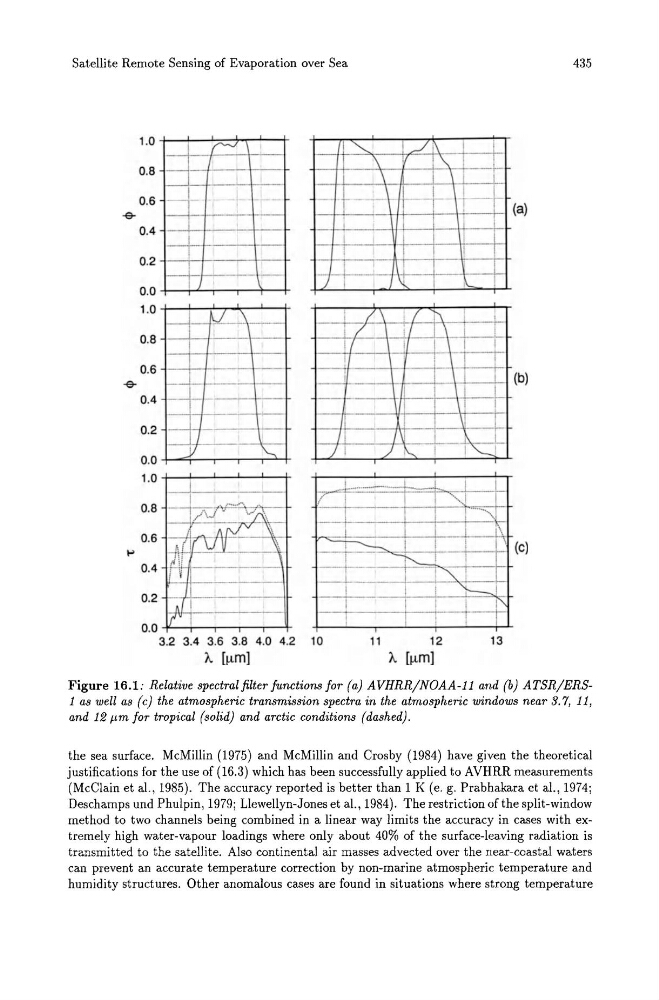
Figure 16.1: Relative spectral filter functions for (a) AVHRR/NOAA-ll and (b) ATSR/ERS1 as well as (c) the atmospheric transmission spectra in the atmospheric windows near 3.7,11,
and 12 pm for tropical (solid) and arctic conditions (dashed).
the sea surface. McMillin (1975) and McMillin and Crosby (1984) have given the theoretical
justifications for the use of (16.3) which has been successfully applied to AVHRR measurements
(McClain et al., 1985). The accuracy reported is better than 1 K (e. g. Prabhakara et al., 1974;
Deschamps und Phulpin, 1979; Llewellyn-Jones et al., 1984). The restriction of the split-window
method to two channels being combined in a linear way limits the accuracy in cases with extremely high water-vapour loadings where only about 40% of the surface-leaving radiation is
transmitted to the satellite. Also continental air masses advected over the near-coastal waters
can prevent an accurate temperature correction by non-marine atmospheric temperature and
humidity structures. Other anomalous cases are found in situations where strong temperature
1.0
~\ I
~ I
./ ' 1\
,
I
I
'\
"
\
\
0.8
I
I
1 -
-
+---\\ I
f0.6
-&
-&
~
0.4
0.2
0.0
1.0
I -r l
---1
-IT --,
I
I
-L..
,
~
V 1 \
0.8
, \ I
0.6
,
0.4
I
0.2
/
\1
0.0
/
'-"
1.0 +--+_1...---'-----'-_+
0.8 -i--+-:c0.6 -1--+1,,,,,,- +11
0.4 -i+-iH~--0.2
0.0 +--+-.----.---.-+
-
. _ -
I
1
I
!
)
\
=±z/\ I ( 0
R I
\
-+ . II \ \
l
J.
\
\
\
\
I
I
\
I
) 1
./ I'.. I
I
.,. ~ - .... --. . -..... . -- --_ .. -(
3.2 3.4 3.6 3.8 4.0 4.2 10
11
12
A. b.lml
A. [I.lm]
I
I
1
1"-. 1
435
(a)
(b)
Figure 16.1: Relative spectral filter functions for (a) AVHRR/NOAA-ll and (b) ATSR/ERS1 as well as (c) the atmospheric transmission spectra in the atmospheric windows near 3.7,11,
and 12 pm for tropical (solid) and arctic conditions (dashed).
the sea surface. McMillin (1975) and McMillin and Crosby (1984) have given the theoretical
justifications for the use of (16.3) which has been successfully applied to AVHRR measurements
(McClain et al., 1985). The accuracy reported is better than 1 K (e. g. Prabhakara et al., 1974;
Deschamps und Phulpin, 1979; Llewellyn-Jones et al., 1984). The restriction of the split-window
method to two channels being combined in a linear way limits the accuracy in cases with extremely high water-vapour loadings where only about 40% of the surface-leaving radiation is
transmitted to the satellite. Also continental air masses advected over the near-coastal waters
can prevent an accurate temperature correction by non-marine atmospheric temperature and
humidity structures. Other anomalous cases are found in situations where strong temperature