

434
P. Schliissel
Channel
Band
Purpose
[]tm]
1
1.55 - 1.66
clouds, aerosols
2
3.47 - 3.98
surface temperature
3
10.37 - 1l.48 surface temperature
4
1l.30 - 12.60 surface temperature
NEfl.T
<0.1 K
scan angle
±23.45°
pixels per scan
555 (nadir), 371 (forward)
scan rate
1 line per 150 ms
integration time
80 Its
calibration
two internal black bodies
resolution
1.29 mrad (nadir), 1.54 mrad (forward)
Off-nadir distance Zenith angle
Relative air mass
[km]
[0]
0
0
1.000
55.0
1.743
50
4.4
1.003
54.9
1.740
100
8.1
1.010
54.6
1.728
150
12.7
1.025
54.2
1.709
200
16.9
1.045
53.5
1.680
250
21.5
1.075
52.4
1.640
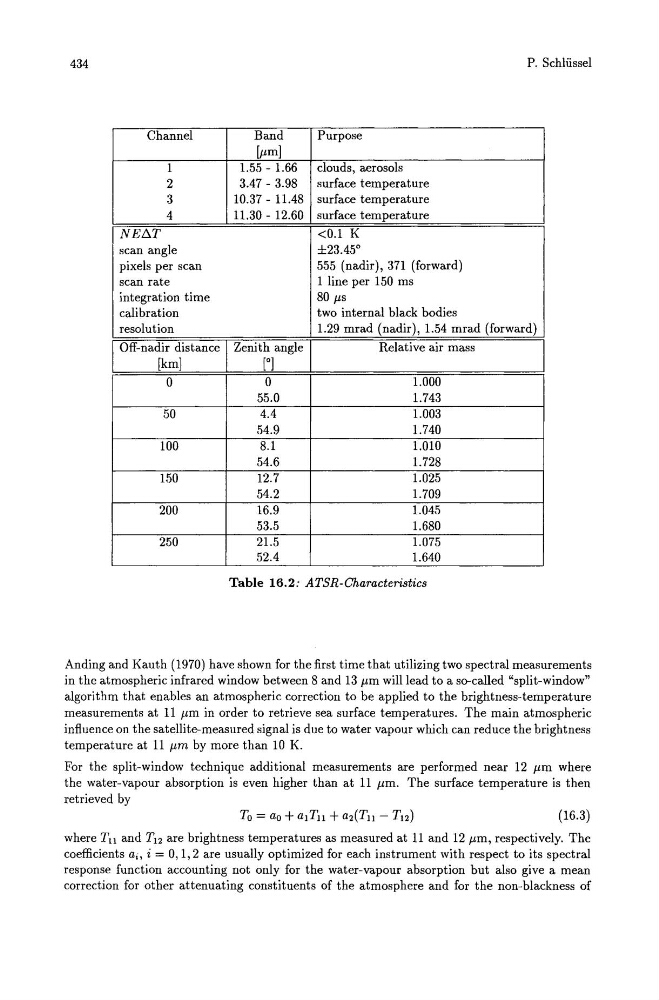
Table 16.2: ATSR-Characteristics
Anding and Kauth (1970) have shown for the first time that utilizing two spectral measurements
in the atmospheric infrared window between 8 and 13 ]tm will lead to a so-called "split-window"
algorithm that enables an atmospheric correction to be applied to the brightness-temperature
measurements at 11 ]tm in order to retrieve sea surface temperatures. The main atmospheric
influence on the satellite-measured signal is due to water vapour which can reduce the brightness
temperature at 11 ]tm by more than 10 K.
For the split-window technique additional measurements are performed near 12 ]tm where
the water-vapour absorption is even higher than at II ]tm. The surface temperature is then
retrieved by
(16.3)
where Tn and T12 are brightness temperatures as measured at II and 12 ]tm, respectively. The
coefficients ai, i = 0,1,2 are usually optimized for each instrument with respect to its spectral
response function accounting not only for the water-vapour absorption but also give a mean
correction for other attenuating constituents of the atmosphere and for the non-blackness of
P. Schliissel
Channel
Band
Purpose
[]tm]
1
1.55 - 1.66
clouds, aerosols
2
3.47 - 3.98
surface temperature
3
10.37 - 1l.48 surface temperature
4
1l.30 - 12.60 surface temperature
NEfl.T
<0.1 K
scan angle
±23.45°
pixels per scan
555 (nadir), 371 (forward)
scan rate
1 line per 150 ms
integration time
80 Its
calibration
two internal black bodies
resolution
1.29 mrad (nadir), 1.54 mrad (forward)
Off-nadir distance Zenith angle
Relative air mass
[km]
[0]
0
0
1.000
55.0
1.743
50
4.4
1.003
54.9
1.740
100
8.1
1.010
54.6
1.728
150
12.7
1.025
54.2
1.709
200
16.9
1.045
53.5
1.680
250
21.5
1.075
52.4
1.640
Table 16.2: ATSR-Characteristics
Anding and Kauth (1970) have shown for the first time that utilizing two spectral measurements
in the atmospheric infrared window between 8 and 13 ]tm will lead to a so-called "split-window"
algorithm that enables an atmospheric correction to be applied to the brightness-temperature
measurements at 11 ]tm in order to retrieve sea surface temperatures. The main atmospheric
influence on the satellite-measured signal is due to water vapour which can reduce the brightness
temperature at 11 ]tm by more than 10 K.
For the split-window technique additional measurements are performed near 12 ]tm where
the water-vapour absorption is even higher than at II ]tm. The surface temperature is then
retrieved by
(16.3)
where Tn and T12 are brightness temperatures as measured at II and 12 ]tm, respectively. The
coefficients ai, i = 0,1,2 are usually optimized for each instrument with respect to its spectral
response function accounting not only for the water-vapour absorption but also give a mean
correction for other attenuating constituents of the atmosphere and for the non-blackness of