

Satellite Remote Sensing of Evaporation over Sea
433
Channel
Band
Resolution Purpose
[pm]
[mrad]
1
0.58 - 0.68
1.39
clouds, vegetation
2
0.725 - 1.10
1.41
clouds, vegetation
3
3.55 - 3.93
1.51
clouds, surface temperature
4
10.30 - 11.80
1.41
surface temperature, water vapour
5
11.50 - 12.50
1.30
surface temperature, water vapour
SIN (channels 1, 2)
3 at 0.5% reflectivity
NEb.T (channels 3 - 5)
0.12 K
scan angle
±55.4°
pixels per line
2048
scan rate
1 line per 1/6 s
integration time
20 ps
calibration
internal black body and space view
SIR = Signal to noise ratio
N Eb.T = noise equivalent temperature difference
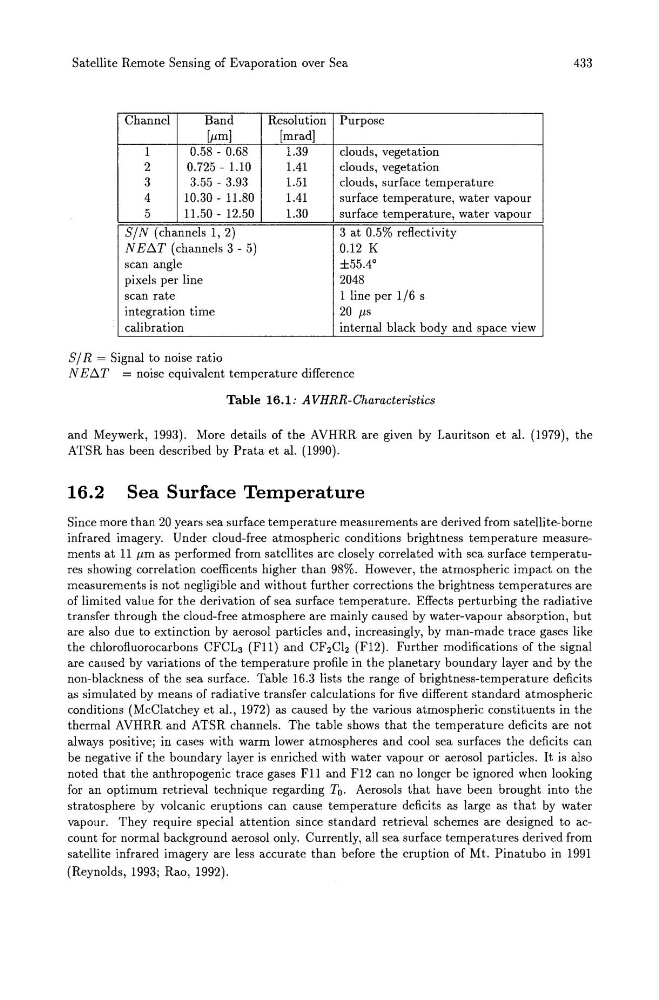
Table 16.1: AVHRR-Characteristics
and Meywerk, 1993). More details of the AVHRR are given by Lauritson et al. (1979), the
ATSR has been described by Prata et al. (1990).
16.2 Sea Surface Temperature
Since more than 20 years sea surface temperature measurements are derived from satellite-borne
infrared imagery. Under cloud-free atmospheric conditions brightness temperature measurements at 11 pm as performed from satellites are closely correlated with sea surface temperatures showing correlation coefficents higher than 98%. However, the atmospheric impact on the
measurements is not negligible and without further corrections the brightness temperatures are
of limited value for the derivation of sea surface temperature. Effects perturbing the radiative
transfer through the cloud-free atmosphere are mainly caused by water-vapour absorption, but
are also due to extinction by aerosol particles and, increasingly, by man-made trace gases like
the chlorofluorocarbons CFCL3 (Fll) and CF2Cl2 (F12). Further modifications of the signal
are caused by variations of the temperature profile in the planetary boundary layer and by the
non-blackness of the sea surface. Table 16.3 lists the range of brightness-temperature deficits
as simulated by means of radiative transfer calculations for five different standard atmospheric
conditions (McClatchey et al., 1972) as caused by the various atmospheric constituents in the
thermal AVHRR and ATSR channels. The table shows that the temperature deficits are not
always positive; in cases with warm lower atmospheres and cool sea surfaces the deficits can
be negative if the boundary layer is enriched with water vapour or aerosol particles. It is also
noted that the anthropogenic trace gases Fll and F12 can no longer be ignored when looking
for an optimum retrieval technique regarding To. Aerosols that have been brought into the
stratosphere by volcanic eruptions can cause temperature deficits as large as that by water
vapour. They require special attention since standard retrieval schemes are designed to account for normal background aerosol only. Currently, all sea surface temperatures derived from
satellite infrared imagery are less accurate than before the eruption of Mt. Pinatubo in 1991
(Reynolds, 1993; Rao, 1992).
433
Channel
Band
Resolution Purpose
[pm]
[mrad]
1
0.58 - 0.68
1.39
clouds, vegetation
2
0.725 - 1.10
1.41
clouds, vegetation
3
3.55 - 3.93
1.51
clouds, surface temperature
4
10.30 - 11.80
1.41
surface temperature, water vapour
5
11.50 - 12.50
1.30
surface temperature, water vapour
SIN (channels 1, 2)
3 at 0.5% reflectivity
NEb.T (channels 3 - 5)
0.12 K
scan angle
±55.4°
pixels per line
2048
scan rate
1 line per 1/6 s
integration time
20 ps
calibration
internal black body and space view
SIR = Signal to noise ratio
N Eb.T = noise equivalent temperature difference
Table 16.1: AVHRR-Characteristics
and Meywerk, 1993). More details of the AVHRR are given by Lauritson et al. (1979), the
ATSR has been described by Prata et al. (1990).
16.2 Sea Surface Temperature
Since more than 20 years sea surface temperature measurements are derived from satellite-borne
infrared imagery. Under cloud-free atmospheric conditions brightness temperature measurements at 11 pm as performed from satellites are closely correlated with sea surface temperatures showing correlation coefficents higher than 98%. However, the atmospheric impact on the
measurements is not negligible and without further corrections the brightness temperatures are
of limited value for the derivation of sea surface temperature. Effects perturbing the radiative
transfer through the cloud-free atmosphere are mainly caused by water-vapour absorption, but
are also due to extinction by aerosol particles and, increasingly, by man-made trace gases like
the chlorofluorocarbons CFCL3 (Fll) and CF2Cl2 (F12). Further modifications of the signal
are caused by variations of the temperature profile in the planetary boundary layer and by the
non-blackness of the sea surface. Table 16.3 lists the range of brightness-temperature deficits
as simulated by means of radiative transfer calculations for five different standard atmospheric
conditions (McClatchey et al., 1972) as caused by the various atmospheric constituents in the
thermal AVHRR and ATSR channels. The table shows that the temperature deficits are not
always positive; in cases with warm lower atmospheres and cool sea surfaces the deficits can
be negative if the boundary layer is enriched with water vapour or aerosol particles. It is also
noted that the anthropogenic trace gases Fll and F12 can no longer be ignored when looking
for an optimum retrieval technique regarding To. Aerosols that have been brought into the
stratosphere by volcanic eruptions can cause temperature deficits as large as that by water
vapour. They require special attention since standard retrieval schemes are designed to account for normal background aerosol only. Currently, all sea surface temperatures derived from
satellite infrared imagery are less accurate than before the eruption of Mt. Pinatubo in 1991
(Reynolds, 1993; Rao, 1992).