

408
W.G.M. Bastiaanssen
-~e-------------.--- Z=Zsur
Tair
r elf
ah
li elf
.. 0. .... Zoh
-------~L------------Z=o
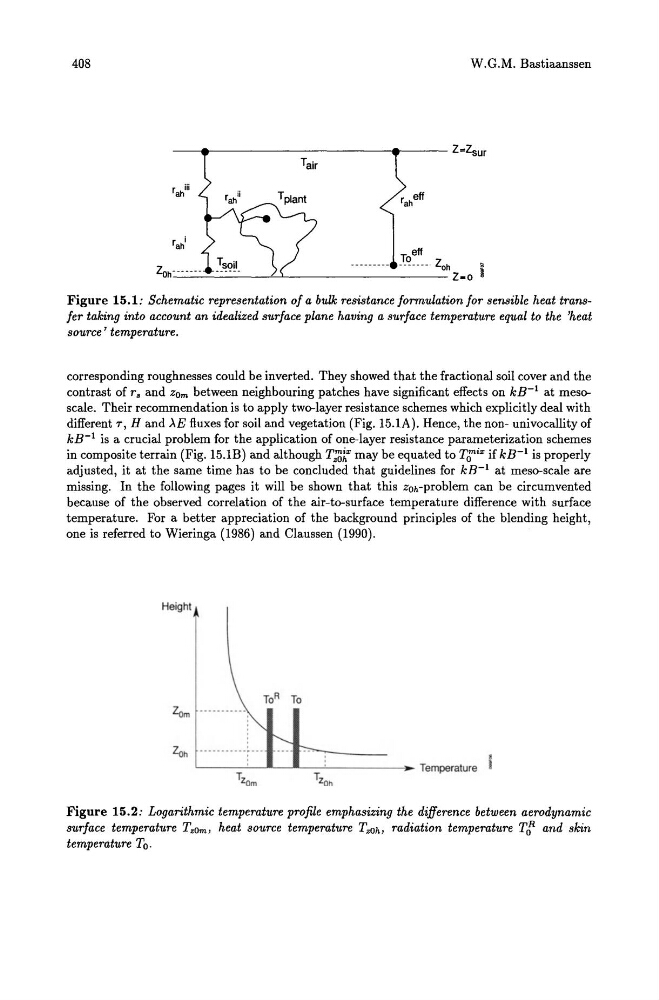
Figure 15.1: Schematic representation of a bulk resistance formulation for sensible heat transfer taking into account an idealized surface plane having a surface temperature equal to the 'heat
source' temperature.
corresponding roughnesses could be inverted. They showed that the fractional soil cover and the
contrast of r. and ZOrn between neighbouring patches have significant effects on kB- 1 at mesoscale. Their recommendation is to apply two-layer resistance schemes which explicitly deal with
different T, H and)"E fluxes for soil and vegetation (Fig. 15.1A). Hence, the non- univocallityof
kB- 1 is a crucial problem for the application of one-layer resistance parameterization schemes
in composite terrain (Fig. 15.1B) and although T;o~x may be equated to T(;'ix if kB- 1 is properly
adjusted, it at the same time has to be concluded that guidelines for kB- 1 at meso-scale are
missing. In the following pages it will be shown that this zOh-problem can be circumvented
because of the observed correlation of the air-to-surface temperature difference with surface
temperature. For a better appreciation of the background principles of the blending height,
one is referred to Wieringa (1986) and Claussen (1990).
Height
Zorn -----.----'---- ------'- ---- ---- - ' - - - -- -__ Temperature i
TZorn
TZoh
Figure 15.2: Logarithmic temperature profile emphasizing the difference between aerodynamic
surface temperature Tzom , heat source temperature TzOh , radiation temperature Tt' and skin
temperature To.
W.G.M. Bastiaanssen
-~e-------------.--- Z=Zsur
Tair
r elf
ah
li elf
.. 0. .... Zoh
-------~L------------Z=o
Figure 15.1: Schematic representation of a bulk resistance formulation for sensible heat transfer taking into account an idealized surface plane having a surface temperature equal to the 'heat
source' temperature.
corresponding roughnesses could be inverted. They showed that the fractional soil cover and the
contrast of r. and ZOrn between neighbouring patches have significant effects on kB- 1 at mesoscale. Their recommendation is to apply two-layer resistance schemes which explicitly deal with
different T, H and)"E fluxes for soil and vegetation (Fig. 15.1A). Hence, the non- univocallityof
kB- 1 is a crucial problem for the application of one-layer resistance parameterization schemes
in composite terrain (Fig. 15.1B) and although T;o~x may be equated to T(;'ix if kB- 1 is properly
adjusted, it at the same time has to be concluded that guidelines for kB- 1 at meso-scale are
missing. In the following pages it will be shown that this zOh-problem can be circumvented
because of the observed correlation of the air-to-surface temperature difference with surface
temperature. For a better appreciation of the background principles of the blending height,
one is referred to Wieringa (1986) and Claussen (1990).
Height
Zorn -----.----'---- ------'- ---- ---- - ' - - - -- -__ Temperature i
TZorn
TZoh
Figure 15.2: Logarithmic temperature profile emphasizing the difference between aerodynamic
surface temperature Tzom , heat source temperature TzOh , radiation temperature Tt' and skin
temperature To.