

Remote Sensing Parameterization of Meso-scale ...
407
with sparse canopies. Consequently, To measurements may have a 'mixed' character because
only the total radiance related to canopy temperature and bare soil temperature is measured.
In that case, a transfer equation being similar to Eq. (15.8) but applying to heterogeneous land
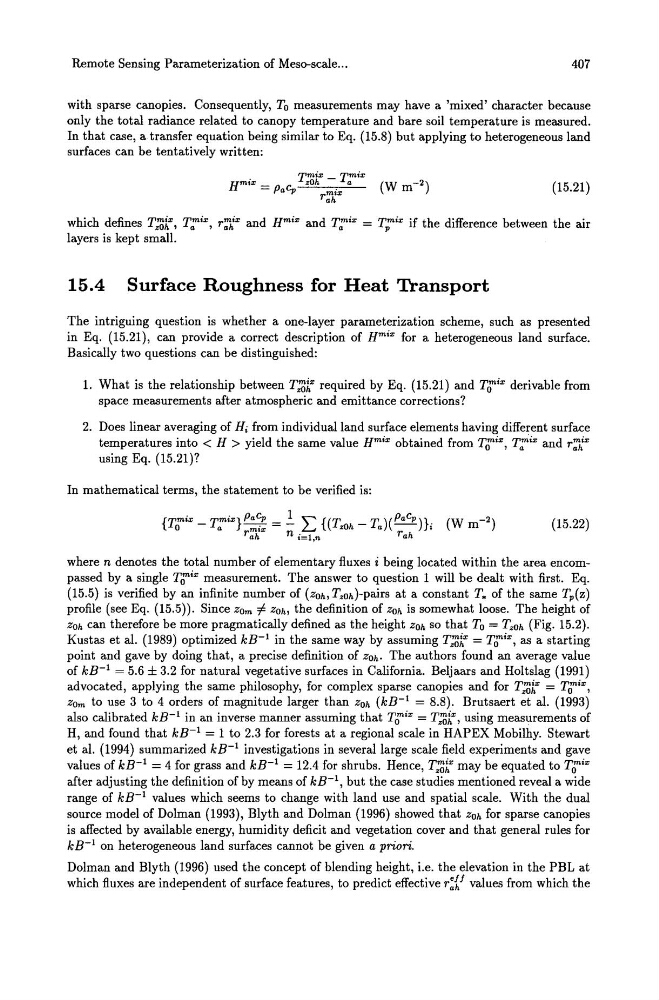
surfaces can be tentatively written:
(15.21 )
which defines T;o~x, T::ix, r;;';x and Hmix and T::ix = T;:ix if the difference between the air
layers is kept small.
15.4 Surface Roughness for Heat Transport
The intriguing question is whether a one-layer parameterization scheme, such as presented
in Eq. (15.21), can provide a correct description of Hmix for a heterogeneous land surface.
Basically two questions can be distinguished:
1. What is the relationship between T;o~x required by Eq. (15.21) and Toix derivable from
space measurements after atmospheric and emittance corrections?
2. Does linear averaging of Hi from individual land surface elements having different surface
temperatures into < H > yield the same value Hmix obtained from Toix, T::ix and r;;';x
using Eq. (15.21)?
In mathematical terms, the statement to be verified is:
{ T. mix _ Tmix}PaCp = .!.. "{(T _ T. )(Pa Cp )}.
o
a
mIx
L...J
zOh
a
,
Tah
n i=l,n
Tah
(15.22)
where n denotes the total number of elementary fluxes i being located within the area encompassed by a single Tomix measurement. The answer to question 1 will be dealt with first. Eq.
(15.5) is verified by an infinite number of (ZOh' TzOh)-pairs at a constant T. of the same Tp(z)
profile (see Eq. (15.5)). Since ZOm i- ZOh, the definition of ZOh is somewhat loose. The height of
ZOh can therefore be more pragmatically defined as the height ZOh so that To = T zOh (Fig. 15.2).
Kustas et al. (1989) optimized kB- 1 in the same way by assuming T;o~x = Toix, as a starting
point and gave by doing that, a precise definition of ZOh. The authors found an average value
of kB- 1 = 5.6 ± 3.2 for natural vegetative surfaces in California. Beljaars and Holtslag (1991)
advocated, applying the same philosophy, for complex sparse canopies and for T;o~x = TOix,
ZOm to use 3 to 4 orders of magnitude larger than ZOh (kB- 1 = 8.8). Brutsaert et al. (1993)
also calibrated kB- 1 in an inverse manner assuming that TOix = T;o~x, using measurements of
H, and found that kB- 1 = 1 to 2.3 for forests at a regional scale in HAPEX Mobilhy. Stewart
et al. (1994) summarized kB- 1 investigations in several large scale field experiments and gave
values of kB- 1 = 4 for grass and kB- 1 = 12.4 for shrubs. Hence, T;;;~x may be equated to Toix
after adjusting the definition of by means of kB- 1 , but the case studies mentioned reveal a wide
range of kB-l values which seems to change with land use and spatial scale. With the dual
source model of Dolman (1993), Blyth and Dolman (1996) showed that ZOh for sparse canopies
is affected by available energy, humidity deficit and vegetation cover and that general rules for
kB- 1 on heterogeneous land surfaces cannot be given a priori.
Dolman and Blyth (1996) used the concept of blending height, i.e. the elevation in the PBL at
which fluxes are independent of surface features, to predict effective r:{f values from which the
407
with sparse canopies. Consequently, To measurements may have a 'mixed' character because
only the total radiance related to canopy temperature and bare soil temperature is measured.
In that case, a transfer equation being similar to Eq. (15.8) but applying to heterogeneous land
surfaces can be tentatively written:
(15.21 )
which defines T;o~x, T::ix, r;;';x and Hmix and T::ix = T;:ix if the difference between the air
layers is kept small.
15.4 Surface Roughness for Heat Transport
The intriguing question is whether a one-layer parameterization scheme, such as presented
in Eq. (15.21), can provide a correct description of Hmix for a heterogeneous land surface.
Basically two questions can be distinguished:
1. What is the relationship between T;o~x required by Eq. (15.21) and Toix derivable from
space measurements after atmospheric and emittance corrections?
2. Does linear averaging of Hi from individual land surface elements having different surface
temperatures into < H > yield the same value Hmix obtained from Toix, T::ix and r;;';x
using Eq. (15.21)?
In mathematical terms, the statement to be verified is:
{ T. mix _ Tmix}PaCp = .!.. "{(T _ T. )(Pa Cp )}.
o
a
mIx
L...J
zOh
a
,
Tah
n i=l,n
Tah
(15.22)
where n denotes the total number of elementary fluxes i being located within the area encompassed by a single Tomix measurement. The answer to question 1 will be dealt with first. Eq.
(15.5) is verified by an infinite number of (ZOh' TzOh)-pairs at a constant T. of the same Tp(z)
profile (see Eq. (15.5)). Since ZOm i- ZOh, the definition of ZOh is somewhat loose. The height of
ZOh can therefore be more pragmatically defined as the height ZOh so that To = T zOh (Fig. 15.2).
Kustas et al. (1989) optimized kB- 1 in the same way by assuming T;o~x = Toix, as a starting
point and gave by doing that, a precise definition of ZOh. The authors found an average value
of kB- 1 = 5.6 ± 3.2 for natural vegetative surfaces in California. Beljaars and Holtslag (1991)
advocated, applying the same philosophy, for complex sparse canopies and for T;o~x = TOix,
ZOm to use 3 to 4 orders of magnitude larger than ZOh (kB- 1 = 8.8). Brutsaert et al. (1993)
also calibrated kB- 1 in an inverse manner assuming that TOix = T;o~x, using measurements of
H, and found that kB- 1 = 1 to 2.3 for forests at a regional scale in HAPEX Mobilhy. Stewart
et al. (1994) summarized kB- 1 investigations in several large scale field experiments and gave
values of kB- 1 = 4 for grass and kB- 1 = 12.4 for shrubs. Hence, T;;;~x may be equated to Toix
after adjusting the definition of by means of kB- 1 , but the case studies mentioned reveal a wide
range of kB-l values which seems to change with land use and spatial scale. With the dual
source model of Dolman (1993), Blyth and Dolman (1996) showed that ZOh for sparse canopies
is affected by available energy, humidity deficit and vegetation cover and that general rules for
kB- 1 on heterogeneous land surfaces cannot be given a priori.
Dolman and Blyth (1996) used the concept of blending height, i.e. the elevation in the PBL at
which fluxes are independent of surface features, to predict effective r:{f values from which the