

Remote Sensing of Soil Moisture
Frequency ( GHz~ 4. 5
18 Polarization: HH
Angle 01 Incidence a (Oeg r .. s~ 10
Bare Soil Data: II Fields with Different
12
Soil Types and Surface Roughnesses
'" 'C
\r -6
-12
-18
•
_.
.. .
.. •
0" IdBI - 0-14B m , -IS. ' 16
N - 181
P • 0.8S
.. Multiple Data Points
• 1974
• 1975
• 1977
-24 0L---'ZS ----'-SO----'-15---1..LOO---I..LZS,.------'-:1SO-'-::----'
Soi l Moisture Content 0' Top 5 cm Layer. m, '" of Field Capacityl
18 . - - - , -- - , - - - r - - . -- - r - - - . - - - ,
t2
.;; 0
:g
.
" ' 0
·12
-18
Vegetation o.t.
A Corn
8 Soybeans
C Milo
o Wheat
• Multi ple Data Points
"
0
Frequency (GHz~ 4. 5
Polarization: HH
Angle 01 Incidence 9 lDeg ree": 10
0" Id BI" 0. 133 m, - 13. 84
N • 143
P " 0.92
Soil Moisture Content 0' Top x m Layer, m, t'lo 0' Field Capacityl
389
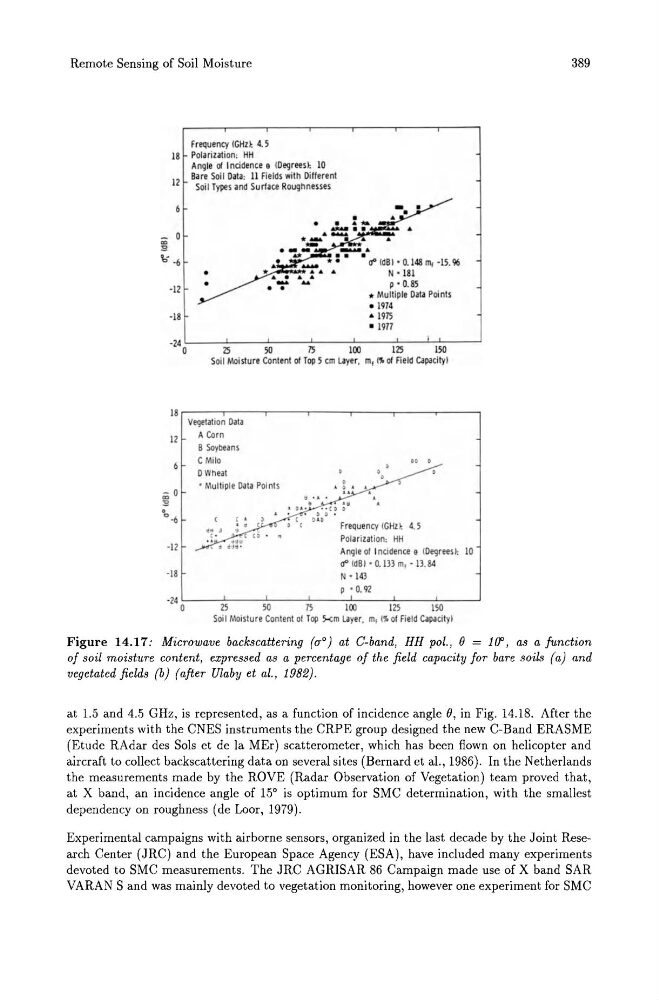
Figure 14.17: Microwave backscattering (UO) at C-band, HH po!., e = 1(J', as a function
of soil moisture content, expressed as a percentage of the field capacity for bare soils (a) and
vegetated fields (b) (after Ulaby et al., 1982) .
at 1.5 and 4.5 GHz, is represented, as a function of incidence angle e, in Fig. 14.18. After the
experiments with the CNES instruments the CRPE group designed the new C-Band ERASME
(Etude RAdar des Sols et de la MEr) scatterometer, which has been flown on helicopter and
aircraft to collect backscattering data on several sites (Bernard et a!., 1986). In the Netherlands
the measurements made by the ROVE (Radar Observation of Vegetation) team proved that,
at X band, an incidence angle of 15° is optimum for SMC determination, with the smallest
dependency on roughness (de Loor, 1979).
Experimental campaigns with airborne sensors, organized in the last decade by the Joint Research Center (JRC) and the European Space Agency (ESA), have included many experiments
devoted to SMC measurements. The JRC AGRISAR 86 Campaign made use of X band SAR
VARAN S and was mainly devoted to vegetation monitoring, however one experiment for SMC
Frequency ( GHz~ 4. 5
18 Polarization: HH
Angle 01 Incidence a (Oeg r .. s~ 10
Bare Soil Data: II Fields with Different
12
Soil Types and Surface Roughnesses
'" 'C
\r -6
-12
-18
•
_.
.. .
.. •
0" IdBI - 0-14B m , -IS. ' 16
N - 181
P • 0.8S
.. Multiple Data Points
• 1974
• 1975
• 1977
-24 0L---'ZS ----'-SO----'-15---1..LOO---I..LZS,.------'-:1SO-'-::----'
Soi l Moisture Content 0' Top 5 cm Layer. m, '" of Field Capacityl
18 . - - - , -- - , - - - r - - . -- - r - - - . - - - ,
t2
.;; 0
:g
.
" ' 0
·12
-18
Vegetation o.t.
A Corn
8 Soybeans
C Milo
o Wheat
• Multi ple Data Points
"
0
Frequency (GHz~ 4. 5
Polarization: HH
Angle 01 Incidence 9 lDeg ree": 10
0" Id BI" 0. 133 m, - 13. 84
N • 143
P " 0.92
Soil Moisture Content 0' Top x m Layer, m, t'lo 0' Field Capacityl
389
Figure 14.17: Microwave backscattering (UO) at C-band, HH po!., e = 1(J', as a function
of soil moisture content, expressed as a percentage of the field capacity for bare soils (a) and
vegetated fields (b) (after Ulaby et al., 1982) .
at 1.5 and 4.5 GHz, is represented, as a function of incidence angle e, in Fig. 14.18. After the
experiments with the CNES instruments the CRPE group designed the new C-Band ERASME
(Etude RAdar des Sols et de la MEr) scatterometer, which has been flown on helicopter and
aircraft to collect backscattering data on several sites (Bernard et a!., 1986). In the Netherlands
the measurements made by the ROVE (Radar Observation of Vegetation) team proved that,
at X band, an incidence angle of 15° is optimum for SMC determination, with the smallest
dependency on roughness (de Loor, 1979).
Experimental campaigns with airborne sensors, organized in the last decade by the Joint Research Center (JRC) and the European Space Agency (ESA), have included many experiments
devoted to SMC measurements. The JRC AGRISAR 86 Campaign made use of X band SAR
VARAN S and was mainly devoted to vegetation monitoring, however one experiment for SMC