

388
S. Paloscia
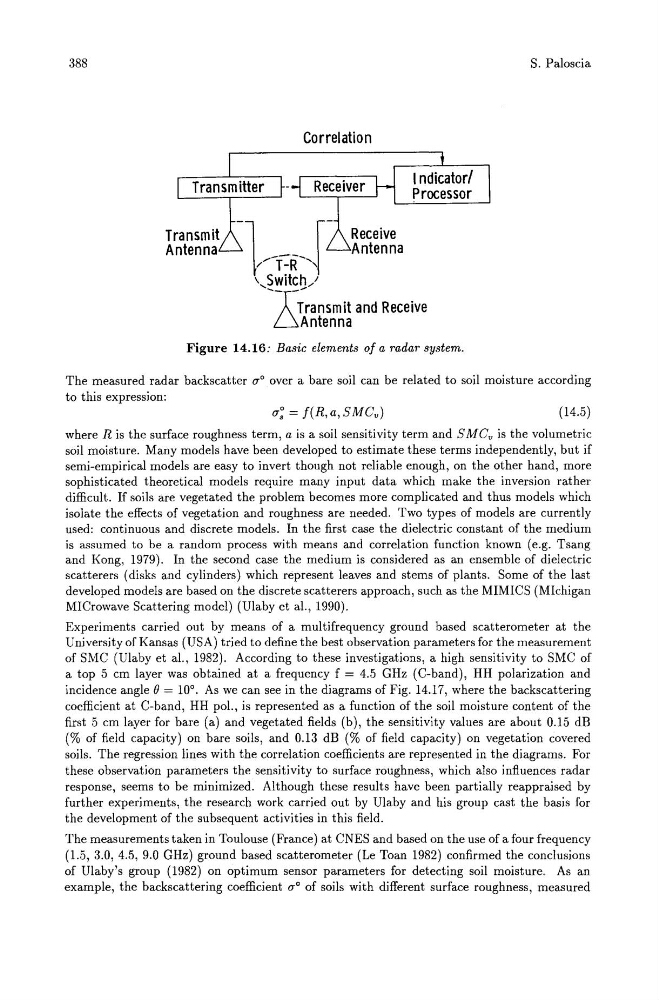
Correlation
Figure 14.16: Basic elements of a radar system.
The measured radar backscatter (TO over a bare soil can be related to soil moisture according
to this expression:
(T~ = f(R,a,SMCv )
(14.5)
where R is the surface roughness term, a is a soil sensitivity term and SMCv is the volumetric
soil moisture. Many models have been developed to estimate these terms independently, but if
semi-empirical models are easy to invert though not reliable enough, on the other hand, more
sophisticated theoretical models require many input data which make the inversion rather
difficult. If soils are vegetated the problem becomes more complicated and thus models which
isolate the effects of vegetation and roughness are needed. Two types of models are currently
used: continuous and discrete models. In the first case the dielectric constant of the medium
is assumed to be a random process with means and correlation function known (e.g. Tsang
and Kong, 1979). In the second case the medium is considered as an ensemble of dielectric
scatterers (disks and cylinders) which represent leaves and stems of plants. Some of the last
developed models are based on the discrete scatterers approach, such as the MIMICS (Michigan
MICrowave Scattering model) (Ulaby et aL, 1990).
Experiments carried out by means of a multifrequency ground based scatterometer at the
University of Kansas (USA) tried to define the best observation parameters for the measurement
of SMC (Ulaby et aL, 1982). According to these investigations, a high sensitivity to SMC of
a top 5 cm layer was obtained at a frequency f = 4.5 GHz (C-band), HH polarization and
incidence angle (j = 10 0 • As we can see in the diagrams of Fig. 14.17, where the backscattering
coefficient at C-band, HH poL, is represented as a function of the soil moisture content of the
first 5 cm layer for bare (a) and vegetated fields (b), the sensitivity values are about 0.15 dB
(% of field capacity) on bare soils, and 0.13 dB (% of field capacity) on vegetation covered
soils. The regression lines with the correlation coefficients are represented in the diagrams. For
these observation parameters the sensitivity to surface roughness, which also influences radar
response, seems to be minimized. Although these results have been partially reappraised by
further experiments, the research work carried out by Ulaby and his group cast the basis for
the development of the subsequent activities in this field.
The measurements taken in Toulouse (France) at CNES and based on the use of a four frequency
(1.5, 3.0, 4.5, 9.0 GHz) ground based scatterometer (Le Toan 1982) confirmed the conclusions
of Ulaby's group (1982) on optimum sensor parameters for detecting soil moisture. As an
example, the backscattering coefficient (To of soils with different surface roughness, measured
S. Paloscia
Correlation
Figure 14.16: Basic elements of a radar system.
The measured radar backscatter (TO over a bare soil can be related to soil moisture according
to this expression:
(T~ = f(R,a,SMCv )
(14.5)
where R is the surface roughness term, a is a soil sensitivity term and SMCv is the volumetric
soil moisture. Many models have been developed to estimate these terms independently, but if
semi-empirical models are easy to invert though not reliable enough, on the other hand, more
sophisticated theoretical models require many input data which make the inversion rather
difficult. If soils are vegetated the problem becomes more complicated and thus models which
isolate the effects of vegetation and roughness are needed. Two types of models are currently
used: continuous and discrete models. In the first case the dielectric constant of the medium
is assumed to be a random process with means and correlation function known (e.g. Tsang
and Kong, 1979). In the second case the medium is considered as an ensemble of dielectric
scatterers (disks and cylinders) which represent leaves and stems of plants. Some of the last
developed models are based on the discrete scatterers approach, such as the MIMICS (Michigan
MICrowave Scattering model) (Ulaby et aL, 1990).
Experiments carried out by means of a multifrequency ground based scatterometer at the
University of Kansas (USA) tried to define the best observation parameters for the measurement
of SMC (Ulaby et aL, 1982). According to these investigations, a high sensitivity to SMC of
a top 5 cm layer was obtained at a frequency f = 4.5 GHz (C-band), HH polarization and
incidence angle (j = 10 0 • As we can see in the diagrams of Fig. 14.17, where the backscattering
coefficient at C-band, HH poL, is represented as a function of the soil moisture content of the
first 5 cm layer for bare (a) and vegetated fields (b), the sensitivity values are about 0.15 dB
(% of field capacity) on bare soils, and 0.13 dB (% of field capacity) on vegetation covered
soils. The regression lines with the correlation coefficients are represented in the diagrams. For
these observation parameters the sensitivity to surface roughness, which also influences radar
response, seems to be minimized. Although these results have been partially reappraised by
further experiments, the research work carried out by Ulaby and his group cast the basis for
the development of the subsequent activities in this field.
The measurements taken in Toulouse (France) at CNES and based on the use of a four frequency
(1.5, 3.0, 4.5, 9.0 GHz) ground based scatterometer (Le Toan 1982) confirmed the conclusions
of Ulaby's group (1982) on optimum sensor parameters for detecting soil moisture. As an
example, the backscattering coefficient (To of soils with different surface roughness, measured