

386
S. Paloscia
radiative transfer theory, Pampaloni and Paloscia (1986) established a semi-empirical relation
between the optical depth of vegetation and the plant water content per unit area. The same
authors pointed out that the normalized difference between vertical and horizontal polarization
components (Polarization Index), of X band (10 GHz) emission, can be correlated to leaf area
index (Pampaloni and Paloscia, 1985; Paloscia and Pampaloni, 1988; Paloscia and Pampaloni,
1992). Emission and scatter spectra, from L to X band, of several vegetated canopies, have
been obtained by a team at the University of Bern, by means of a ground based sensor (Huppi
et al., 1986).
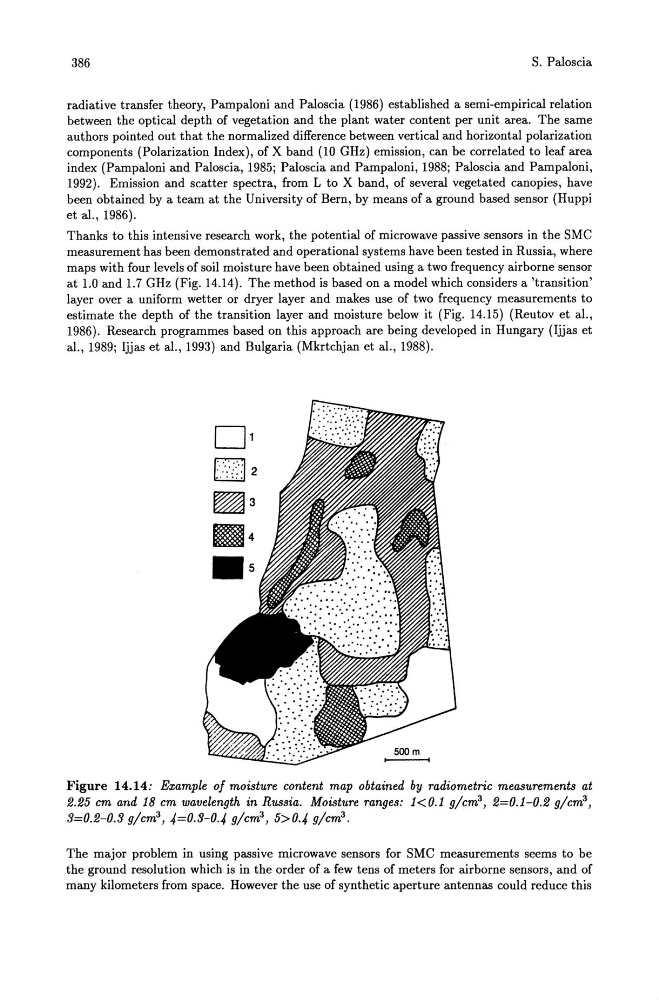
Thanks to this intensive research work, the potential of microwave passive sensors in the SMC
measurement has been demonstrated and operational systems have been tested in Russia, where
maps with four levels of soil moisture have been obtained using a two frequency airborne sensor
at 1.0 and 1.7 GHz (Fig. 14.14). The method is based on a model which considers a 'transition'
layer over a uniform wetter or dryer layer and makes use of two frequency measurements to
estimate the depth of the transition layer and moisture below it (Fig. 14.15) (Reutov et aI.,
1986). Research programmes based on this approach are being developed in Hungary (Ijjas et
aI., 1989; Ijjas et aI., 1993) and Bulgaria (Mkrtchjan et aI., 1988).
0 1
[]2
~3
1114
1115
500 m
I--------<
Figure 14.14: Example of moisture content map obtained by radiometric measurements at
2.25 cm and 18 cm wavelength in Russia. Moisture ranges: 1<0.1 g/cm 3 , 2=0.1-0.2 g/cm 3 ,
3=0.2-0.3 g/cm 3 , 4=0.3-0.4 g/cm 3 , 5>0.4 g/cm 3 •
The major problem in using passive microwave sensors for SMC measurements seems to be
the ground resolution which is in the order of a few tens of meters for airborne sensors, and of
many kilometers from space. However the use of synthetic aperture antennas could reduce this
S. Paloscia
radiative transfer theory, Pampaloni and Paloscia (1986) established a semi-empirical relation
between the optical depth of vegetation and the plant water content per unit area. The same
authors pointed out that the normalized difference between vertical and horizontal polarization
components (Polarization Index), of X band (10 GHz) emission, can be correlated to leaf area
index (Pampaloni and Paloscia, 1985; Paloscia and Pampaloni, 1988; Paloscia and Pampaloni,
1992). Emission and scatter spectra, from L to X band, of several vegetated canopies, have
been obtained by a team at the University of Bern, by means of a ground based sensor (Huppi
et al., 1986).
Thanks to this intensive research work, the potential of microwave passive sensors in the SMC
measurement has been demonstrated and operational systems have been tested in Russia, where
maps with four levels of soil moisture have been obtained using a two frequency airborne sensor
at 1.0 and 1.7 GHz (Fig. 14.14). The method is based on a model which considers a 'transition'
layer over a uniform wetter or dryer layer and makes use of two frequency measurements to
estimate the depth of the transition layer and moisture below it (Fig. 14.15) (Reutov et aI.,
1986). Research programmes based on this approach are being developed in Hungary (Ijjas et
aI., 1989; Ijjas et aI., 1993) and Bulgaria (Mkrtchjan et aI., 1988).
0 1
[]2
~3
1114
1115
500 m
I--------<
Figure 14.14: Example of moisture content map obtained by radiometric measurements at
2.25 cm and 18 cm wavelength in Russia. Moisture ranges: 1<0.1 g/cm 3 , 2=0.1-0.2 g/cm 3 ,
3=0.2-0.3 g/cm 3 , 4=0.3-0.4 g/cm 3 , 5>0.4 g/cm 3 •
The major problem in using passive microwave sensors for SMC measurements seems to be
the ground resolution which is in the order of a few tens of meters for airborne sensors, and of
many kilometers from space. However the use of synthetic aperture antennas could reduce this