

Remote Sensing of Soil Moisture
385
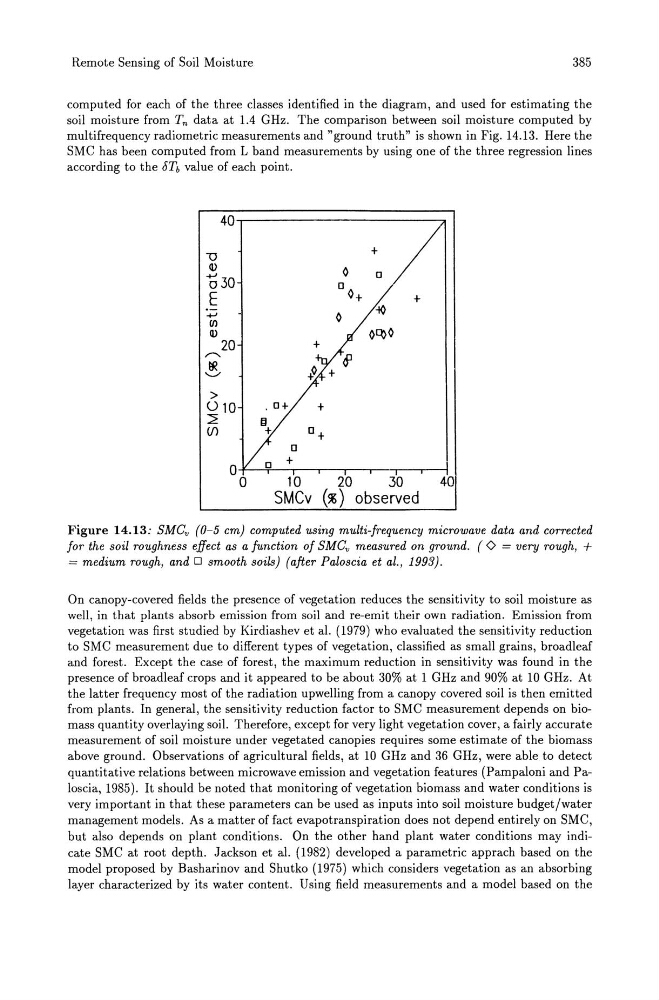
computed for each of the three classes identified in the diagram, and used for estimating the
soil moisture from Tn data at 1.4 GHz. The comparison between soil moisture computed by
multifrequency radiometric measurements and "ground truth" is shown in Fig. 14.13. Here the
SMC has been computed from L band measurements by using one of the three regression lines
according to the oTb value of each point.
40
"0
+
/
Q)
0
'030
°
E
° 0+
+
+'
¢
~
rJl
Q)
O~O
20
+
r--..
OJ
IR
+0
'-"
+
>
010
. 0+
+
L
1:1
(f)
+
0+
o
o +
I
O+-~-'~-'--~'I-'~
a
10
20
30
40
SMCv (%) observed
Figure 14.13: SMGv (0-5 cm) computed using multi-frequency microwave data and corrected
for the soil roughness effect as a function of SMGv measured on ground. (0 = very rough, +
= medium rough, and 0 smooth soils) (after Paloscia et al., 1993).
On canopy-covered fields the presence of vegetation reduces the sensitivity to soil moisture as
well, in that plants absorb emission from soil and re-emit their own radiation. Emission from
vegetation was first studied by Kirdiashev et al. (1979) who evaluated the sensitivity reduction
to SMC measurement due to different types of vegetation, classified as small grains, broadleaf
and forest. Except the case of forest, the maximum reduction in sensitivity was found in the
presence of broadleaf crops and it appeared to be about 30% at 1 GHz and 90% at 10 GHz. At
the latter frequency most of the radiation upwelling from a canopy covered soil is then emitted
from plants. In general, the sensitivity reduction factor to SMC measurement depends on biomass quantity overlaying soil. Therefore, except for very light vegetation cover, a fairly accurate
measurement of soil moisture under vegetated canopies requires some estimate of the biomass
above ground. Observations of agricultural fields, at 10 GHz and 36 GHz, were able to detect
quantitative relations between microwave emission and vegetation features (Pampaloni and Paloscia, 1985). It should be noted that monitoring of vegetation biomass and water conditions is
very important in that these parameters can be used as inputs into soil moisture budget/water
management models. As a matter of fact evapotranspiration does not depend entirely on SMC,
but also depends on plant conditions. On the other hand plant water conditions may indicate SMC at root depth. Jackson et al. (1982) developed a parametric apprach based on the
model proposed by Basharinov and Shutko (1975) which considers vegetation as an absorbing
layer characterized by its water content. Using field measurements and a model based on the
385
computed for each of the three classes identified in the diagram, and used for estimating the
soil moisture from Tn data at 1.4 GHz. The comparison between soil moisture computed by
multifrequency radiometric measurements and "ground truth" is shown in Fig. 14.13. Here the
SMC has been computed from L band measurements by using one of the three regression lines
according to the oTb value of each point.
40
"0
+
/
Q)
0
'030
°
E
° 0+
+
+'
¢
~
rJl
Q)
O~O
20
+
r--..
OJ
IR
+0
'-"
+
>
010
. 0+
+
L
1:1
(f)
+
0+
o
o +
I
O+-~-'~-'--~'I-'~
a
10
20
30
40
SMCv (%) observed
Figure 14.13: SMGv (0-5 cm) computed using multi-frequency microwave data and corrected
for the soil roughness effect as a function of SMGv measured on ground. (0 = very rough, +
= medium rough, and 0 smooth soils) (after Paloscia et al., 1993).
On canopy-covered fields the presence of vegetation reduces the sensitivity to soil moisture as
well, in that plants absorb emission from soil and re-emit their own radiation. Emission from
vegetation was first studied by Kirdiashev et al. (1979) who evaluated the sensitivity reduction
to SMC measurement due to different types of vegetation, classified as small grains, broadleaf
and forest. Except the case of forest, the maximum reduction in sensitivity was found in the
presence of broadleaf crops and it appeared to be about 30% at 1 GHz and 90% at 10 GHz. At
the latter frequency most of the radiation upwelling from a canopy covered soil is then emitted
from plants. In general, the sensitivity reduction factor to SMC measurement depends on biomass quantity overlaying soil. Therefore, except for very light vegetation cover, a fairly accurate
measurement of soil moisture under vegetated canopies requires some estimate of the biomass
above ground. Observations of agricultural fields, at 10 GHz and 36 GHz, were able to detect
quantitative relations between microwave emission and vegetation features (Pampaloni and Paloscia, 1985). It should be noted that monitoring of vegetation biomass and water conditions is
very important in that these parameters can be used as inputs into soil moisture budget/water
management models. As a matter of fact evapotranspiration does not depend entirely on SMC,
but also depends on plant conditions. On the other hand plant water conditions may indicate SMC at root depth. Jackson et al. (1982) developed a parametric apprach based on the
model proposed by Basharinov and Shutko (1975) which considers vegetation as an absorbing
layer characterized by its water content. Using field measurements and a model based on the