

358
Eugene E. Clothiaux, Thomas P. Ackerman, David M. Babb
well-behaved because the total optical depths at the two frequencies have different dependencies
on the water vapor and cloud liquid water column amounts. Furthermore, the retrieved WV P
and LW P are not seriously affected by the presence of ice particles in the atmosphere since ice
water is not radiatively active at these two wavelengths.
Cloud Liquid and Ice Water Content from Radar Reflectivity
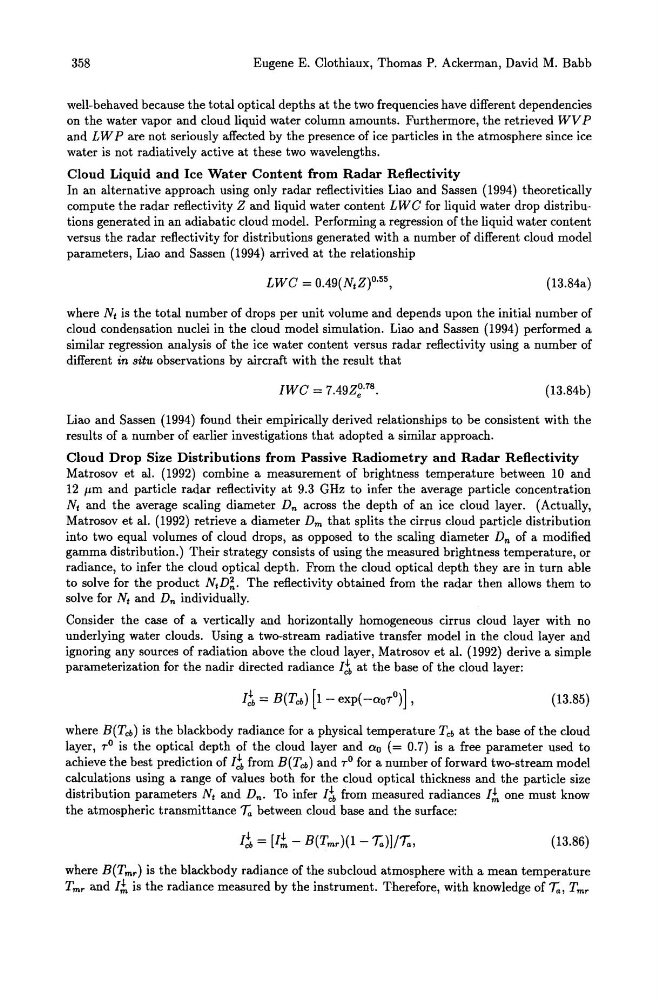
In an alternative approach using only radar reflectivities Liao and Sassen (1994) theoretically
compute the radar reflectivity Z and liquid water content LWC for liquid water drop distributions generated in an adiabatic cloud model. Performing a regression of the liquid water content
versus the radar reflectivity for distributions generated with a number of different cloud model
parameters, Liao and Sassen (1994) arrived at the relationship
(13.84a)
where Nt is the total number of drops per unit volume and depends upon the initial number of
cloud condensation nuclei in the cloud model simulation. Liao and Sassen (1994) performed a
similar regression analysis of the ice water content versus radar reflectivity using a number of
different in situ observations by aircraft with the result that
(13.84b)
Liao and Sassen (1994) found their empirically derived relationships to be consistent with the
results of a number of earlier investigations that adopted a similar approach.
Cloud Drop Size Distributions from Passive Radiometry and Radar Reflectivity
Matrosov et al. (1992) combine a measurement of brightness temperature between 10 and
12 Ilm and particle radar reflectivity at 9.3 GHz to infer the average particle concentration
Nt and the average scaling diameter Dn across the depth of an ice cloud layer. (Actually,
Matrosov et al. (1992) retrieve a diameter Dm that splits the cirrus cloud particle distribution
into two equal volumes of cloud drops, as opposed to the scaling diameter Dn of a modified
gamma distribution.) Their strategy consists of using the measured brightness temperature, or
radiance, to infer the cloud optical depth. From the cloud optical depth they are in turn able
to solve for the product NtD~. The reflectivity obtained from the radar then allows them to
solve for Nt and Dn individually.
Consider the case of a vertically and horizontally homogeneous cirrus cloud layer with no
underlying water clouds. Using a two-stream radiative transfer model in the cloud layer and
ignoring any sources of radiation above the cloud layer, Matrosov et al. (1992) derive a simple
parameterization for the nadir directed radiance I: b at the base of the cloud layer:
(13.85)
where B(Tcb) is the blackbody radiance for a physical temperature Tcb at the base ofthe cloud
layer, TO is the optical depth of the cloud layer and ao (= 0.7) is a free parameter used to
achieve the best prediction of I: b from B(Tcb) and TO for a number of forward two-stream model
calculations using a range of values both for the cloud optical thickness and the particle size
distribution parameters Nt and Dn. To infer I: b from measured radiances I;' one must know
the atmospheric transmittance 7. between cloud base and the surface:
(13.86)
where B(T mr) is the blackbody radiance of the sub cloud atmosphere with a mean temperature
Tmr and I;' is the radiance measured by the instrument. Therefore, with knowledge of 7., Tmr
Eugene E. Clothiaux, Thomas P. Ackerman, David M. Babb
well-behaved because the total optical depths at the two frequencies have different dependencies
on the water vapor and cloud liquid water column amounts. Furthermore, the retrieved WV P
and LW P are not seriously affected by the presence of ice particles in the atmosphere since ice
water is not radiatively active at these two wavelengths.
Cloud Liquid and Ice Water Content from Radar Reflectivity
In an alternative approach using only radar reflectivities Liao and Sassen (1994) theoretically
compute the radar reflectivity Z and liquid water content LWC for liquid water drop distributions generated in an adiabatic cloud model. Performing a regression of the liquid water content
versus the radar reflectivity for distributions generated with a number of different cloud model
parameters, Liao and Sassen (1994) arrived at the relationship
(13.84a)
where Nt is the total number of drops per unit volume and depends upon the initial number of
cloud condensation nuclei in the cloud model simulation. Liao and Sassen (1994) performed a
similar regression analysis of the ice water content versus radar reflectivity using a number of
different in situ observations by aircraft with the result that
(13.84b)
Liao and Sassen (1994) found their empirically derived relationships to be consistent with the
results of a number of earlier investigations that adopted a similar approach.
Cloud Drop Size Distributions from Passive Radiometry and Radar Reflectivity
Matrosov et al. (1992) combine a measurement of brightness temperature between 10 and
12 Ilm and particle radar reflectivity at 9.3 GHz to infer the average particle concentration
Nt and the average scaling diameter Dn across the depth of an ice cloud layer. (Actually,
Matrosov et al. (1992) retrieve a diameter Dm that splits the cirrus cloud particle distribution
into two equal volumes of cloud drops, as opposed to the scaling diameter Dn of a modified
gamma distribution.) Their strategy consists of using the measured brightness temperature, or
radiance, to infer the cloud optical depth. From the cloud optical depth they are in turn able
to solve for the product NtD~. The reflectivity obtained from the radar then allows them to
solve for Nt and Dn individually.
Consider the case of a vertically and horizontally homogeneous cirrus cloud layer with no
underlying water clouds. Using a two-stream radiative transfer model in the cloud layer and
ignoring any sources of radiation above the cloud layer, Matrosov et al. (1992) derive a simple
parameterization for the nadir directed radiance I: b at the base of the cloud layer:
(13.85)
where B(Tcb) is the blackbody radiance for a physical temperature Tcb at the base ofthe cloud
layer, TO is the optical depth of the cloud layer and ao (= 0.7) is a free parameter used to
achieve the best prediction of I: b from B(Tcb) and TO for a number of forward two-stream model
calculations using a range of values both for the cloud optical thickness and the particle size
distribution parameters Nt and Dn. To infer I: b from measured radiances I;' one must know
the atmospheric transmittance 7. between cloud base and the surface:
(13.86)
where B(T mr) is the blackbody radiance of the sub cloud atmosphere with a mean temperature
Tmr and I;' is the radiance measured by the instrument. Therefore, with knowledge of 7., Tmr