

Ground-Based Remote Sensing of Cloud Properties ...
359
and Tcb, which can be estimated from radiosonde profiles, the measured radiance If,. can be
inverted to optical thickness TO.
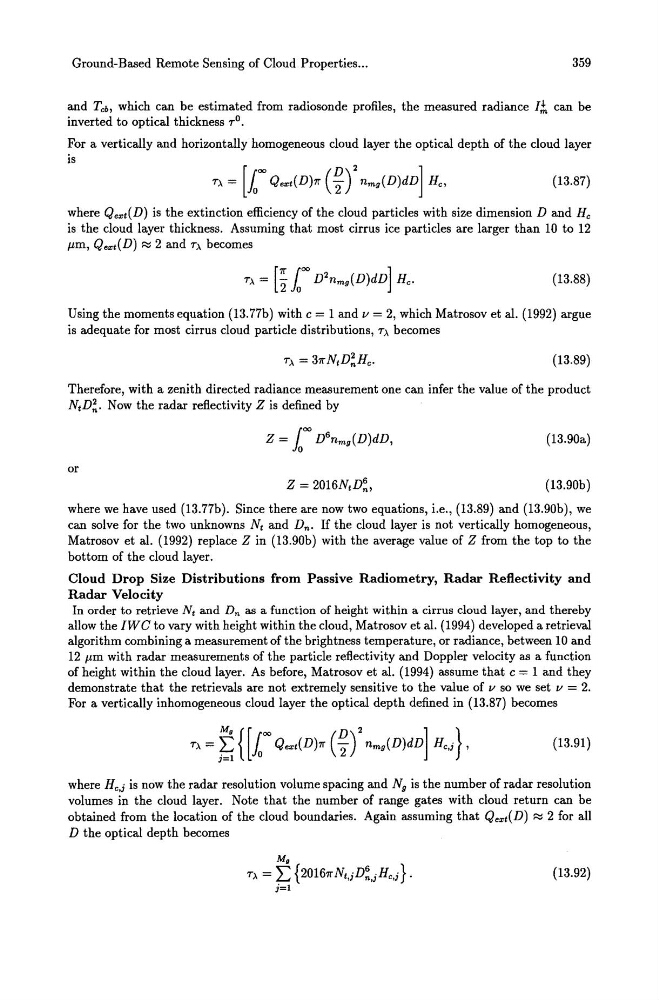
For a vertically and horizontally homogeneous cloud layer the optical depth of the cloud layer
is
(13.87)
where Qext(D) is the extinction efficiency of the cloud particles with size dimension D and He
is the cloud layer thickness. Assuming that most cirrus ice particles are larger than 10 to 12
pm, Qext(D) r:::! 2 and T). becomes
(13.88)
Using the moments equation (13. 77b) with c = 1 and 1/ = 2, which Matrosov et al. (1992) argue
is adequate for most cirrus cloud particle distributions, T). becomes
(13.89)
Therefore, with a zenith directed radiance measurement one can infer the value of the product
NtD~. Now the radar reflectivity Z is defined by
(13.90a)
or
(13.90b)
where we have used (13.77b). Since there are now two equations, i.e., (13.89) and (13.90b), we
can solve for the two unknowns Nt and Dn. If the cloud layer is not vertically homogeneous,
Matrosov et al. (1992) replace Z in (13.90b) with the average value of Z from the top to the
bottom of the cloud layer.
Cloud Drop Size Distributions from Passive Radiometry, Radar Reflectivity and
Radar Velocity
In order to retrieve Nt and Dn as a function of height within a cirrus cloud layer, and thereby
allow the IWC to vary with height within the cloud, Matrosov et al. (1994) developed a retrieval
algorithm combining a measurement of the brightness temperature, or radiance, between 10 and
12 pm with radar measurements of the particle reflectivity and Doppler velocity as a function
of height within the cloud layer. As before, Matrosov et al. (1994) assume that c = 1 and they
demonstrate that the retrievals are not extremely sensitive to the value of 1/ so we set 1/ = 2.
For a vertically inhomogeneous cloud layer the optical depth defined in (13.87) becomes
(13.91 )
where He,j is now the radar resolution volume spacing and Ng is the number of radar resolution
volumes in the cloud layer. Note that the number of range gates with cloud return can be
obtained from the location of the cloud boundaries. Again assuming that Qext(D) r:::! 2 for all
D the optical depth becomes
M.
T). = L{20167rNt,jD~,jHe,j}.
(13.92)
j=l
359
and Tcb, which can be estimated from radiosonde profiles, the measured radiance If,. can be
inverted to optical thickness TO.
For a vertically and horizontally homogeneous cloud layer the optical depth of the cloud layer
is
(13.87)
where Qext(D) is the extinction efficiency of the cloud particles with size dimension D and He
is the cloud layer thickness. Assuming that most cirrus ice particles are larger than 10 to 12
pm, Qext(D) r:::! 2 and T). becomes
(13.88)
Using the moments equation (13. 77b) with c = 1 and 1/ = 2, which Matrosov et al. (1992) argue
is adequate for most cirrus cloud particle distributions, T). becomes
(13.89)
Therefore, with a zenith directed radiance measurement one can infer the value of the product
NtD~. Now the radar reflectivity Z is defined by
(13.90a)
or
(13.90b)
where we have used (13.77b). Since there are now two equations, i.e., (13.89) and (13.90b), we
can solve for the two unknowns Nt and Dn. If the cloud layer is not vertically homogeneous,
Matrosov et al. (1992) replace Z in (13.90b) with the average value of Z from the top to the
bottom of the cloud layer.
Cloud Drop Size Distributions from Passive Radiometry, Radar Reflectivity and
Radar Velocity
In order to retrieve Nt and Dn as a function of height within a cirrus cloud layer, and thereby
allow the IWC to vary with height within the cloud, Matrosov et al. (1994) developed a retrieval
algorithm combining a measurement of the brightness temperature, or radiance, between 10 and
12 pm with radar measurements of the particle reflectivity and Doppler velocity as a function
of height within the cloud layer. As before, Matrosov et al. (1994) assume that c = 1 and they
demonstrate that the retrievals are not extremely sensitive to the value of 1/ so we set 1/ = 2.
For a vertically inhomogeneous cloud layer the optical depth defined in (13.87) becomes
(13.91 )
where He,j is now the radar resolution volume spacing and Ng is the number of radar resolution
volumes in the cloud layer. Note that the number of range gates with cloud return can be
obtained from the location of the cloud boundaries. Again assuming that Qext(D) r:::! 2 for all
D the optical depth becomes
M.
T). = L{20167rNt,jD~,jHe,j}.
(13.92)
j=l