

Ground-Based Remote Sensing of Cloud Properties ...
357
0.50
Q)
u
•
s:: 0.40r•
-
Q)
H
H
::J
u
u 0.30 -
-
0
4-<
0
Q)
-
01
III
.w
•
s:: Q)
u
H
Q)
0.10 -
-
Po<
•
0.00
•
0
1
2
3
4
5
Number of Cloud Layers
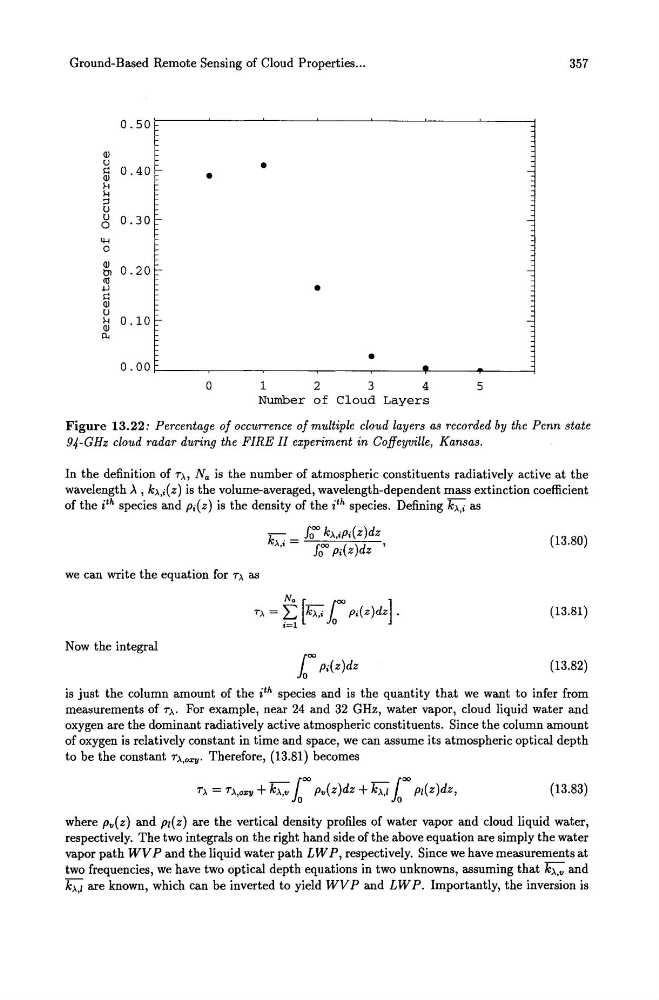
Figure 13.22: Percentage of occurrence of multiple cloud layers as recorded by the Penn state
94-GHz cloud radar during the FIRE II experiment in Coffeyville, Kansas.
In the definition of TA, Na is the number of atmospheric constituents radiatively active at the
wavelength oX, kA,i(Z) is the volume-averaged, wavelength-dependent mass extinction coefficient
of the itk species and Pi( z) is the density of the itk species. Defining kA,i as
we can write the equation for TA as
r _ 10
00
kA,iPi(Z)dz
A,. -
roo.()d '
Jo p. Z Z
T>. = ~ [k>"i 1
00 Pi(z)dz] .
.=1
0
Now the integral
1
00 pi(z)dz
(13.80)
(13.81 )
(13.82)
is just the column amount of the ith species and is the quantity that we want to infer from
measurements of TA• For example, near 24 and 32 GHz, water vapor, cloud liquid water and
oxygen are the dominant radiatively active atmospheric constituents. Since the column amount
of oxygen is relatively constant in time and space, we can assume its atmospheric optical depth
to be the constant TA,oxy' Therefore, (13.81) becomes
T>. = T>.,oxy + kA,,, 1
00 p,,(z)dz + kA,1 1
00 Pl(z)dz,
(13.83)
where p,,(z) and Pl(Z) are the vertical density profiles of water vapor and cloud liquid water,
respectively. The two integrals on the right hand side of the above equation are simply the water
vapor path WV P and the liquid water path LW P, respectively. Since we have measurements at
two frequencies, we have two optical depth equations in two unknowns, assuming that k>.,,, and
k>.,l are known, which can be inverted to yield WVP and LWP. Importantly, the inversion is
357
0.50
Q)
u
•
s:: 0.40r•
-
Q)
H
H
::J
u
u 0.30 -
-
0
4-<
0
Q)
-
01
III
.w
•
s:: Q)
u
H
Q)
0.10 -
-
Po<
•
0.00
•
0
1
2
3
4
5
Number of Cloud Layers
Figure 13.22: Percentage of occurrence of multiple cloud layers as recorded by the Penn state
94-GHz cloud radar during the FIRE II experiment in Coffeyville, Kansas.
In the definition of TA, Na is the number of atmospheric constituents radiatively active at the
wavelength oX, kA,i(Z) is the volume-averaged, wavelength-dependent mass extinction coefficient
of the itk species and Pi( z) is the density of the itk species. Defining kA,i as
we can write the equation for TA as
r _ 10
00
kA,iPi(Z)dz
A,. -
roo.()d '
Jo p. Z Z
T>. = ~ [k>"i 1
00 Pi(z)dz] .
.=1
0
Now the integral
1
00 pi(z)dz
(13.80)
(13.81 )
(13.82)
is just the column amount of the ith species and is the quantity that we want to infer from
measurements of TA• For example, near 24 and 32 GHz, water vapor, cloud liquid water and
oxygen are the dominant radiatively active atmospheric constituents. Since the column amount
of oxygen is relatively constant in time and space, we can assume its atmospheric optical depth
to be the constant TA,oxy' Therefore, (13.81) becomes
T>. = T>.,oxy + kA,,, 1
00 p,,(z)dz + kA,1 1
00 Pl(z)dz,
(13.83)
where p,,(z) and Pl(Z) are the vertical density profiles of water vapor and cloud liquid water,
respectively. The two integrals on the right hand side of the above equation are simply the water
vapor path WV P and the liquid water path LW P, respectively. Since we have measurements at
two frequencies, we have two optical depth equations in two unknowns, assuming that k>.,,, and
k>.,l are known, which can be inverted to yield WVP and LWP. Importantly, the inversion is