

346
Eugene E. Clothiaux, Thomas P. Ackerman, David M. Babb
P =1 N=l,2,5,10,20,35
2.5
I::l
0
2.0
'M
.w
u
I::l
;::I
Ii<
>t 1.5
.w
'M
Ul
I::l
Q)
~
>t 1.0
.w
'M
.-I
'M
..Q
III
..Q
0
""'
p., 0.5
0.0
0 .. 5
1.0
1.5
2.0
Power (Arbitrary Units)
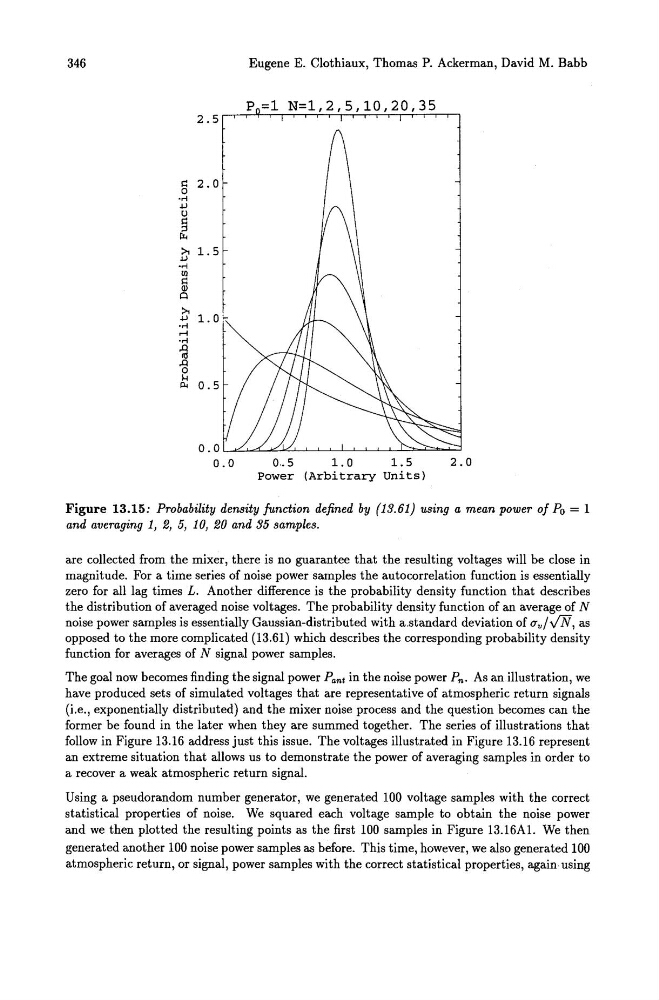
Figure 13.15: Probability density function defined by (19.61) using a mean power of Po = 1
and averaging 1, 2, 5, 10, 20 and 95 samples.
are collected from the mixer, there is no guarantee that the resulting voltages will be close in
magnitude. For a time series of noise power samples the autocorrelation function is essentially
zero for all lag times L. Another difference is the probability density function that describes
the distribution of averaged noise voltages. The probability density function of an average of N
noise power samples is essentially Gaussian-distributed with a.standard deviation of O"v/../N, as
opposed to the more complicated (13.61) which describes the corresponding probability density
function for averages of N signal power samples.
The goal now becomes finding the signal power Pant in the noise power Pn. As an illustration, we
have produced sets of simulated voltages that are representative of atmospheric return signals
(Le., exponentially distributed) and the mixer noise process and the question becomes can the
former be found in the later when they are summed together. The series of illustrations that
follow in Figure 13.16 address just this issue. The voltages illustrated in Figure 13.16 represent
an extreme situation that allows us to demonstrate the power of averaging samples in order to
a recover a weak atmospheric return signal.
Using a pseudorandom number generator, we generated 100 voltage samples with the correct
statistical properties of noise. We squared each voltage sample to obtain the noise power
and we then plotted the resulting points as the first 100 samples in Figure 13.16Al. We then
generated another 100 noise power samples as before. This time, however, we also generated 100
atmospheric return, or signal, power samples with the correct statistical properties, again using
Eugene E. Clothiaux, Thomas P. Ackerman, David M. Babb
P =1 N=l,2,5,10,20,35
2.5
I::l
0
2.0
'M
.w
u
I::l
;::I
Ii<
>t 1.5
.w
'M
Ul
I::l
Q)
~
>t 1.0
.w
'M
.-I
'M
..Q
III
..Q
0
""'
p., 0.5
0.0
0 .. 5
1.0
1.5
2.0
Power (Arbitrary Units)
Figure 13.15: Probability density function defined by (19.61) using a mean power of Po = 1
and averaging 1, 2, 5, 10, 20 and 95 samples.
are collected from the mixer, there is no guarantee that the resulting voltages will be close in
magnitude. For a time series of noise power samples the autocorrelation function is essentially
zero for all lag times L. Another difference is the probability density function that describes
the distribution of averaged noise voltages. The probability density function of an average of N
noise power samples is essentially Gaussian-distributed with a.standard deviation of O"v/../N, as
opposed to the more complicated (13.61) which describes the corresponding probability density
function for averages of N signal power samples.
The goal now becomes finding the signal power Pant in the noise power Pn. As an illustration, we
have produced sets of simulated voltages that are representative of atmospheric return signals
(Le., exponentially distributed) and the mixer noise process and the question becomes can the
former be found in the later when they are summed together. The series of illustrations that
follow in Figure 13.16 address just this issue. The voltages illustrated in Figure 13.16 represent
an extreme situation that allows us to demonstrate the power of averaging samples in order to
a recover a weak atmospheric return signal.
Using a pseudorandom number generator, we generated 100 voltage samples with the correct
statistical properties of noise. We squared each voltage sample to obtain the noise power
and we then plotted the resulting points as the first 100 samples in Figure 13.16Al. We then
generated another 100 noise power samples as before. This time, however, we also generated 100
atmospheric return, or signal, power samples with the correct statistical properties, again using