

Ground-Based Remote Sensing of Cloud Properties ...
333
cloud radar the beamwidth at the half-maximum of the primary lobe is 0.24°. If the resolution
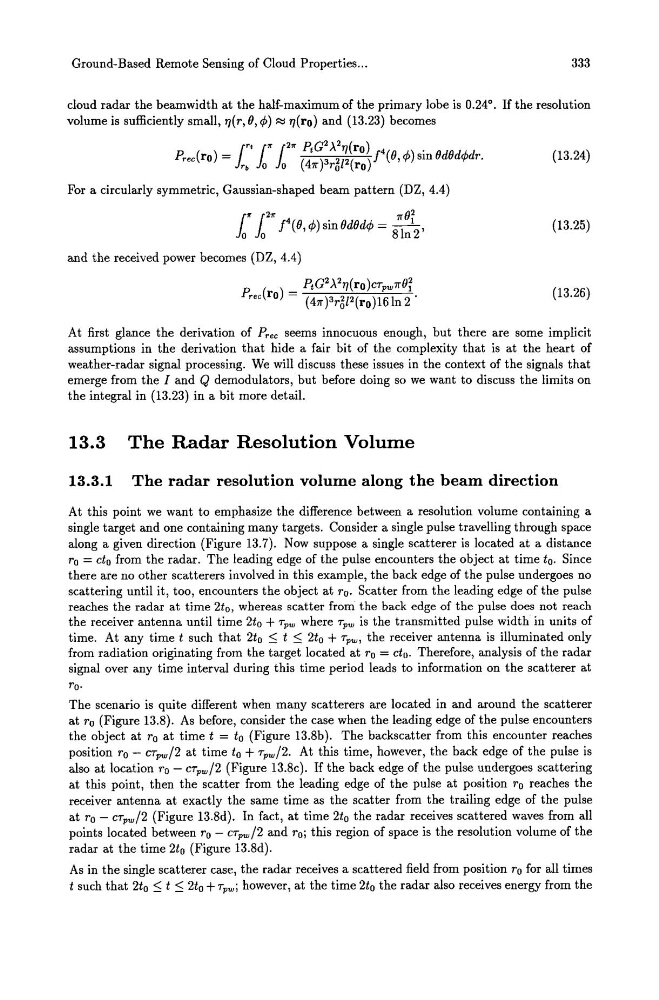
volume is sufficiently small, TJ(r, (J, 4» R:l TJ(ro) and (13.23) becomes
1
r • (" [2" Pt G 2 ,X2TJ(ro) 4
.
Pree(rO) = rb Jo Jo (47rp r 5 l2 (ro/ ((J, 4» sm (Jd(Jd4>dr.
(13.24)
For a circularly symmetric, Gaussian-shaped beam pattern (DZ, 4.4)
(" [2" j4((J,4» sin (Jd(Jd4> = 7r(J~ ,
k k
8~2
(13.25)
and the received power becomes (DZ, 4.4)
(13.26)
At first glance the derivation of Pree seems innocuous enough, but there are some implicit
assumptions in the derivation that hide a fair bit of the complexity that is at the heart of
weather-radar signal processing. We will discuss these issues in the context of the signals that
emerge from the I and Q demodulators, but before doing so we want to discuss the limits on
the integral in (13.23) in a bit more detail.
13.3 The Radar Resolution Volume
13.3.1 The radar resolution volume along the beam direction
At this point we want to emphasize the difference between a resolution volume containing a
single target and one containing many targets. Consider a single pulse travelling through space
along a given direction (Figure 13.7). Now suppose a single scatterer is located at a distance
ro = eto from the radar. The leading edge of the pulse encounters the object at time to. Since
there are no other scatterers involved in this example, the back edge of the pulse undergoes no
scattering until it, too, encounters the object at roo Scatter from the leading edge of the pulse
reaches the radar at time 2to, whereas scatter from the back edge of the pulse does not reach
the receiver antenna until time 2to + Tpw where Tpw is the transmitted pulse width in units of
time. At any time t such that 2to :S t :S 2to + Tpw, the receiver antenna is illuminated only
from radiation originating from the target located at ro = eto. Therefore, analysis of the radar
signal over any time interval during this time period leads to information on the scatterer at
roo
The scenario is quite different when many scatterers are located in and around the scatterer
at ro (Figure 13.8). As before, consider the case when the leading edge of the pulse encounters
the object at ro at time t = to (Figure 13.8b). The backscatter from this encounter reaches
position ro - cTpw /2 at time to + Tpw /2. At this time, however, the back edge of the pulse is
also at location ro - CTpw/2 (Figure 13.8c). If the back edge of the pulse undergoes scattering
at this point, then the scatter from the leading edge of the pulse at position ro reaches the
receiver antenna at exactly the same time as the scatter from the trailing edge of the pulse
at ro - cTpw /2 (Figure 13.8d). In fact, at time 2to the radar receives scattered waves from all
points located between ro - CTpw/2 and ro; this region of space is the resolution volume of the
radar at the time 2to (Figure 13.8d).
As in the single scatterer case, the radar receives a scattered field from position ro for all times
t such that 2to :S t :S 2to + Tpw; however, at the time 2to the radar also receives energy from the
333
cloud radar the beamwidth at the half-maximum of the primary lobe is 0.24°. If the resolution
volume is sufficiently small, TJ(r, (J, 4» R:l TJ(ro) and (13.23) becomes
1
r • (" [2" Pt G 2 ,X2TJ(ro) 4
.
Pree(rO) = rb Jo Jo (47rp r 5 l2 (ro/ ((J, 4» sm (Jd(Jd4>dr.
(13.24)
For a circularly symmetric, Gaussian-shaped beam pattern (DZ, 4.4)
(" [2" j4((J,4» sin (Jd(Jd4> = 7r(J~ ,
k k
8~2
(13.25)
and the received power becomes (DZ, 4.4)
(13.26)
At first glance the derivation of Pree seems innocuous enough, but there are some implicit
assumptions in the derivation that hide a fair bit of the complexity that is at the heart of
weather-radar signal processing. We will discuss these issues in the context of the signals that
emerge from the I and Q demodulators, but before doing so we want to discuss the limits on
the integral in (13.23) in a bit more detail.
13.3 The Radar Resolution Volume
13.3.1 The radar resolution volume along the beam direction
At this point we want to emphasize the difference between a resolution volume containing a
single target and one containing many targets. Consider a single pulse travelling through space
along a given direction (Figure 13.7). Now suppose a single scatterer is located at a distance
ro = eto from the radar. The leading edge of the pulse encounters the object at time to. Since
there are no other scatterers involved in this example, the back edge of the pulse undergoes no
scattering until it, too, encounters the object at roo Scatter from the leading edge of the pulse
reaches the radar at time 2to, whereas scatter from the back edge of the pulse does not reach
the receiver antenna until time 2to + Tpw where Tpw is the transmitted pulse width in units of
time. At any time t such that 2to :S t :S 2to + Tpw, the receiver antenna is illuminated only
from radiation originating from the target located at ro = eto. Therefore, analysis of the radar
signal over any time interval during this time period leads to information on the scatterer at
roo
The scenario is quite different when many scatterers are located in and around the scatterer
at ro (Figure 13.8). As before, consider the case when the leading edge of the pulse encounters
the object at ro at time t = to (Figure 13.8b). The backscatter from this encounter reaches
position ro - cTpw /2 at time to + Tpw /2. At this time, however, the back edge of the pulse is
also at location ro - CTpw/2 (Figure 13.8c). If the back edge of the pulse undergoes scattering
at this point, then the scatter from the leading edge of the pulse at position ro reaches the
receiver antenna at exactly the same time as the scatter from the trailing edge of the pulse
at ro - cTpw /2 (Figure 13.8d). In fact, at time 2to the radar receives scattered waves from all
points located between ro - CTpw/2 and ro; this region of space is the resolution volume of the
radar at the time 2to (Figure 13.8d).
As in the single scatterer case, the radar receives a scattered field from position ro for all times
t such that 2to :S t :S 2to + Tpw; however, at the time 2to the radar also receives energy from the