

Ground-Based Remote Sensing of Cloud Properties ...
327
I
I
Field
Amplitude
t=OTs
There is a sinusoidal
. \
variation of the electromagnetic field within
the pulse; the field
amplitude is 0 outside
of the pulse envelope.
I
, ,
\
,
\ t = 1 Ts
\
, "
/
.... -
\
\
,
I
I
t=2 Ts
.. Time
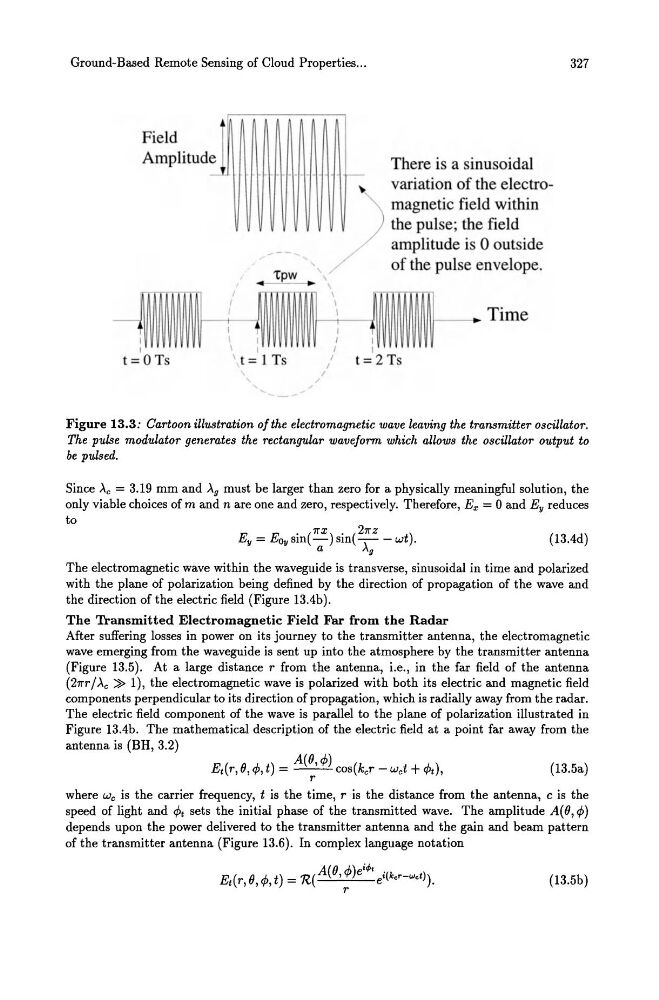
Figure 13.3: Cartoon illustration of the electromagnetic wave leaving the transmitter oscillator.
The pulse modulator generates the rectangular waveform which allows the oscillator output to
be pulsed.
Since .Ac = 3.19 mm and .Ag must be larger than zero for a physically meaningful solution, the
only viable choices of m and n are one and zero, respectively. Therefore, Ex = 0 and Ey reduces
to
E
E . (1l"x) . (21l"z
)
y= Oysm -
sm ,--wt.
a
Ag
(13.4d)
The electromagnetic wave within the waveguide is transverse, sinusoidal in time and polarized
with the plane of polarization being defined by the direction of propagation of the wave and
the direction of the electric field (Figure 13.4b).
The Transmitted Electromagnetic Field Far from the Radar
After suffering losses in power on its journey to the transmitter antenna, the electromagnetic
wave emerging from the waveguide is sent up into the atmosphere by the transmitter antenna
(Figure 13.5). At a large distance r from the antenna, i.e., in the far field of the antenna
(21l"rj.Ac ~ 1), the electromagnetic wave is polarized with both its electric and magnetic field
components perpendicular to its direction of propagation, which is radially away from the radar.
The electric field component of the wave is parallel to the plane of polarization illustrated in
Figure 13.4b. The mathematical description of the electric field at a point far away from the
antenna is (BH, 3.2)
(13.5a)
where We is the carrier frequency, t is the time, r is the distance from the antenna, c is the
speed of light and ~t sets the initial phase of the transmitted wave. The amplitude A( e, ~)
depends upon the power delivered to the transmitter antenna and the gain and beam pattern
of the transmitter antenna (Figure 13.6). In complex language notation
(13.5b)
327
I
I
Field
Amplitude
t=OTs
There is a sinusoidal
. \
variation of the electromagnetic field within
the pulse; the field
amplitude is 0 outside
of the pulse envelope.
I
, ,
\
,
\ t = 1 Ts
\
, "
/
.... -
\
\
,
I
I
t=2 Ts
.. Time
Figure 13.3: Cartoon illustration of the electromagnetic wave leaving the transmitter oscillator.
The pulse modulator generates the rectangular waveform which allows the oscillator output to
be pulsed.
Since .Ac = 3.19 mm and .Ag must be larger than zero for a physically meaningful solution, the
only viable choices of m and n are one and zero, respectively. Therefore, Ex = 0 and Ey reduces
to
E
E . (1l"x) . (21l"z
)
y= Oysm -
sm ,--wt.
a
Ag
(13.4d)
The electromagnetic wave within the waveguide is transverse, sinusoidal in time and polarized
with the plane of polarization being defined by the direction of propagation of the wave and
the direction of the electric field (Figure 13.4b).
The Transmitted Electromagnetic Field Far from the Radar
After suffering losses in power on its journey to the transmitter antenna, the electromagnetic
wave emerging from the waveguide is sent up into the atmosphere by the transmitter antenna
(Figure 13.5). At a large distance r from the antenna, i.e., in the far field of the antenna
(21l"rj.Ac ~ 1), the electromagnetic wave is polarized with both its electric and magnetic field
components perpendicular to its direction of propagation, which is radially away from the radar.
The electric field component of the wave is parallel to the plane of polarization illustrated in
Figure 13.4b. The mathematical description of the electric field at a point far away from the
antenna is (BH, 3.2)
(13.5a)
where We is the carrier frequency, t is the time, r is the distance from the antenna, c is the
speed of light and ~t sets the initial phase of the transmitted wave. The amplitude A( e, ~)
depends upon the power delivered to the transmitter antenna and the gain and beam pattern
of the transmitter antenna (Figure 13.6). In complex language notation
(13.5b)