

308
P. Joe
6
79 40
III
>""
I>
59 20 ~
Irl J
...
39 0 IIJ
0::J £
t!~
19 -20 ~ t!
N'" _ 0
0::§!Q
-40 0
IIJ
N
:::i
-21 -60'" ~
0::
0
z
0.4
0.2
-80
RAINFALL RATE (mm/hrl
800 30.0
4.4
1.1
2
5
6
7
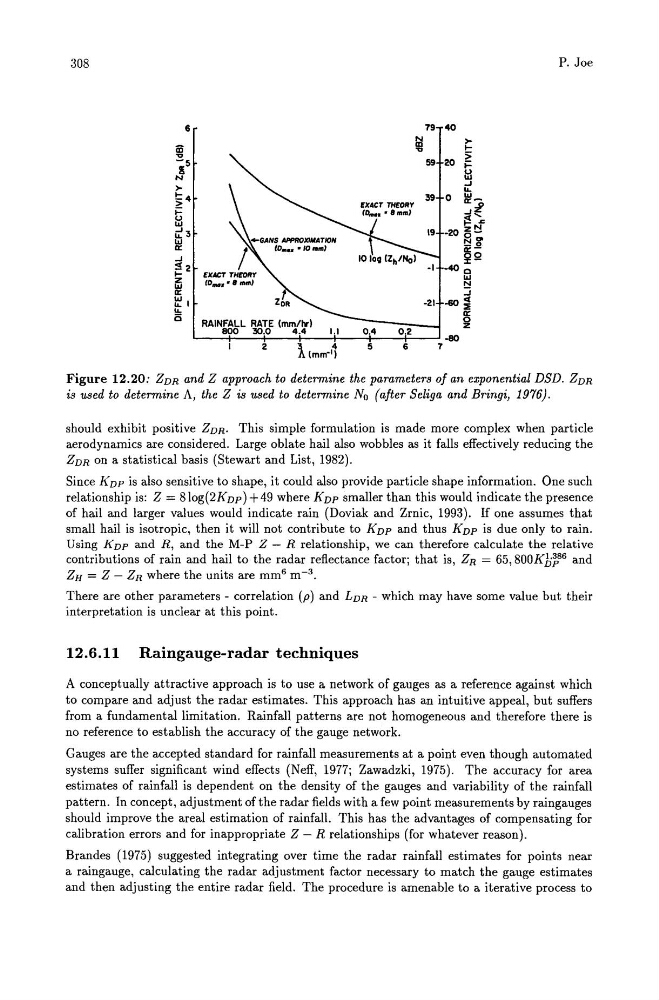
Figure 12.20: ZDR and Z approach to determine the parameters of an exponential DSD. ZDR
is used to determine A, the Z is used to determine No (after Seliga and Bringi, 1976).
should exhibit positive ZDR. This simple formulation is made more complex when particle
aerodynamics are considered. Large oblate hail also wobbles as it falls effectively reducing the
ZDR on a statistical basis (Stewart and List, 1982).
Since K DP is also sensitive to shape, it could also provide particle shape information. One such
relationship is: Z = 8Iog(2KDP) + 49 where KDP smaller than this would indicate the presence
of hail and larger values would indicate rain (Doviak and Zrnic, 1993). If one assumes that
small hail is isotropic, then it will not contribute to KDP and thus KDP is due only to rain.
Using KDP and R, and the M-P Z - R relationship, we can therefore calculate the relative
contributions of rain and hail to the radar reflectance factor; that is, ZR = 65, 800 KbJ,86 and
ZH = Z - ZR where the units are mm 6 m- 3 •
There are other parameters - correlation (p) and LDR - which may have some value but their
interpretation is unclear at this point.
12.6.11 Raingauge-radar techniques
A conceptually attractive approach is to use a network of gauges as a reference against which
to compare and adjust the radar estimates. This approach has an intuitive appeal, but suffers
from a fundamental limitation. Rainfall patterns are not homogeneous and therefore there is
no reference to establish the accuracy of the gauge network.
Gauges are the accepted standard for rainfall measurements at a point even though automated
systems suffer significant wind effects (Neff, 1977; Zawadzki, 1975). The accuracy for area
estimates of rainfall is dependent on the density of the gauges and variability of the rainfall
pattern. In concept, adjustment of the radar fields with a few point measurements by raingauges
should improve the areal estimation of rainfall. This has the advantages of compensating for
calibration errors and for inappropriate Z - R relationships (for whatever reason).
Brandes (1975) suggested integrating over time the radar rainfall estimates for points near
a raingauge, calculating the radar adjustment factor necessary to match the gauge estimates
and then adjusting the entire radar field. The procedure is amenable to a iterative process to
P. Joe
6
79 40
III
>""
I>
59 20 ~
Irl J
...
39 0 IIJ
0::J £
t!~
19 -20 ~ t!
N'" _ 0
0::§!Q
-40 0
IIJ
N
:::i
-21 -60'" ~
0::
0
z
0.4
0.2
-80
RAINFALL RATE (mm/hrl
800 30.0
4.4
1.1
2
5
6
7
Figure 12.20: ZDR and Z approach to determine the parameters of an exponential DSD. ZDR
is used to determine A, the Z is used to determine No (after Seliga and Bringi, 1976).
should exhibit positive ZDR. This simple formulation is made more complex when particle
aerodynamics are considered. Large oblate hail also wobbles as it falls effectively reducing the
ZDR on a statistical basis (Stewart and List, 1982).
Since K DP is also sensitive to shape, it could also provide particle shape information. One such
relationship is: Z = 8Iog(2KDP) + 49 where KDP smaller than this would indicate the presence
of hail and larger values would indicate rain (Doviak and Zrnic, 1993). If one assumes that
small hail is isotropic, then it will not contribute to KDP and thus KDP is due only to rain.
Using KDP and R, and the M-P Z - R relationship, we can therefore calculate the relative
contributions of rain and hail to the radar reflectance factor; that is, ZR = 65, 800 KbJ,86 and
ZH = Z - ZR where the units are mm 6 m- 3 •
There are other parameters - correlation (p) and LDR - which may have some value but their
interpretation is unclear at this point.
12.6.11 Raingauge-radar techniques
A conceptually attractive approach is to use a network of gauges as a reference against which
to compare and adjust the radar estimates. This approach has an intuitive appeal, but suffers
from a fundamental limitation. Rainfall patterns are not homogeneous and therefore there is
no reference to establish the accuracy of the gauge network.
Gauges are the accepted standard for rainfall measurements at a point even though automated
systems suffer significant wind effects (Neff, 1977; Zawadzki, 1975). The accuracy for area
estimates of rainfall is dependent on the density of the gauges and variability of the rainfall
pattern. In concept, adjustment of the radar fields with a few point measurements by raingauges
should improve the areal estimation of rainfall. This has the advantages of compensating for
calibration errors and for inappropriate Z - R relationships (for whatever reason).
Brandes (1975) suggested integrating over time the radar rainfall estimates for points near
a raingauge, calculating the radar adjustment factor necessary to match the gauge estimates
and then adjusting the entire radar field. The procedure is amenable to a iterative process to