

Precipitation at the Ground: Radar Techniques
309
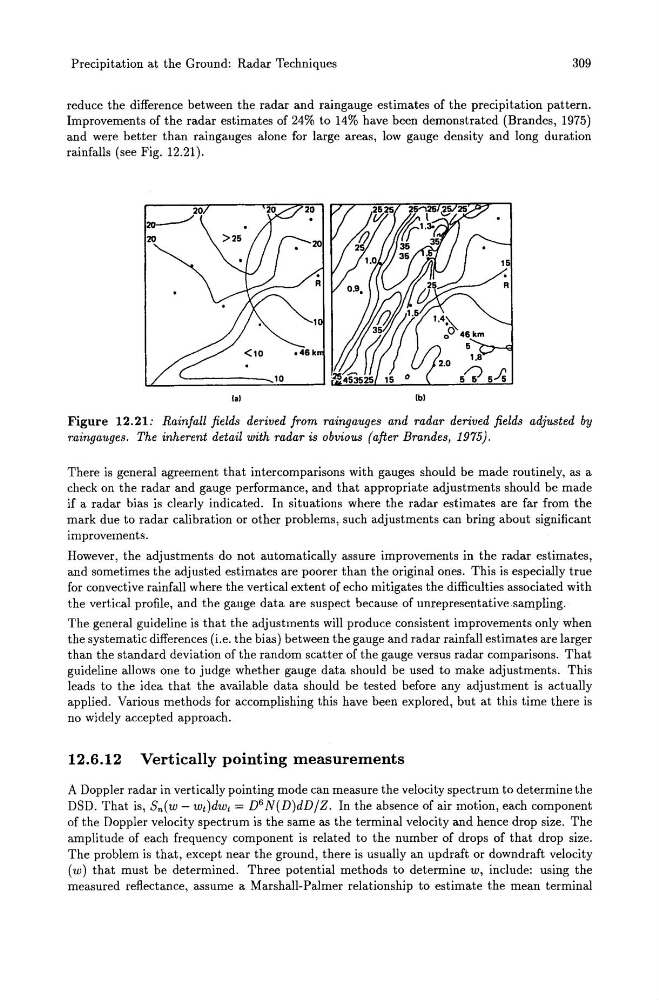
reduce the difference between the radar and raingauge estimates of the precipitation pattern.
Improvements of the radar estimates of 24% to 14% have been demonstrated (Brandes, 1975)
and were better than raingauges alone for large areas, low gauge density and long duration
rainfalls (see Fig. 12.21).
101
Ibl
Figure 12.21: Rainfall fields derived from raingauges and radar derived fields adjusted by
raingauges. The inherent detail with radar is obvious (after Brandes, 1975).
There is general agreement that intercomparisons with gauges should be made routinely, as a
check on the radar and gauge performance, and that appropriate adjustments should be made
if a radar bias is clearly indicated. In situations where the radar estimates are far from the
mark due to radar calibration or other problems, such adjustments can bring about significant
improvements.
However, the adjustments do not automatically assure improvements in the radar estimates,
and sometimes the adjusted estimates are poorer than the original ones. This is especially true
for convective rainfall where the vertical extent of echo mitigates the difficulties associated with
the vertical profile, and the gauge data are suspect because of unrepresentative sampling.
The general guideline is that the adjustments will produce consistent improvements only when
the systematic differences (i.e. the bias) between the gauge and radar rainfall estimates are larger
than the standard deviation of the random scatter of the gauge versus radar comparisons. That
guideline allows one to judge whether gauge data should be used to make adjustments. This
leads to the idea that the available data should be tested before any adjustment is actually
applied. Various methods for accomplishing this have been explored, but at this time there is
no widely accepted approach.
12.6.12 Vertically pointing measurements
A Doppler radar in vertically pointing mode can measure the velocity spectrum to determine the
DSD. That is, Sn( W - Wt)dWt = D6 N(D)dD jZ. In the absence of air motion, each component
of the Doppler velocity spectrum is the same as the terminal velocity and hence drop size. The
amplitude of each frequency component is related to the number of drops of that drop size.
The problem is that, except near the ground, there is usually an updraft or downdraft velocity
(w) that must be determined. Three potential methods to determine w, include: using the
measured reflectance, assume a Marshall-Palmer relationship to estimate the mean terminal
309
reduce the difference between the radar and raingauge estimates of the precipitation pattern.
Improvements of the radar estimates of 24% to 14% have been demonstrated (Brandes, 1975)
and were better than raingauges alone for large areas, low gauge density and long duration
rainfalls (see Fig. 12.21).
101
Ibl
Figure 12.21: Rainfall fields derived from raingauges and radar derived fields adjusted by
raingauges. The inherent detail with radar is obvious (after Brandes, 1975).
There is general agreement that intercomparisons with gauges should be made routinely, as a
check on the radar and gauge performance, and that appropriate adjustments should be made
if a radar bias is clearly indicated. In situations where the radar estimates are far from the
mark due to radar calibration or other problems, such adjustments can bring about significant
improvements.
However, the adjustments do not automatically assure improvements in the radar estimates,
and sometimes the adjusted estimates are poorer than the original ones. This is especially true
for convective rainfall where the vertical extent of echo mitigates the difficulties associated with
the vertical profile, and the gauge data are suspect because of unrepresentative sampling.
The general guideline is that the adjustments will produce consistent improvements only when
the systematic differences (i.e. the bias) between the gauge and radar rainfall estimates are larger
than the standard deviation of the random scatter of the gauge versus radar comparisons. That
guideline allows one to judge whether gauge data should be used to make adjustments. This
leads to the idea that the available data should be tested before any adjustment is actually
applied. Various methods for accomplishing this have been explored, but at this time there is
no widely accepted approach.
12.6.12 Vertically pointing measurements
A Doppler radar in vertically pointing mode can measure the velocity spectrum to determine the
DSD. That is, Sn( W - Wt)dWt = D6 N(D)dD jZ. In the absence of air motion, each component
of the Doppler velocity spectrum is the same as the terminal velocity and hence drop size. The
amplitude of each frequency component is related to the number of drops of that drop size.
The problem is that, except near the ground, there is usually an updraft or downdraft velocity
(w) that must be determined. Three potential methods to determine w, include: using the
measured reflectance, assume a Marshall-Palmer relationship to estimate the mean terminal