

306
P. Joe
10'
10·
10'
10'
10· E
u
Ul
al
E 10·
10·'2
u
~
::: 10·'
10·'
E ,. .....
~ 10·'
10· 10·'
Z
0
i=
~ 10·' o·
Z
ill
...
~
10·'
10·' E
u
al
E
,...
,...
;:: 10-1
10·' d
N
ci
10·'
10·
10'
10·
RAINFALL RATE (mm/hr)
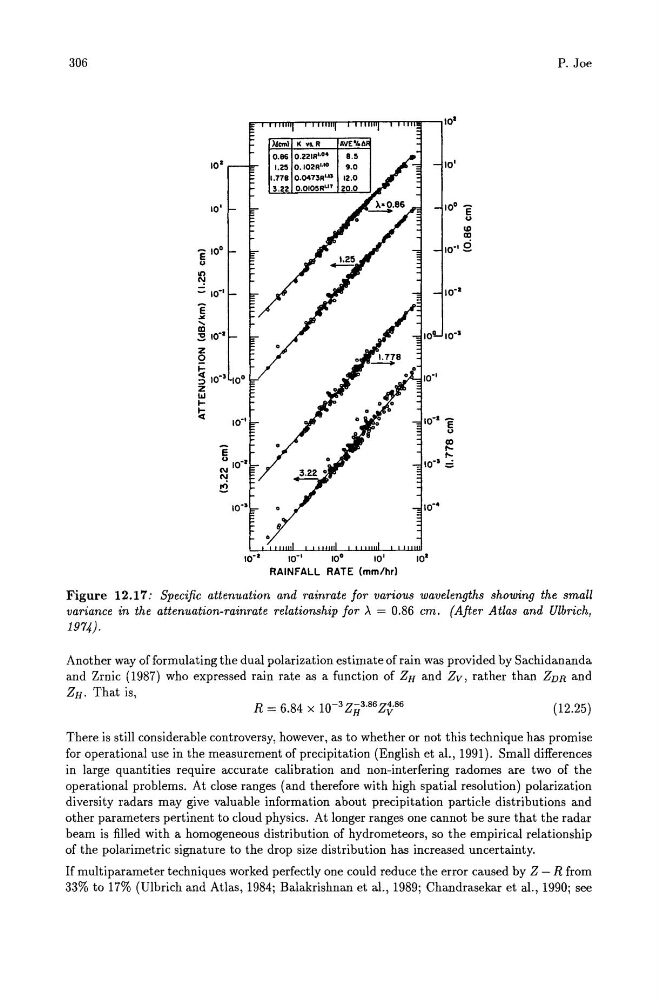
Figure 12.17: Specific attenuation and rainrate for various wavelengths showing the small
variance in the attenuation·rainrate relationship for A = 0.86 cm. (After Atlas and Ulbrich,
1974)·
Another way of formulating the dual polarization estimate of rain was provided by Sachidananda
and Zrnic (1987) who expressed rain rate as a function of ZH and Zv, rather than ZDR and
ZH. That is,
R = 6.84 X 10- 3 Zj{3.86 Zt 86
(12.25)
There is still considerable controversy, however, as to whether or not this technique has promise
for operational use in the measurement of precipitation (English et al., 1991). Small differences
in large quantities require accurate calibration and non-interfering radomes are two of the
operational problems. At close ranges (and therefore with high spatial resolution) polarization
diversity radars may give valuable information about precipitation particle distributions and
other parameters pertinent to cloud physics. At longer ranges one cannot be sure that the radar
beam is filled with a homogeneous distribution of hydrometeors, so the empirical relationship
of the polarimetric signature to the drop size distribution has increased uncertainty.
If multiparameter techniques worked perfectly one could reduce the error caused by Z - R from
33% to 17% (Ulbrich and Atlas, 1984; Balakrishnan et al., 1989; Chandrasekar et al., 1990; see
P. Joe
10'
10·
10'
10'
10· E
u
Ul
al
E 10·
10·'2
u
~
::: 10·'
10·'
E ,. .....
~ 10·'
10· 10·'
Z
0
i=
~ 10·' o·
Z
ill
...
~
10·'
10·' E
u
al
E
,...
,...
;:: 10-1
10·' d
N
ci
10·'
10·
10'
10·
RAINFALL RATE (mm/hr)
Figure 12.17: Specific attenuation and rainrate for various wavelengths showing the small
variance in the attenuation·rainrate relationship for A = 0.86 cm. (After Atlas and Ulbrich,
1974)·
Another way of formulating the dual polarization estimate of rain was provided by Sachidananda
and Zrnic (1987) who expressed rain rate as a function of ZH and Zv, rather than ZDR and
ZH. That is,
R = 6.84 X 10- 3 Zj{3.86 Zt 86
(12.25)
There is still considerable controversy, however, as to whether or not this technique has promise
for operational use in the measurement of precipitation (English et al., 1991). Small differences
in large quantities require accurate calibration and non-interfering radomes are two of the
operational problems. At close ranges (and therefore with high spatial resolution) polarization
diversity radars may give valuable information about precipitation particle distributions and
other parameters pertinent to cloud physics. At longer ranges one cannot be sure that the radar
beam is filled with a homogeneous distribution of hydrometeors, so the empirical relationship
of the polarimetric signature to the drop size distribution has increased uncertainty.
If multiparameter techniques worked perfectly one could reduce the error caused by Z - R from
33% to 17% (Ulbrich and Atlas, 1984; Balakrishnan et al., 1989; Chandrasekar et al., 1990; see