

Precipitation at the Ground: Radar Techniques
2l
It
.....
bV
10
z
Q 10·
IU
UI
If)
If)
~
U
Z
o
~ 10"'
~
lX
UI
o
UI
N
:J
ct
~
a:: 10-'
~
A -0.86 em ....
, --+--10--_+__1 D(mm)
I
4
10
• 3.21 1 - , ---..----<~-t----
10
( ~),.'7
/ - - X
I
.5.5 .... :-~--~~_,~
-10.0 ... , - - + - -... , ---<-...... ,
I
4
10
SYMPTOTE
T=O·C
- - )"zIO,Ocm
- - - x' 5.5 em
.......... X· 3.21 em
- - X·0.86em
10-' "='_ . . . . . . . . . '--~--'-L7:-_-L _ _ L--'--'-7":-_-'-7_-'----'-':::'
0.01
0.1
1.0
10.0
NORMALIZED DROP DIAMETER .. 0/).
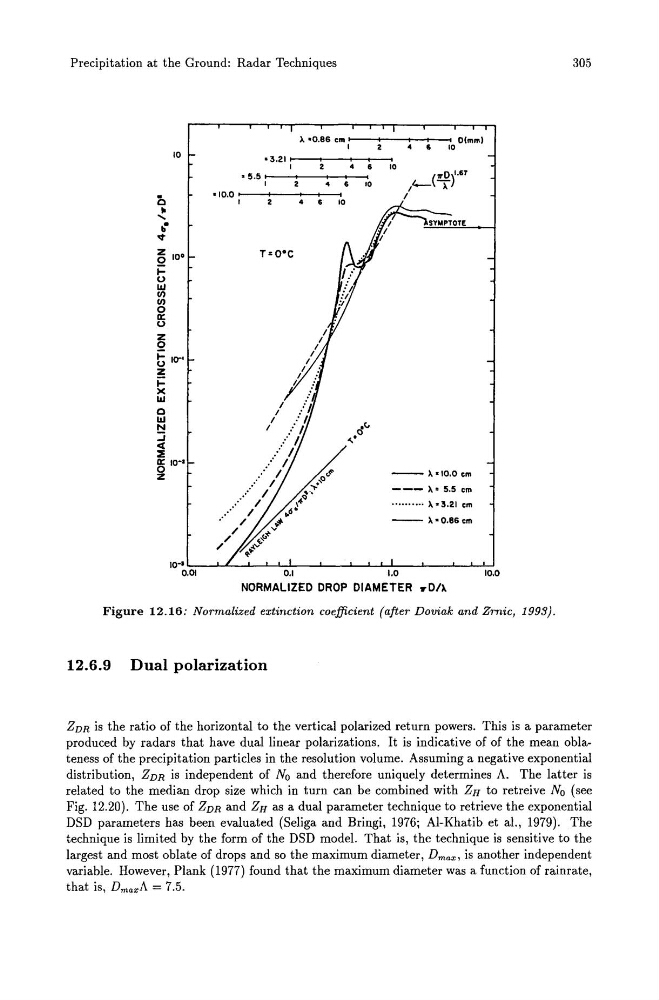
Figure 12.16: Normalized extinction coefficient (after Doviak and Zmic, 1993).
12.6.9 Dual polarization
305
ZVR is the ratio of the horizontal to the vertical polarized return powers. This is a parameter
produced by radars that have dual linear polarizations. It is indicative of of the mean oblateness of the precipitation particles in the resolution volume. Assuming a negative exponential
distribution, ZVR is independent of No and therefore uniquely determines A. The latter is
related to the median drop size which in turn can be combined with ZH to retreive No (see
Fig. 12.20). The use of ZVR and ZH as a dual parameter technique to retrieve the exponential
DSD parameters has been evaluated (Seliga and Bringi, 1976; AI-Khatib et al., 1979). The
technique is limited by the form of the DSD model. That is, the technique is sensitive to the
largest and most oblate of drops and so the maximum diameter, Dmax , is another independent
variable. However, Plank (1977) found that the maximum diameter was a function of rainrate,
that is, DmaxA = 7.5.
2l
It
.....
bV
10
z
Q 10·
IU
UI
If)
If)
~
U
Z
o
~ 10"'
~
lX
UI
o
UI
N
:J
ct
~
a:: 10-'
~
A -0.86 em ....
, --+--10--_+__1 D(mm)
I
4
10
• 3.21 1 - , ---..----<~-t----
10
( ~),.'7
/ - - X
I
.5.5 .... :-~--~~_,~
-10.0 ... , - - + - -... , ---<-...... ,
I
4
10
SYMPTOTE
T=O·C
- - )"zIO,Ocm
- - - x' 5.5 em
.......... X· 3.21 em
- - X·0.86em
10-' "='_ . . . . . . . . . '--~--'-L7:-_-L _ _ L--'--'-7":-_-'-7_-'----'-':::'
0.01
0.1
1.0
10.0
NORMALIZED DROP DIAMETER .. 0/).
Figure 12.16: Normalized extinction coefficient (after Doviak and Zmic, 1993).
12.6.9 Dual polarization
305
ZVR is the ratio of the horizontal to the vertical polarized return powers. This is a parameter
produced by radars that have dual linear polarizations. It is indicative of of the mean oblateness of the precipitation particles in the resolution volume. Assuming a negative exponential
distribution, ZVR is independent of No and therefore uniquely determines A. The latter is
related to the median drop size which in turn can be combined with ZH to retreive No (see
Fig. 12.20). The use of ZVR and ZH as a dual parameter technique to retrieve the exponential
DSD parameters has been evaluated (Seliga and Bringi, 1976; AI-Khatib et al., 1979). The
technique is limited by the form of the DSD model. That is, the technique is sensitive to the
largest and most oblate of drops and so the maximum diameter, Dmax , is another independent
variable. However, Plank (1977) found that the maximum diameter was a function of rainrate,
that is, DmaxA = 7.5.