

Energy and Water Cycles in the Climate System ...
c
.2
2
' ii,
" 2
a.
-4
- 0 .50
1100
- 0. 25
0.00
21
0.25
0.50
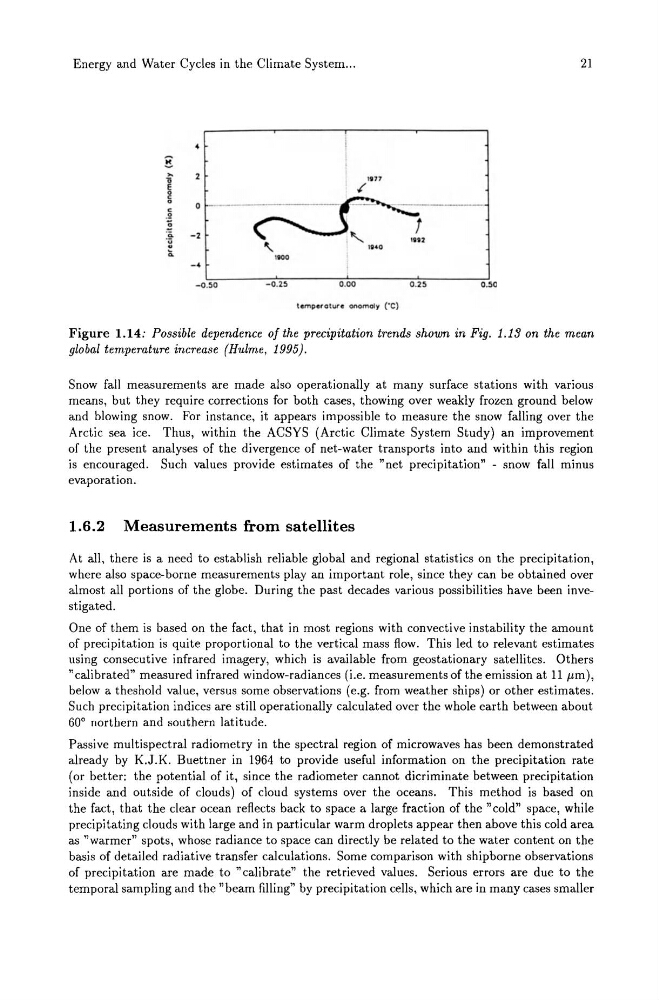
Figure 1.14: Possible dependence o/the precipitation trends shown in Fig. 1.13 on the mean
global temperature increase (Hulme, 1995).
Snow fall measurements are made also operationally at many surface stations with various
means, but they require corrections for both cases, thowing over weakly frozen ground below
and blowing snow. For instance, it appears impossible to measure the snow falling over the
Arctic sea ice. Thus, within the ACSYS (Arctic Climate System Study) an improvement
of the present analyses of the divergence of net-water transports into and within this region
is encouraged. Such values provide estimates of the "net precipitation" - snow fall minus
evaporation.
1.6.2 Measurements from satellites
At all, there is a need to establish reliable global and regional statistics on the precipitation,
where also space-borne measurements play an important role, since they can be obtained over
almost all portions of the globe. During the past decades various possibilities have been investigated.
One of them is based on the fact, that in most regions with convective instability the amount
of precipitation is quite proportional to the vertical mass flow. This led to relevant estimates
using consecutive infrared imagery, which is available from geostationary satellites. Others
"calibrated" measured infrared window-radiances (i.e. measurements of the emission at 11 11m),
below a theshold value, versus some observations (e.g. from weather ships) or other estimates.
Such precipitation indices are still operationally calculated over the whole earth between about
60° northern and southern latitude.
Passive multispectral radiometry in the spectral region of microwaves has been demonstrated
already by K.J.K. Buettner in 1964 to provide useful information on the precipitation rate
(or better: the potential of it, since the radiometer cannot dicriminate between precipitation
inside and outside of clouds) of cloud systems over the oceans. This method is based on
the fact, that the clear ocean reflects back to space a large fraction of the "cold" space, while
precipitating clouds with large and in particular warm droplets appear then above this cold area
as "warmer" spots, whose radiance to space can directly be related to the water content on the
basis of detailed radiative transfer calculations. Some comparison with shipborne observations
of precipitation are made to "calibrate" the retrieved values. Serious errors are due to the
temporal sampling and the "beam filling" by precipitation cells, which are in many cases smaller
c
.2
2
' ii,
" 2
a.
-4
- 0 .50
1100
- 0. 25
0.00
21
0.25
0.50
Figure 1.14: Possible dependence o/the precipitation trends shown in Fig. 1.13 on the mean
global temperature increase (Hulme, 1995).
Snow fall measurements are made also operationally at many surface stations with various
means, but they require corrections for both cases, thowing over weakly frozen ground below
and blowing snow. For instance, it appears impossible to measure the snow falling over the
Arctic sea ice. Thus, within the ACSYS (Arctic Climate System Study) an improvement
of the present analyses of the divergence of net-water transports into and within this region
is encouraged. Such values provide estimates of the "net precipitation" - snow fall minus
evaporation.
1.6.2 Measurements from satellites
At all, there is a need to establish reliable global and regional statistics on the precipitation,
where also space-borne measurements play an important role, since they can be obtained over
almost all portions of the globe. During the past decades various possibilities have been investigated.
One of them is based on the fact, that in most regions with convective instability the amount
of precipitation is quite proportional to the vertical mass flow. This led to relevant estimates
using consecutive infrared imagery, which is available from geostationary satellites. Others
"calibrated" measured infrared window-radiances (i.e. measurements of the emission at 11 11m),
below a theshold value, versus some observations (e.g. from weather ships) or other estimates.
Such precipitation indices are still operationally calculated over the whole earth between about
60° northern and southern latitude.
Passive multispectral radiometry in the spectral region of microwaves has been demonstrated
already by K.J.K. Buettner in 1964 to provide useful information on the precipitation rate
(or better: the potential of it, since the radiometer cannot dicriminate between precipitation
inside and outside of clouds) of cloud systems over the oceans. This method is based on
the fact, that the clear ocean reflects back to space a large fraction of the "cold" space, while
precipitating clouds with large and in particular warm droplets appear then above this cold area
as "warmer" spots, whose radiance to space can directly be related to the water content on the
basis of detailed radiative transfer calculations. Some comparison with shipborne observations
of precipitation are made to "calibrate" the retrieved values. Serious errors are due to the
temporal sampling and the "beam filling" by precipitation cells, which are in many cases smaller