

Precipitation at the Ground: Radar Techniques
303
o SEEOEO CLUSTERS
CORR COEFF. • 0.98
110
1
10'
25 dBI-AREA TIME rHEGRAL I~m' ~"
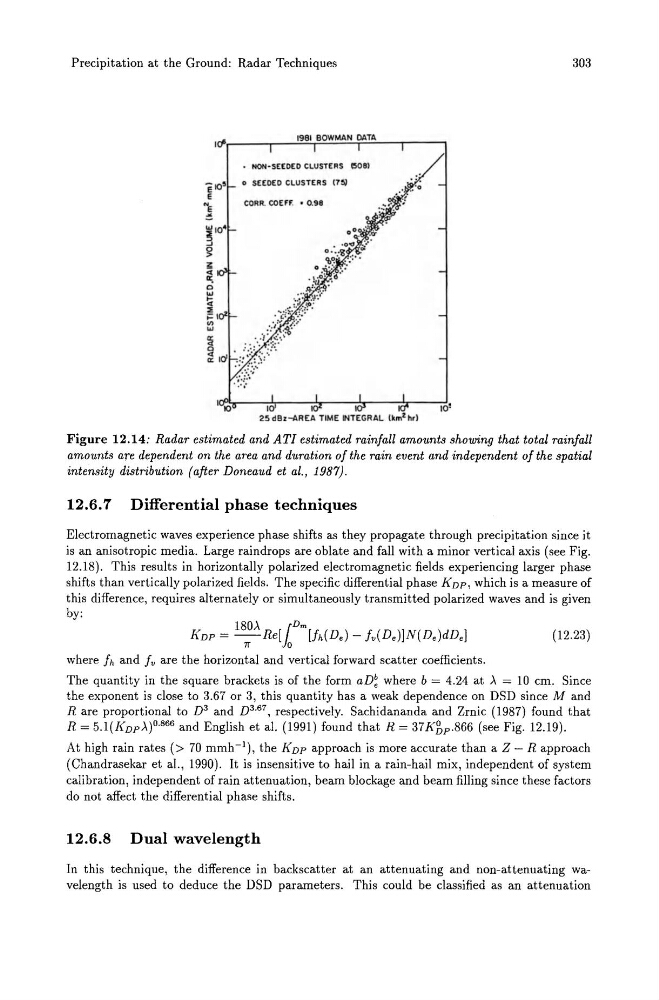
Figure 12.14: Radar estimated and AT! estimated rainfall amounts showing that total rainfall
amounts are dependent on the area and duration of the rain event and independent of the spatial
intensity distribution (after Doneaud et al., 1987).
12.6.7 Differential phase techniques
Electromagnetic waves experience phase shifts as they propagate through precipitation since it
is an anisotropic media. Large raindrops are oblate and fall with a minor vertical axis (see Fig.
12.18). This results in horizontally polarized electromagnetic fields experiencing larger phase
shifts than vertically polarized fields. The specific differential phase KDP , which is a measure of
this difference, requires alternately or simultaneously transmitted polarized waves and is given
by:
180>'
l Dm
KDP = -Re[
[fh(De) - fv(De)]N(De)dDe]
IT
°
(12.23)
where fh and fv are the horizontal and vertical forward scatter coefficients.
The quantity in the square brackets is of the form aD~ where b = 4.24 at >. = 10 cm. Since
the exponent is close to 3.67 or 3, this quantity has a weak dependence on DSD since M and
R are proportional to D3 and D 3 . 67 , respectively. Sachidananda and Zrnic (1987) found that
R = 5.1(KDP >.)o.866 and English et al. (1991) found that R = 37KBp.866 (see Fig. 12.19).
At high rain rates (> 70 mmh- 1 ), the KDP approach is more accurate than a Z - R approach
(Chandrasekar et al., 1990). It is insensitive to hail in a rain-hail mix, independent of system
calibration, independent of rain attenuation, beam blockage and beam filling since these factors
do not affect the differential phase shifts.
12.6.8 Dual wavelength
In this technique, the difference in backscatter at an attenuating and non-attenuating wavelength is used to deduce the DSD parameters. This could be classified as an attenuation
303
o SEEOEO CLUSTERS
CORR COEFF. • 0.98
110
1
10'
25 dBI-AREA TIME rHEGRAL I~m' ~"
Figure 12.14: Radar estimated and AT! estimated rainfall amounts showing that total rainfall
amounts are dependent on the area and duration of the rain event and independent of the spatial
intensity distribution (after Doneaud et al., 1987).
12.6.7 Differential phase techniques
Electromagnetic waves experience phase shifts as they propagate through precipitation since it
is an anisotropic media. Large raindrops are oblate and fall with a minor vertical axis (see Fig.
12.18). This results in horizontally polarized electromagnetic fields experiencing larger phase
shifts than vertically polarized fields. The specific differential phase KDP , which is a measure of
this difference, requires alternately or simultaneously transmitted polarized waves and is given
by:
180>'
l Dm
KDP = -Re[
[fh(De) - fv(De)]N(De)dDe]
IT
°
(12.23)
where fh and fv are the horizontal and vertical forward scatter coefficients.
The quantity in the square brackets is of the form aD~ where b = 4.24 at >. = 10 cm. Since
the exponent is close to 3.67 or 3, this quantity has a weak dependence on DSD since M and
R are proportional to D3 and D 3 . 67 , respectively. Sachidananda and Zrnic (1987) found that
R = 5.1(KDP >.)o.866 and English et al. (1991) found that R = 37KBp.866 (see Fig. 12.19).
At high rain rates (> 70 mmh- 1 ), the KDP approach is more accurate than a Z - R approach
(Chandrasekar et al., 1990). It is insensitive to hail in a rain-hail mix, independent of system
calibration, independent of rain attenuation, beam blockage and beam filling since these factors
do not affect the differential phase shifts.
12.6.8 Dual wavelength
In this technique, the difference in backscatter at an attenuating and non-attenuating wavelength is used to deduce the DSD parameters. This could be classified as an attenuation