

300
P. Joe
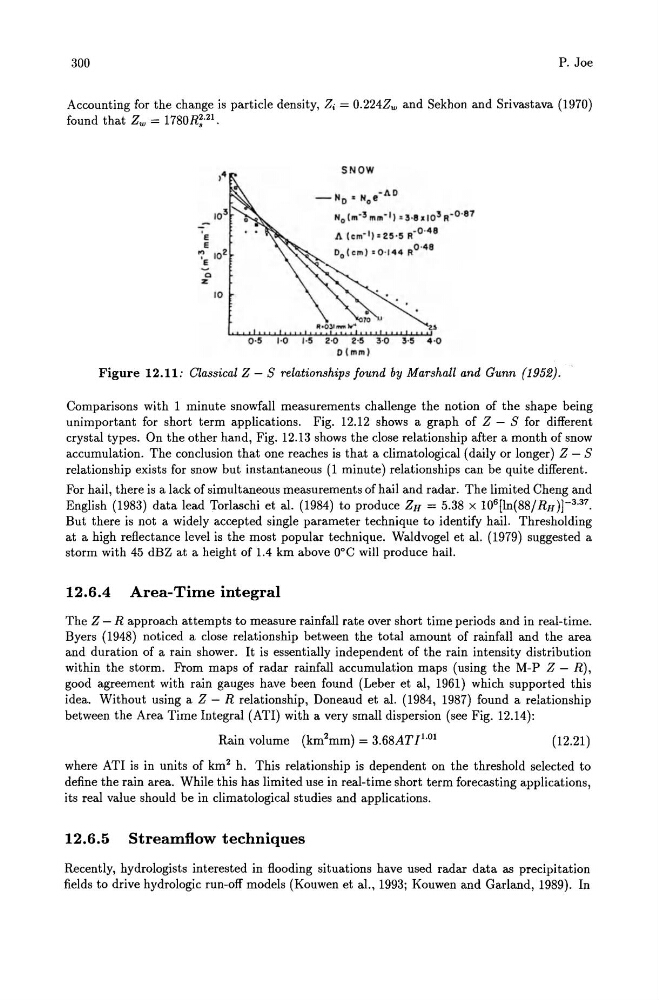
Accounting for the change is particle density, Zi = 0.224Zw and Sekhon and Srivastava (1970)
found that Zw = 1780R~·21 .
10
SNOW
-
No' Hoe-AD
Ho (m-3 m .. - I ) , 3.81 103 R-O'87
A (e .. - I ). 2"5 R- O · 48
Do (em) , 0'144 RO ' 48
0 ·5
1·0
1·5 Z'O 2·5 3'0 3'5 4 '0
D(mm)
Figure 12.11: Classical Z - S relationships found by Marshall and Gunn (1952).
Comparisons with 1 minute snowfall measurements challenge the notion of the shape being
unimportant for short term applications. Fig. 12.12 shows a graph of Z - S for different
crystal types. On the other hand, Fig. 12.13 shows the close relationship after a month of snow
accumulation. The conclusion that one reaches is that a climatological (daily or longer) Z - S
relationship exists for snow but instantaneous (1 minute) relationships can be quite different.
For hail, there is a lack of simultaneous measurements of hail and radar. The limited Cheng and
English (1983) data lead Torlaschi et al. (1984) to produce ZH = 5.38 x 10⁶[ln(88j RH )]-3.37.
But there is not a widely accepted single parameter technique to identify hail. Thresholding
at a high reflectance level is the most popular technique. Waldvogel et al. (1979) suggested a
storm with 45 dBZ at a height of 1.4 km above O°C will produce hail.
12.6.4 Area-Time integral
The Z - R approach attempts to measure rainfall rate over short time periods and in real-time.
Byers (1948) noticed a close relationship between the total amount of rainfall and the area
and duration of a rain shower. It is essentially independent of the rain intensity distribution
within the storm. From maps of radar rainfall accumulation maps (using the M-P Z - R),
good agreement with rain gauges have been found (Leber et aI, 1961) which supported this
idea. Without using a Z - R relationship, Doneaud et al. (1984, 1987) found a relationship
between the Area Time Integral (ATI) with a very small dispersion (see Fig. 12.14):
Rain volume (km 2 mm) = 3.68AT 11.01
(12.21)
where ATI is in units of km 2 h. This relationship is dependent on the threshold selected to
define the rain area. While this has limited use in real-time short term forecasting applications,
its real value should be in climatological studies and applications.
12.6.5 Streamflow techniques
Recently, hydrologists interested in flooding situations have used radar data as precipitation
fields to drive hydrologic run-off models (Kouwen et aI., 1993; Kouwen and Garland, 1989). In
P. Joe
Accounting for the change is particle density, Zi = 0.224Zw and Sekhon and Srivastava (1970)
found that Zw = 1780R~·21 .
10
SNOW
-
No' Hoe-AD
Ho (m-3 m .. - I ) , 3.81 103 R-O'87
A (e .. - I ). 2"5 R- O · 48
Do (em) , 0'144 RO ' 48
0 ·5
1·0
1·5 Z'O 2·5 3'0 3'5 4 '0
D(mm)
Figure 12.11: Classical Z - S relationships found by Marshall and Gunn (1952).
Comparisons with 1 minute snowfall measurements challenge the notion of the shape being
unimportant for short term applications. Fig. 12.12 shows a graph of Z - S for different
crystal types. On the other hand, Fig. 12.13 shows the close relationship after a month of snow
accumulation. The conclusion that one reaches is that a climatological (daily or longer) Z - S
relationship exists for snow but instantaneous (1 minute) relationships can be quite different.
For hail, there is a lack of simultaneous measurements of hail and radar. The limited Cheng and
English (1983) data lead Torlaschi et al. (1984) to produce ZH = 5.38 x 10⁶[ln(88j RH )]-3.37.
But there is not a widely accepted single parameter technique to identify hail. Thresholding
at a high reflectance level is the most popular technique. Waldvogel et al. (1979) suggested a
storm with 45 dBZ at a height of 1.4 km above O°C will produce hail.
12.6.4 Area-Time integral
The Z - R approach attempts to measure rainfall rate over short time periods and in real-time.
Byers (1948) noticed a close relationship between the total amount of rainfall and the area
and duration of a rain shower. It is essentially independent of the rain intensity distribution
within the storm. From maps of radar rainfall accumulation maps (using the M-P Z - R),
good agreement with rain gauges have been found (Leber et aI, 1961) which supported this
idea. Without using a Z - R relationship, Doneaud et al. (1984, 1987) found a relationship
between the Area Time Integral (ATI) with a very small dispersion (see Fig. 12.14):
Rain volume (km 2 mm) = 3.68AT 11.01
(12.21)
where ATI is in units of km 2 h. This relationship is dependent on the threshold selected to
define the rain area. While this has limited use in real-time short term forecasting applications,
its real value should be in climatological studies and applications.
12.6.5 Streamflow techniques
Recently, hydrologists interested in flooding situations have used radar data as precipitation
fields to drive hydrologic run-off models (Kouwen et aI., 1993; Kouwen and Garland, 1989). In