

Precipitation at the Ground: Radar Techniques
299
proportional to the 4th power of the particle diameters whereas the radar reflectance (Z) is
proportional to the 6th power of particle diameters. Thus, the natural variability in drop-size
distributions is an important source of uncertainty in radar measurements of precipitation.
An empirical Z - R relation can be obtained from measured drop-size distributions (MarshallPalmer, 1948). An alternative is to compare Z measured aloft by the radar with R measured
at the ground. The latter approach also reflects any differences between the radar detected
precipitation aloft and that which reaches the ground and has the advantage that it also takes
into account errors in the radar calibration, but the result is not strictly a Z - R relationship
and it may not apply to other radars. Differences in radar calibration could lead to different
Z - R relationship for the same DSD.
The possibility of accounting for part of the variability of Z - R relation by stratifying storms
according to rain type (such as convective, stratiform, orographic) has received a good deal
of attention (Battan, 1981). The improvements achieved are not substantial and questions
remain as to the practicality of applying this technique on an real-time operational basis. After
averaging over time and/or space, the errors associated with these variations, will rarely exceed
a factor of two in rain rate. At longer ranges (>130 km), errors caused by the inability to
observe the precipitation close to the ground and beam filling are usually dominant.
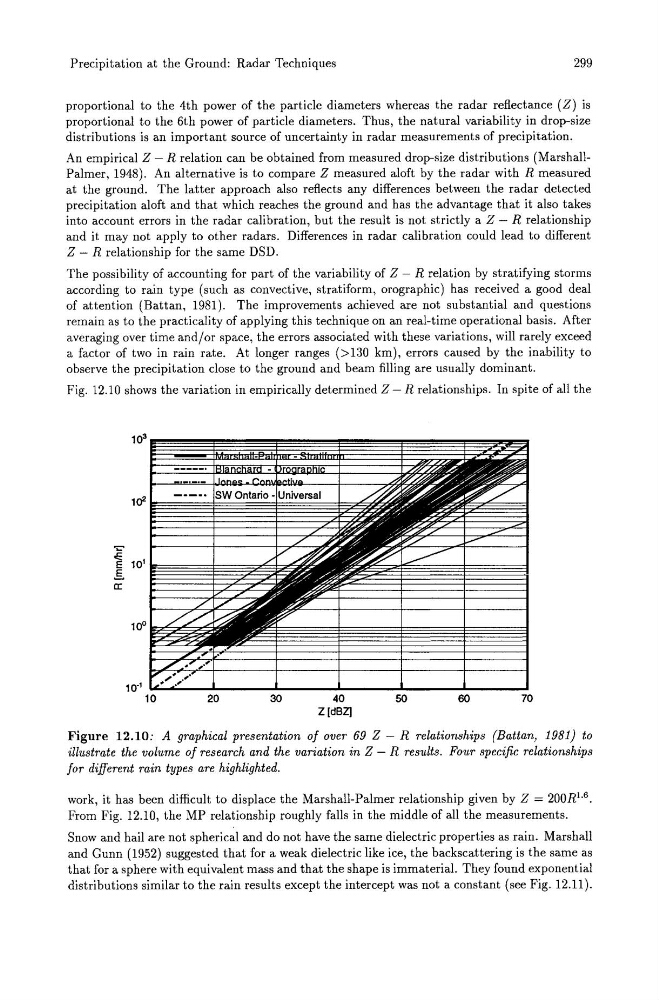
Fig. 12.10 shows the variation in empirically determined Z - R relationships. In spite of all the
10.1
10
20
30
40
Z [d8Z)
50
60
70
Figure 12.10: A graphical presentation of over 69 Z - R relationships (Battan, 1981) to
illustrate the volume of research and the variation in Z - R results. Four specific relationships
for different rain types are highlighted.
work, it has been difficult to displace the Marshall-Palmer relationship given by Z = 200R1.6.
From Fig. 12.10, the MP relationship roughly falls in the middle of all the measurements.
Snow and hail are not spherical and do not have the same dielectric properties as rain. Marshall
and Gunn (1952) suggested that for a weak dielectric like ice, the backscattering is the same as
that for a sphere with equivalent mass and that the shape is immaterial. They found exponential
distributions similar to the rain results except the intercept was not a constant (see Fig. 12.11).
299
proportional to the 4th power of the particle diameters whereas the radar reflectance (Z) is
proportional to the 6th power of particle diameters. Thus, the natural variability in drop-size
distributions is an important source of uncertainty in radar measurements of precipitation.
An empirical Z - R relation can be obtained from measured drop-size distributions (MarshallPalmer, 1948). An alternative is to compare Z measured aloft by the radar with R measured
at the ground. The latter approach also reflects any differences between the radar detected
precipitation aloft and that which reaches the ground and has the advantage that it also takes
into account errors in the radar calibration, but the result is not strictly a Z - R relationship
and it may not apply to other radars. Differences in radar calibration could lead to different
Z - R relationship for the same DSD.
The possibility of accounting for part of the variability of Z - R relation by stratifying storms
according to rain type (such as convective, stratiform, orographic) has received a good deal
of attention (Battan, 1981). The improvements achieved are not substantial and questions
remain as to the practicality of applying this technique on an real-time operational basis. After
averaging over time and/or space, the errors associated with these variations, will rarely exceed
a factor of two in rain rate. At longer ranges (>130 km), errors caused by the inability to
observe the precipitation close to the ground and beam filling are usually dominant.
Fig. 12.10 shows the variation in empirically determined Z - R relationships. In spite of all the
10.1
10
20
30
40
Z [d8Z)
50
60
70
Figure 12.10: A graphical presentation of over 69 Z - R relationships (Battan, 1981) to
illustrate the volume of research and the variation in Z - R results. Four specific relationships
for different rain types are highlighted.
work, it has been difficult to displace the Marshall-Palmer relationship given by Z = 200R1.6.
From Fig. 12.10, the MP relationship roughly falls in the middle of all the measurements.
Snow and hail are not spherical and do not have the same dielectric properties as rain. Marshall
and Gunn (1952) suggested that for a weak dielectric like ice, the backscattering is the same as
that for a sphere with equivalent mass and that the shape is immaterial. They found exponential
distributions similar to the rain results except the intercept was not a constant (see Fig. 12.11).