

288
100 ...... -.-.,...,.......--...,...-.-r-r-,-,--.-,....,...""T"""1,....,....,--r.,.,~ .........
~_ 10
~br:
....
5 J!. I
B~ ..... aI..,
~~ .1
Nil)
- I I )
..J o
"",
~u.OI
~
"
/RAYLEIGH (ICE I
I
••
I~RAYLEIGH (WATER)
" .l
I
:
/ ... /
WATEA
.001 o~ ........ ~->-..J'-'--!- ................. --!.,........~--!:-8 ....... -'--:'::10-'-L.-L~12:-'-"'"--'"-:',.
ELECTRICAL SIZE ( •• Wf)
P. Joe
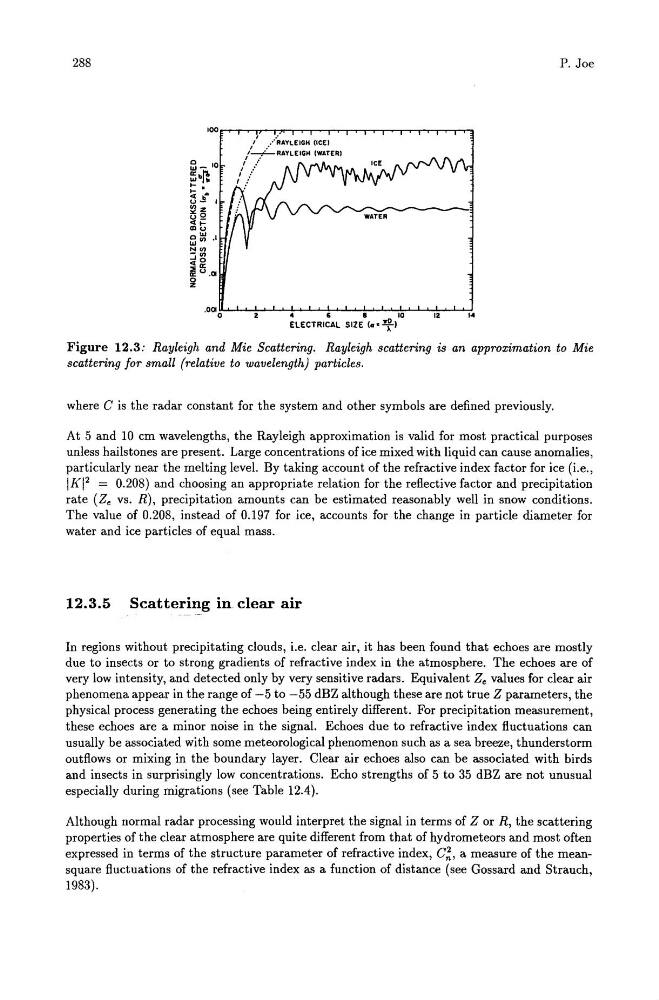
Figure 12.3: Rayleigh and Mie Scattering. Rayleigh scattering is an approximation to Mie
scattering for small (relative to wavelength) particles.
where C is the radar constant for the system and other symbols are defined previously.
At 5 and 10 cm wavelengths, the Rayleigh approximation is valid for most practical purposes
unless hailstones are present. Large concentrations of ice mixed with liquid can cause anomalies,
particularly near the melting level. By taking account of the refractive index factor for ice (i.e.,
IKI2 = 0.208) and choosing an appropriate relation for the reflective factor and precipitation
rate (Ze vs. R), precipitation amounts can be estimated reasonably well in snow conditions.
The value of 0.208, instead of 0.197 for ice, accounts for the change in particle diameter for
water and ice particles of equal mass.
12.3.5 Scattering in clear air
In regions without precipitating clouds, i.e. clear air, it has been found that echoes are mostly
due to insects or to strong gradients of refractive index in the atmosphere. The echoes are of
very low intensity, and detected only by very sensitive radars. Equivalent Ze values for clear air
phenomena appear in the range of -5 to -55 dBZ although these are not true Z parameters, the
physical process generating the echoes being entirely different. For precipitation measurement,
these echoes are a minor noise in the signal. Echoes due to refractive index fluctuations can
usually be associated with some meteorological phenomenon such as a sea breeze, thunderstorm
outflows or mixing in the boundary layer. Clear air echoes also can be associated with birds
and insects in surprisingly low concentrations. Echo strengths of 5 to 35 dBZ are not unusual
especially during migrations (see Table 12.4).
Although normal radar processing would interpret the signal in terms of Z or R, the scattering
properties of the clear atmosphere are quite different from that of hydrometeors and most often
expressed in terms of the structure parameter of refractive index, C~, a measure of the meansquare fluctuations of the refractive index as a function of distance (see Gossard and Strauch,
1983).
100 ...... -.-.,...,.......--...,...-.-r-r-,-,--.-,....,...""T"""1,....,....,--r.,.,~ .........
~_ 10
~br:
....
5 J!. I
B~ ..... aI..,
~~ .1
Nil)
- I I )
..J o
"",
~u.OI
~
"
/RAYLEIGH (ICE I
I
••
I~RAYLEIGH (WATER)
" .l
I
:
/ ... /
WATEA
.001 o~ ........ ~->-..J'-'--!- ................. --!.,........~--!:-8 ....... -'--:'::10-'-L.-L~12:-'-"'"--'"-:',.
ELECTRICAL SIZE ( •• Wf)
P. Joe
Figure 12.3: Rayleigh and Mie Scattering. Rayleigh scattering is an approximation to Mie
scattering for small (relative to wavelength) particles.
where C is the radar constant for the system and other symbols are defined previously.
At 5 and 10 cm wavelengths, the Rayleigh approximation is valid for most practical purposes
unless hailstones are present. Large concentrations of ice mixed with liquid can cause anomalies,
particularly near the melting level. By taking account of the refractive index factor for ice (i.e.,
IKI2 = 0.208) and choosing an appropriate relation for the reflective factor and precipitation
rate (Ze vs. R), precipitation amounts can be estimated reasonably well in snow conditions.
The value of 0.208, instead of 0.197 for ice, accounts for the change in particle diameter for
water and ice particles of equal mass.
12.3.5 Scattering in clear air
In regions without precipitating clouds, i.e. clear air, it has been found that echoes are mostly
due to insects or to strong gradients of refractive index in the atmosphere. The echoes are of
very low intensity, and detected only by very sensitive radars. Equivalent Ze values for clear air
phenomena appear in the range of -5 to -55 dBZ although these are not true Z parameters, the
physical process generating the echoes being entirely different. For precipitation measurement,
these echoes are a minor noise in the signal. Echoes due to refractive index fluctuations can
usually be associated with some meteorological phenomenon such as a sea breeze, thunderstorm
outflows or mixing in the boundary layer. Clear air echoes also can be associated with birds
and insects in surprisingly low concentrations. Echo strengths of 5 to 35 dBZ are not unusual
especially during migrations (see Table 12.4).
Although normal radar processing would interpret the signal in terms of Z or R, the scattering
properties of the clear atmosphere are quite different from that of hydrometeors and most often
expressed in terms of the structure parameter of refractive index, C~, a measure of the meansquare fluctuations of the refractive index as a function of distance (see Gossard and Strauch,
1983).