

Precipitation at the Ground: Radar Techniques
Wavelength (cm)
10
5
3.2
Relation (dB km 1)
0.000343RO·97
0.0018R1.05
0.OlR1.21
287
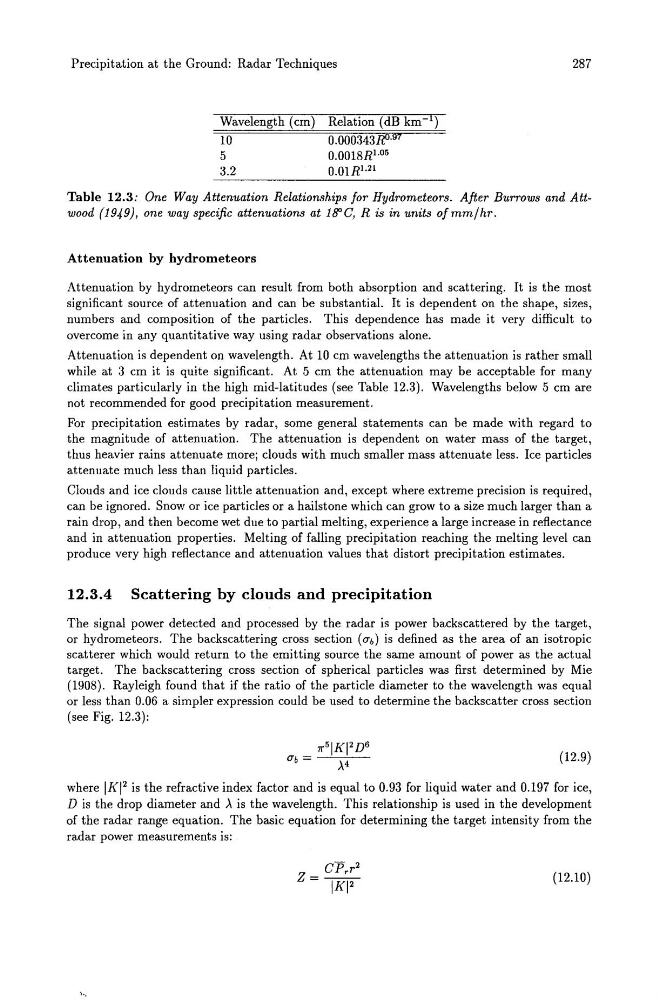
Table 12.3: One Way Attenuation Relationships for Hydrometeors. After Burrows and Attwood (1949), one way specific attenuations at 18'C, R is in units ofmm/hr.
Attenuation by hydrometeors
Attenuation by hydrometeors can result from both absorption and scattering. It is the most
significant source of attenuation and can be substantial. It is dependent on the shape, sizes,
numbers and composition of the particles. This dependence has made it very difficult to
overcome in any quantitative way using radar observations alone.
Attenuation is dependent on wavelength. At 10 cm wavelengths the attenuation is rather small
while at 3 cm it is quite significant. At 5 cm the attenuation may be acceptable for many
climates particularly in the high mid-latitudes (see Table 12.3). Wavelengths below 5 cm are
not recommended for good precipitation measurement.
For precipitation estimates by radar, some general statements can be made with regard to
the magnitude of attenuation. The attenuation is dependent on water mass of the target,
thus heavier rains attenuate more; clouds with much smaller mass attenuate less. Ice particles
attenuate much less than liquid particles.
Clouds and ice clouds cause little attenuation and, except where extreme precision is required,
can be ignored. Snow or ice particles or a hailstone which can grow to a size much larger than a
rain drop, and then become wet due to partial melting, experience a large increase in reflectance
and in attenuation properties. Melting of falling precipitation reaching the melting level can
produce very high reflectance and attenuation values that distort precipitation estimates.
12.3.4 Scattering by clouds and precipitation
The signal power detected and processed by the radar is power backscattered by the target,
or hydrometeors. The backscattering cross section (O"b) is defined as the area of an isotropic
scatterer which would return to the emitting source the same amount of power as the actual
target. The backscattering cross section of spherical particles was first determined by Mie
(1908). Rayleigh found that if the ratio of the particle diameter to the wavelength was equal
or less than 0.06 a simpler expression could be used to determine the backscatter cross section
(see Fig. 12.3):
(12.9)
where IKI2 is the refractive index factor and is equal to 0.93 for liquid water and 0.197 for ice,
D is the drop diameter and>' is the wavelength. This relationship is used in the development
of the radar range equation. The basic equation for determining the target intensity from the
radar power measurements is:
(12.10)
Wavelength (cm)
10
5
3.2
Relation (dB km 1)
0.000343RO·97
0.0018R1.05
0.OlR1.21
287
Table 12.3: One Way Attenuation Relationships for Hydrometeors. After Burrows and Attwood (1949), one way specific attenuations at 18'C, R is in units ofmm/hr.
Attenuation by hydrometeors
Attenuation by hydrometeors can result from both absorption and scattering. It is the most
significant source of attenuation and can be substantial. It is dependent on the shape, sizes,
numbers and composition of the particles. This dependence has made it very difficult to
overcome in any quantitative way using radar observations alone.
Attenuation is dependent on wavelength. At 10 cm wavelengths the attenuation is rather small
while at 3 cm it is quite significant. At 5 cm the attenuation may be acceptable for many
climates particularly in the high mid-latitudes (see Table 12.3). Wavelengths below 5 cm are
not recommended for good precipitation measurement.
For precipitation estimates by radar, some general statements can be made with regard to
the magnitude of attenuation. The attenuation is dependent on water mass of the target,
thus heavier rains attenuate more; clouds with much smaller mass attenuate less. Ice particles
attenuate much less than liquid particles.
Clouds and ice clouds cause little attenuation and, except where extreme precision is required,
can be ignored. Snow or ice particles or a hailstone which can grow to a size much larger than a
rain drop, and then become wet due to partial melting, experience a large increase in reflectance
and in attenuation properties. Melting of falling precipitation reaching the melting level can
produce very high reflectance and attenuation values that distort precipitation estimates.
12.3.4 Scattering by clouds and precipitation
The signal power detected and processed by the radar is power backscattered by the target,
or hydrometeors. The backscattering cross section (O"b) is defined as the area of an isotropic
scatterer which would return to the emitting source the same amount of power as the actual
target. The backscattering cross section of spherical particles was first determined by Mie
(1908). Rayleigh found that if the ratio of the particle diameter to the wavelength was equal
or less than 0.06 a simpler expression could be used to determine the backscatter cross section
(see Fig. 12.3):
(12.9)
where IKI2 is the refractive index factor and is equal to 0.93 for liquid water and 0.197 for ice,
D is the drop diameter and>' is the wavelength. This relationship is used in the development
of the radar range equation. The basic equation for determining the target intensity from the
radar power measurements is:
(12.10)