

286
Parameter Definition
¢
Azimuth angle
I
Elevation angle
v,.
Mean Doppler velocity
Z
Reflectance factor
(Jv
Doppler spectrum width
Acceptable Accuracy
.1 deg
.1 deg
.25 mls
1 dBZ
1 mls
P. Joe
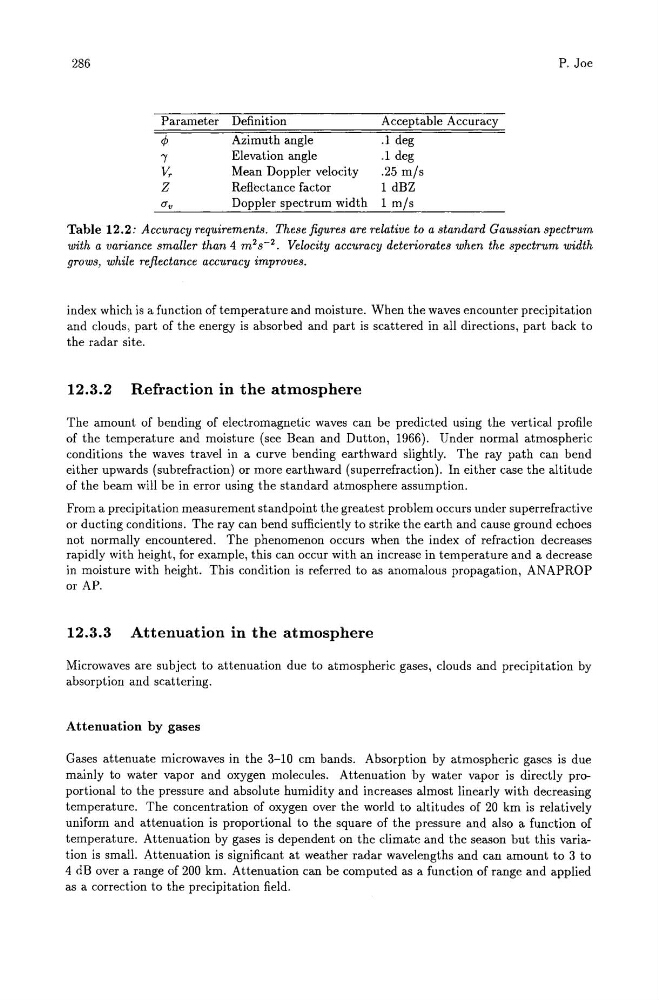
Table 12.2; Accuracy requirements. These figures are relative to a standard Gaussian spectrum
with a variance smaller than 4 m 2 S-2. Velocity accuracy deteriorates when the spectrum width
grows, while reflectance accuracy improves.
index which is a function of temperature and moisture. When the waves encounter precipitation
and clouds, part of the energy is absorbed and part is scattered in all directions, part back to
the radar site.
12.3.2 Refraction in the atmosphere
The amount of bending of electromagnetic waves can be predicted using the vertical profile
of the temperature and moisture (see Bean and Dutton, 1966). Under normal atmospheric
conditions the waves travel in a curve bending earthward slightly. The ray path can bend
either upwards (subrefraction) or more earthward (superrefraction). In either case the altitude
of the beam will be in error using the standard atmosphere assumption.
From a precipitation measurement standpoint the greatest problem occurs under superrefractive
or ducting conditions. The ray can bend sufficiently to strike the earth and cause ground echoes
not normally encountered. The phenomenon occurs when the index of refraction decreases
rapidly with height, for example, this can occur with an increase in temperature and a decrease
in moisture with height. This condition is referred to as anomalous propagation, ANAPROP
or AP.
12.3.3 Attenuation in the atmosphere
Microwaves are subject to attenuation due to atmospheric gases, clouds and precipitation by
absorption and scattering.
Attenuation by gases
Gases attenuate microwaves in the 3-10 cm bands. Absorption by atmospheric gases is due
mainly to water vapor and oxygen molecules. Attenuation by water vapor is directly proportional to the pressure and absolute humidity and increases almost linearly with decreasing
temperature. The concentration of oxygen over the world to altitudes of 20 km is relatively
uniform and attenuation is proportional to the square of the pressure and also a function of
temperature. Attenuation by gases is dependent on the climate and the season but this variation is small. Attenuation is significant at weather radar wavelengths and can amount to 3 to
4 dB over a range of 200 km. Attenuation can be computed as a function of range and applied
as a correction to the precipitation field.
Parameter Definition
¢
Azimuth angle
I
Elevation angle
v,.
Mean Doppler velocity
Z
Reflectance factor
(Jv
Doppler spectrum width
Acceptable Accuracy
.1 deg
.1 deg
.25 mls
1 dBZ
1 mls
P. Joe
Table 12.2; Accuracy requirements. These figures are relative to a standard Gaussian spectrum
with a variance smaller than 4 m 2 S-2. Velocity accuracy deteriorates when the spectrum width
grows, while reflectance accuracy improves.
index which is a function of temperature and moisture. When the waves encounter precipitation
and clouds, part of the energy is absorbed and part is scattered in all directions, part back to
the radar site.
12.3.2 Refraction in the atmosphere
The amount of bending of electromagnetic waves can be predicted using the vertical profile
of the temperature and moisture (see Bean and Dutton, 1966). Under normal atmospheric
conditions the waves travel in a curve bending earthward slightly. The ray path can bend
either upwards (subrefraction) or more earthward (superrefraction). In either case the altitude
of the beam will be in error using the standard atmosphere assumption.
From a precipitation measurement standpoint the greatest problem occurs under superrefractive
or ducting conditions. The ray can bend sufficiently to strike the earth and cause ground echoes
not normally encountered. The phenomenon occurs when the index of refraction decreases
rapidly with height, for example, this can occur with an increase in temperature and a decrease
in moisture with height. This condition is referred to as anomalous propagation, ANAPROP
or AP.
12.3.3 Attenuation in the atmosphere
Microwaves are subject to attenuation due to atmospheric gases, clouds and precipitation by
absorption and scattering.
Attenuation by gases
Gases attenuate microwaves in the 3-10 cm bands. Absorption by atmospheric gases is due
mainly to water vapor and oxygen molecules. Attenuation by water vapor is directly proportional to the pressure and absolute humidity and increases almost linearly with decreasing
temperature. The concentration of oxygen over the world to altitudes of 20 km is relatively
uniform and attenuation is proportional to the square of the pressure and also a function of
temperature. Attenuation by gases is dependent on the climate and the season but this variation is small. Attenuation is significant at weather radar wavelengths and can amount to 3 to
4 dB over a range of 200 km. Attenuation can be computed as a function of range and applied
as a correction to the precipitation field.